 Kidy
Kidy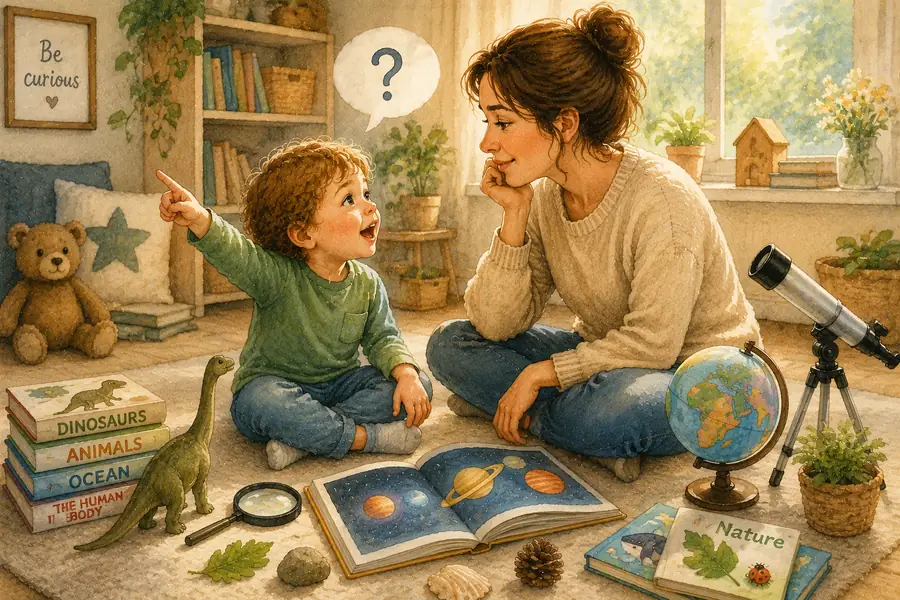
My oldest was late to talk. For months I cornered her daycare teachers at pickup with the same question: did she say anything today? Then the words arrived, and the questions came with them, and they have not stopped since.
If you are living with a curious child somewhere in that stage, this page is a list you can steal from:
- 100 questions, grouped into 15 topics, each with a one-sentence answer
- Best fit for ages 3 to 9, with the easier questions marked by topic
- Peak "why" years are 3 to 5, when children build cause-and-effect thinking
- Every question links to a free card with a fun fact and a small thing to try
- It works the other way round too, as a game: you ask, your child guesses (see questions by age)
You do not need to know the answers. You need something to say in the four seconds before the next question arrives.
Quick Reference
| Age | What the questions sound like | Where to start on this page |
|---|---|---|
| 3–4 years | "What is that?", "Why?" on repeat | Animals, Body, Emotions |
| 4–6 years | "Why do cats purr?", "Why does it rain?" | Space, Nature, Weather, Dinosaurs |
| 6–9 years | "How does a fossil form?", "What is gravity?" | Science, How things work, Ocean |
| 9+ years | "Why do some places never get rain?" | Follow the links into each topic |
Jump to a topic
🚀 Space · 🐱 Animals · 🧠 Body · 🌳 Nature · 🌦️ Weather · 🌊 Ocean · 🦖 Dinosaurs · 🔬 Science · ⚙️ How things work · 🐜 Bugs · 🍞 Food · 🏠 Everyday life · 💛 Emotions · 🚒 People who help · 🎨 Art
How to use this list
Read the question out loud, then the answer, then stop. That is the whole method. A child who wants more will ask, and the follow-up is usually better than anything you planned.
If you would rather understand what is driving all of this before you start answering, read why your child asks "why" all the time first. This page is the answers; that one is the reason.
Space questions
- What is a star? A giant ball of hot, glowing gas, very far away. Our Sun is one too, just the closest.
- Why do stars twinkle? Their light passes through moving air around Earth, and the air bends it as it shifts.
- Why does the Moon change shape? It does not. As it circles Earth, the Sun lights up different parts of it.
- Why does the Moon follow me? It is so far away that walking cannot leave it behind, so it never seems to move.
- Why is Mars red? Its dust is full of iron, the same thing that turns metal rusty.
- How many planets are there? Eight travel around our Sun, and Earth is one of them.
- Why do astronauts float? Out there, gravity's pull is so gentle that nothing feels heavy any more.
- What is gravity? An invisible pull between things. Big things pull harder, and Earth is very big.
Animal questions
- Why do cats purr? Mostly when they feel calm, but also to comfort themselves when they are hurt or scared.
- Why do dogs wag their tails? It is how they show feelings. A loose wag is happy; a stiff one means unsure.
- Why do dogs pant? They cannot sweat through their skin like we do, so panting is how they cool off.
- How do bees make honey? They drink flower nectar, carry it home in a special tummy, and store it for winter.
- Why can owls see at night? Huge eyes soak up the little light there is, and their hearing finds the rest.
- Why do fireflies glow? The light in their bellies is a message to other fireflies in the dark.
- Why do zebras have stripes? Standing together, the stripes blur into a pattern a lion struggles to pick one animal out of.
- How does a caterpillar become a butterfly? Inside the chrysalis its body breaks down and rebuilds into something new.
Body questions
- Why do we sneeze? Your nose blows out whatever is tickling it, in one very fast puff of air.
- Why do baby teeth fall out? Bigger grown-up teeth are pushing up underneath, so the small ones get wobbly and let go.
- How do eyes see? They turn light into little messages, and the brain turns those messages into pictures.
- Why does my heart beat faster when I run? Your muscles need more air, so the heart speeds up to deliver it.
- Why does my tummy rumble? Your stomach squeezes air and juices around inside, and it gets louder when empty.
- Why do we poop? Your body keeps the useful parts of food and pushes the leftovers out.
- How does a cut heal? Blood turns sticky and plugs the hole, then new skin grows underneath the scab.
- Why do I get dizzy when I spin? Liquid inside your ears keeps swirling after you stop, so your brain thinks you are still turning.
Nature questions
- Why is the sky blue? Sunlight is all colours mixed, and the blue part scatters around the sky far more than the rest.
- Why does it rain? Water rises into the sky as invisible steam, gathers into clouds, then falls back when the drops get heavy.
- Where do rainbows come from? Sunlight passing through floating raindrops gets bent and split into separate colours.
- Why do leaves fall in autumn? The tree stops feeding them before winter, so the green fades and they let go.
- Why are leaves green? They are packed with chlorophyll, the green stuff that catches sunlight to make food.
- How does a seed become a plant? Water and warmth wake up the tiny plant inside, which sends a root down and a shoot up.
- Where do puddles go? The sun turns the water into invisible steam that floats up to become part of a cloud.
- What is a volcano? An opening where melted rock from deep underground bursts out and cools into new rock.
Weather questions
- What are clouds made of? Millions of tiny water droplets floating high up, light enough to hang in the air.
- What causes thunder? Lightning heats the air so fast that it bangs. That bang is thunder.
- What makes lightning? Ice and water bumping around inside a storm cloud build up an enormous spark.
- What causes wind? Warm air rises, cooler air rushes in to fill the gap, and you feel it move.
- Why do the seasons change? Earth's journey around the Sun gives us longer warm days, then shorter cool ones.
- How does snow form? High in a cold cloud, water freezes into ice flakes instead of raindrops.
- What is a tornado? A spinning column of air reaching from a storm cloud down to the ground.
Ocean questions
- Why is the ocean salty? Rivers carry minerals from rocks into the sea, the water evaporates, and the salt stays.
- Why is the ocean blue? Water swallows the warm colours in sunlight and bounces the blue back to your eyes.
- What makes waves? Wind dragging across the surface, pushing the water into rolling shapes that travel on.
- Why does the tide go in and out? The Moon's gravity tugs the sea into a bulge, and Earth spins each coast through it.
- What is a coral reef? Layers of stony skeletons left by tiny animals, built up over thousands of years.
- How do crabs walk sideways? Their leg joints bend sideways, so scuttling across is simply faster than walking forward.
- How do whales hold their breath so long? They store oxygen in blood and muscle, then slow their own heart rate while diving.
Dinosaur questions
- Why are there no dinosaurs today? Something enormous happened long ago and most did not survive. Birds are what is left.
- How big were dinosaurs? Every size. The giants were longer than a swimming pool; the smallest were chicken-sized.
- What did dinosaurs eat? Plants or meat, and you can often tell which from the shape of their teeth.
- Did dinosaurs roar? Probably not like the films. Booms, honks and hisses are the better guess.
- Did any dinosaurs have feathers? Plenty did, long before flight, some for warmth and some for showing off.
- How does a fossil form? Buried bone slowly turns to stone as minerals seep in over millions of years.
- Are birds living dinosaurs? Yes. The sparrow in your garden is a real dinosaur, just small and feathery.
Science questions
- Why do we ask "why"? Because every question moves you closer to knowing something. There are no silly ones.
- Why does ice melt? Warmth turns it back into water. Your hand is enough to start it.
- Why does vinegar fizz with baking soda? The two react and make gas, and the gas rushes out as bubbles.
- Why don't oil and water mix? Oil is lighter and refuses to blend, so it floats back to the top every time.
- Why do things fall down? Earth pulls everything toward it, which is why nothing you drop drifts away.
- How do mirrors work? A very smooth surface bounces light straight back instead of scattering it everywhere.
- Why do some things glow in the dark? They soak up light while it is bright, then release it slowly once it is dark.
How things work
- Why do boats float? The boat pushes water aside, and that water pushes back hard enough to hold it up.
- How do planes stay up? Air rushing over the curved wings lifts the plane, as long as it keeps moving fast.
- Why do magnets stick? An invisible pull grabs certain metals, mostly iron, without touching them first.
- How does a key open a lock? Its teeth match one lock's shape exactly, and only that shape lets it turn.
- Why do some balloons float up? Helium is lighter than air. The ones you blow up yourself are full of heavier air.
- Why do you hear an echo? Sound hits a hard wall and bounces back, arriving a moment after you made it.
- How does a screen make pictures? Millions of tiny dots glow red, green or blue, and mix into every colour you see.
Bug questions
- Why do spiders spin webs? To catch food. Sticky threads hold an insect while the spider feels the shaking.
- Why do ladybugs have spots? The bright pattern warns birds that this one tastes bitter and is not worth eating.
- Why do ants walk in a line? The first ant leaves a scent trail, and every ant after it makes the trail stronger.
- Why do crickets chirp? The males rub one wing against the other, mostly to attract a mate.
- Why do worms come out after rain? Water fills the air spaces in the soil, so they come up to breathe.
- Why do we need bees? They pollinate a huge share of the fruit and vegetables that end up on our plates.
Food questions
- Where does our food come from? A field, an orchard or a farm, then months of waiting, then a long trip to the shop.
- Why does popcorn pop? A drop of water inside turns to steam and bursts the hard shell inside out.
- Why does bread dough rise? Yeast feeds on sugar in the flour and puffs the dough up with tiny gas bubbles.
- Why are some foods sour? They contain acids, and your taste buds are unusually good at spotting them.
- Why do we keep food in the fridge? Cold slows down the germs that would otherwise multiply and spoil it.
- How is cheese made from milk? Milk is split into solid curds and watery whey, then the curds are pressed and aged.
Everyday life questions
- Why do we dream? The brain stays busy during one stage of sleep, sorting memories and feelings.
- Why do we yawn? A big stretchy breath that seems to wake the brain up a little when you are tired.
- Why do we brush our teeth? Food left on teeth turns into a sticky film that drills holes if nobody scrubs it off.
- Why does soap make bubbles? Soap lets water stretch into a thin skin, and trapped air puffs that skin into a ball.
- How does water come from the tap? From a river, lake or well, through a cleaning plant, then pipes under your street.
- Why do kids need more sleep than adults? Growing bodies and new brain connections are mostly built while asleep.
Emotion questions
- Why do we cry? A big feeling has to go somewhere. Sadness, pain and sometimes happiness all do it.
- Why do we laugh? Surprise, mostly. And laughing together makes everyone in the room feel closer.
- Why do I get mad? Because something felt unfair. The feeling is fine; what you do next is the part that matters.
- Why do friends fight? They want different things on the same day. It does not break the friendship.
- What is empathy? Imagining how someone else feels from the inside, not just noticing they are upset.
- Why do siblings fight so much? They share everything, including you, so small annoyances pile up faster.
Questions about people who help
- What does a doctor do? Works out what is wrong by asking and checking, then explains what will help.
- What does a firefighter do? Puts out fires, and also rescues people from car crashes and dangerous places.
- What does a vet do? Treats animals who cannot say where it hurts, so they read behaviour instead.
- What does a farmer do? Grows crops or raises animals, timing everything around weather they cannot control.
- What happens when you call for help? A dispatcher answers, works out what is needed, and radios the closest crew.
Art questions
- What happens when you mix two colours? You get a third one. Blue and yellow make green, and the first time is genuinely magic.
- Why do crayons make marks? Wax rubs off onto the paper, and the paper's tiny bumps grab and hold it.
- What is paint made of? Grains of colour mixed into a liquid. The liquid dries away; the colour stays stuck.
- Why do people make art? To put a feeling somewhere outside themselves, and to decide every single choice.
Questions by age, with answers
The same question lands differently at three and at six. For each age, the topics that tend to work and five questions from the list to start with.
Questions for 3-year-olds
At three, most questions are naming questions: what is that, what does it do, where did it go. Animals, Body and Emotions are the ones that stick, because the answer is something they can see or feel. Keep it to one short sentence. Your face while you answer matters more than the content.
- Why do we sneeze? Your nose blows out whatever is tickling it, in one very fast puff of air.
- Why do dogs wag their tails? It is how they show feelings. A loose wag is happy; a stiff one means unsure.
- Why do we cry? A big feeling has to go somewhere. Sadness, pain and sometimes happiness all do it.
- Why does my tummy rumble? Your stomach squeezes air and juices around inside, and it gets louder when empty.
- What does a doctor do? Works out what is wrong by asking and checking, then explains what will help.
Questions for 4-year-olds
Four is when "why" arrives properly and does not leave. Cause and effect is the new game, so Space, Nature and Weather suddenly work: the Moon changing shape, rain, thunder. Dinosaurs tend to take over around here and stay for a year.
- Why does the Moon follow me? It is so far away that walking cannot leave it behind, so it never seems to move.
- Why does it rain? Water rises into the sky as invisible steam, gathers into clouds, then falls back when the drops get heavy.
- What causes thunder? Lightning heats the air so fast that it bangs. That bang is thunder.
- Why are there no dinosaurs today? Something enormous happened long ago and most did not survive. Birds are what is left.
- Why do leaves fall in autumn? The tree stops feeding them before winter, so the green fades and they let go.
Questions for 5-year-olds
Five wants mechanisms, not just names. How things work, Bugs and Food land well, because a five-year-old can hold a two-step explanation: the yeast makes gas, the gas puffs the dough. This is also the age where "I don't know, let's find out" starts producing actual joint research.
- Why do boats float? The boat pushes water aside, and that water pushes back hard enough to hold it up.
- How do bees make honey? They drink flower nectar, carry it home in a special tummy, and store it for winter.
- Why do ants walk in a line? The first ant leaves a scent trail, and every ant after it makes the trail stronger.
- Why does popcorn pop? A drop of water inside turns to steam and bursts the hard shell inside out.
- Why do baby teeth fall out? Bigger grown-up teeth are pushing up underneath, so the small ones get wobbly and let go.
Questions for 6-year-olds and up
By six the questions get harder to fob off. Science, Ocean and the people who help section suit this age, and so does admitting the limits of what anyone knows. "Nobody has ever heard a dinosaur" is a better answer than a confident guess.
- What is gravity? An invisible pull between things. Big things pull harder, and Earth is very big.
- Why is the ocean salty? Rivers carry minerals from rocks into the sea, the water evaporates, and the salt stays.
- How does a fossil form? Buried bone slowly turns to stone as minerals seep in over millions of years.
- Why do stars twinkle? Their light passes through moving air around Earth, and the air bends it as it shifts.
- What is empathy? Imagining how someone else feels from the inside, not just noticing they are upset.
Easy questions to ask your child: the list turned around
Plenty of people land on this page looking for the opposite: questions to ask a child, with the answer ready. The list works for that too, just flipped. You read the question, your child has a guess, and the short answer comes last.
Getting it right is not the point. In a meta-analysis of 38 studies and 2,455 children on shared book reading, the way the adult read, including asking the child questions along the way, was one of the few things that changed how many new words children learned. The child's age did not (Flack et al., 2018). The NHS says something similar for three to five year olds: start conversations with questions that have lots of possible answers, like "What is your favourite toy?" or "What do you want to do tomorrow?".
So the quiz question, the one with a single right answer, is the one that gives you least:
| Kind of question | Example | What it gets you |
|---|---|---|
| One right answer | "What colour is the sky?" | Checks one word. Over in a second |
| Guess first | "Why do you think the Moon follows us?" | Your child builds an explanation before hearing yours |
| Open | "If you were a cat, what would you do today?" | A long conversation with no wrong answer |
Three rules for the game:
- Let them answer first, even if it is nonsense. "The Moon follows me because it likes me" is a brilliant start.
- The short answer goes after theirs, not instead of it.
- Stop when they stop asking. If they hand you a question back at the end, it worked.
What to do when you do not know
Most of the questions on this list have an answer. Plenty of the ones your child actually asks will not, or not one you can reach at 6pm with dinner half made.
- If you know it → one sentence, then stop talking. Long answers lose them.
- If you half know it → say the part you are sure of and label the rest as a guess.
- If you have no idea → "I don't know. Let's find out." Then actually look, later, together.
- If it is the fourth "but why" in a row → hand it back: "What do you think?"
That last one is not a dodge. The back-and-forth of question and response is what the Harvard Center on the Developing Child calls serve and return, and it does more for a developing brain than a correct answer does. Telling stories sits on the American Academy of Pediatrics list for three to four year olds, right next to hopping on one foot. The questions get their own line on the CDC's three-year checklist: who, what, where and why, all expected by that birthday.
The questions almost never arrive at a good time. Ours came in the car, in the dark, on the way home from daycare, when I was thinking about what was in the fridge. I answered badly a lot of the time. It did not seem to matter much; she asked again the next day.
Common mistakes worth skipping
- Answering the wrong question. "Why do I have to?" is usually a test of whether the rule is real, not a request for reasoning.
- The lecture. Four sentences in, most preschoolers have left. One sentence holds them.
- Making something up. They repeat it, at daycare, with your name attached.
- Handing over a screen instead. Real back-and-forth talk builds language in a way passive watching does not, which our guide on screen time and speech delay goes through properly.
- Treating it as a quiz you can fail. You cannot. There is no score.
When a lack of questions is worth a check
The flood is a good sign. The absence is the thing to watch. If a four-year-old asks almost nothing, rarely points at things to share them with you, or has lost words they used to have, mention it to your pediatrician. The CDC milestone checklists are a reasonable place to compare notes first, and they treat a lost skill as its own reason to call. The American Speech-Language-Hearing Association sets out what communication usually looks like between four and five.
Our guides on when to seek help for a speech delay and how to encourage a toddler to talk go into the practical side. Raising it early costs you one conversation.
Where these cards came from
I did not set out to build a library. My oldest asks questions the way other people breathe, hundreds in a day, and she takes in answers faster than I can find them. So I started writing questions down for her, sorted, so that I could reach for one when I had nothing left. That pile became the Discovery Cards, and then it became part of KidyGrow, because it turned out I was not the only parent running out of answers.
She picks the new categories with me now. Some of the ones still waiting in the queue are hers.
How KidyGrow helps you
The Discovery Cards behind every link are free, no account needed. Each has the short answer, a fun fact and a question to hand back.
In the app, Today's Discovery is one card a day, personalised to your child's age and to the interests and favourites saved in their profile. You set the level, from Easiest to Harder, and your child can say whether a card was too easy or too hard. The app remembers every card read, grows their Garden of knowledge with it and counts the days in a row you explore.
What it does not do is notice on its own that dinosaurs have turned into bugs. Add that to the profile and the daily card follows.
What is coming next
This list grows. The Discovery Cards already cover 20 topics and this page has 15: Earth, History, Time, Vehicles and Music and sound have their cards and do not have questions here yet. Individual questions on this page are also becoming full articles of their own, so a link that points to a card today may point to a longer guide in a few months.
If your child is younger than three and not asking yet, the groundwork is play and conversation rather than facts. Play is development covers the science, and outdoor play ideas for 0 to 2 year olds has things to do this afternoon.
Frequently asked questions
What age do children ask the most questions?
The peak is roughly three to five years old, when children are building cause-and-effect thinking and have finally got the language to interrogate you properly. Some start at two, some ramp up at six. The intensity varies enormously between children in the same family.
How do I answer a question I do not understand myself?
Say so, then look it up together rather than guessing. "I don't know, let's find out" teaches something more durable than the answer would have. It also stops the made-up answer from being repeated confidently at daycare next Tuesday.
My child asks the same question over and over. Is that normal?
Yes. Repetition is how young children confirm that the world stays consistent, and it is often a bid for your attention as much as for information. A short, identical answer usually settles it faster than a new, more detailed one.
Should I worry if my child does not ask many questions?
One quiet child is not a diagnosis. A near-total absence of questions by four, especially alongside little pointing or sharing or a loss of words, is worth mentioning to your pediatrician. Curiosity and language develop together, so a gap in one is worth checking against the other.
What easy questions can I ask a 3 to 5 year old?
The ones on this list work turned around: read the question, let your child guess, then give the short answer. At three, animals, body and feelings land best; at four and five, the Moon, rain and dinosaurs. Mix in an open one, like "What would you do if you were a bird?", because there is no wrong answer to it.
Are these questions the right level for my child?
The animal, body and emotion sections work from about three. Space, nature, weather and dinosaurs land best between four and six. Science, how things work and the ocean questions suit six and up. If an answer goes over their head, they will tell you by walking away.
Can I use this list without the app?
Yes. Every link goes to a free page with no account required, in English, Croatian, Spanish and German. The app version just picks the daily card for you.
Still getting new questions every day?
Sources
- American Academy of Pediatrics, HealthyChildren.org: Developmental milestones: 3 to 4 year olds
- Centers for Disease Control and Prevention: Learn the Signs. Act Early. milestone checklists
- Centers for Disease Control and Prevention: Milestones by 3 years
- American Speech-Language-Hearing Association: Communication milestones: 4 to 5 years
- NHS Best Start in Life: Learning conversations: 3 to 5 years
- Harvard University, Center on the Developing Child: Serve and Return
- Flack ZM, Field AP, Horst JS (2018). The effects of shared storybook reading on word learning: A meta-analysis. Developmental Psychology, 54(7), 1334–1346.