 Kidy
Kidy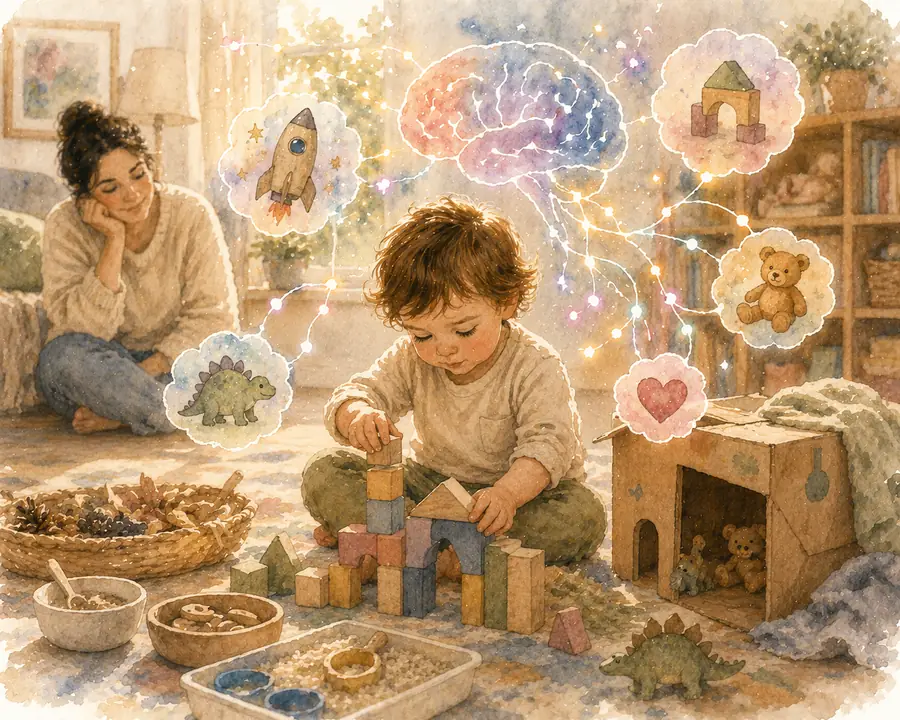
We treat play like the reward after the real work of learning. The science says it's the other way around. For a young child, play is the work, and it's how the brain physically wires itself. What play is actually doing under the hood:
🎨 Something to try today: the Developmental activity finder suggests play that fits your child's age and what they are working on.
- Building and pruning neural connections through repetition and exploration
- Growing executive function, focus, impulse control, planning, mostly through pretend play
- Strengthening language via back-and-forth interaction, not flashcards
- Wiring emotional regulation and social skills by practicing them in low stakes
None of that requires a special toy, a class, or a screen labeled "educational." A cardboard box and your attention out-build most of the toy aisle.
Quick reference: what play builds, by type
| Type of play | What it builds | Looks like |
|---|---|---|
| Sensory play | Brain wiring, focus | Water, sand, dough, textures |
| Gross-motor play | Coordination, body confidence | Climbing, running, rough-and-tumble |
| Pretend play | Executive function, empathy | Kitchen, dolls, "you be the dog" |
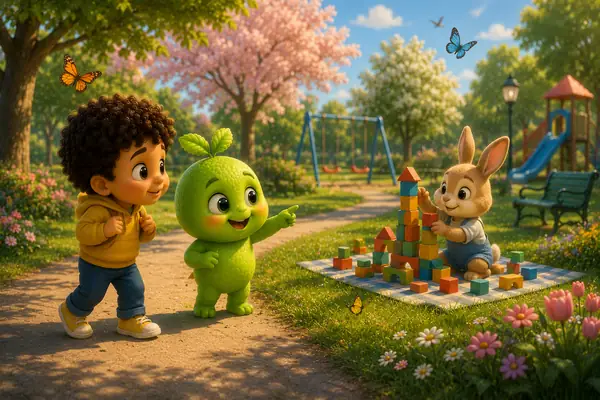
| Construction play | Problem-solving, spatial skills | Blocks, stacking, knocking down |
| Social play | Turn-taking, regulation | Peekaboo, simple games, peers |
Why play is the brain's main job
In the first years, the brain forms more than a million new neural connections every second, and the ones that get used get kept (CDC, positive parenting). Play is the activity that fires those connections at scale. When a toddler stacks blocks and they topple, they're running a tiny physics experiment: hypothesis, test, result, adjust. When they pretend the banana is a phone, they're doing abstract symbolic thinking, the same machinery they'll later use to read.
This is why pediatric bodies treat play as essential, not optional. It's where cognition, language, motor skill, and emotional regulation all get built at once (AAP, early childhood development). A child deep in play isn't taking a break from development. They are mid-rep.
The kind of play that matters most
Here's the part that surprises tired parents: the most developmentally powerful play is the kind you do least, child-led and unstructured. When a child directs the play, they have to plan, choose, problem-solve, and self-regulate, all the executive-function muscles. When an adult runs it like a lesson, the child mostly follows instructions, which builds far less.
So "playing right" usually means doing less, not more. Offer a few open-ended things, then get out of the way. Resist narrating it into a quiz. Stepping back and following your child's lead is the same instinct at the heart of gentle parenting. The dull-looking ten minutes where your kid moves cups around is real cognitive work.
A pattern parents miss: boredom is the on-ramp
We rush to fill every gap, and we skip the most useful state a child can be in: a little bored. Boredom is uncomfortable, so the brain reaches for an idea, and that reach is the birth of imaginative play. A child who is never bored never has to generate their own play. If your kid says "I'm bored," that's not a failure to entertain them. It's the runway. The same instinct that helps you read tantrum and behavior patterns applies here: less management, more observation. And if you genuinely can't tell what kind of play your child gravitates to, tracking their patterns for a week makes it obvious.
What NOT to do
- Don't over-buy. More toys often means shallower play. A few open-ended materials beat a room full of single-purpose plastic that does one thing and beeps.
- Don't turn play into school. Drilling letters during play drains the thing that makes play powerful. Let it be play.
- Don't rely on "educational" screens. For children under two, learning comes from real interaction, not apps. Screen content can't return a child's serve.
- Don't hover and direct. Supervise for safety, then let them lead. The boring-looking stretch is the developmental gold.
Play by stage, briefly
- 0–6 months: faces, high-contrast objects, your voice. Tummy time on a blanket is play and motor work at once.
- 6–12 months: cause and effect, dropping, banging, peekaboo. They're testing how the world responds.
- 12–24 months: early pretend, containers, stacking, simple problem-solving. Imitation explodes.
- 2–3 years: rich pretend play, roles, stories, rules. This is executive function's gym.
Match the play to the stage and you barely need anything else. A predictable daily rhythm helps too, which is why a baby sleep guide for 0–2 years and protected play windows go together.
When to seek guidance
Play is also a window onto development, so it's a reasonable place to notice concerns. Talk to your pediatrician if, by the expected ages, your child shows no interest in interactive play like peekaboo, doesn't imitate or pretend at all by around age two, makes little eye contact during play, or has lost play skills they previously had. Most variation is just temperament and timing. A child who plays differently isn't necessarily a child who plays wrong, but a quick check beats months of quietly worrying (AAP, communication and connection). If you're too depleted to engage at all, that matters too, and parent self-care is part of the picture, not separate from it.
Frequently asked questions
Is play really that important for brain development?
Yes. In early childhood, play is the primary way the brain builds and strengthens connections. It develops language, problem-solving, motor skills, and emotional regulation all at once, which is why pediatric experts consider it essential, not optional.
What's the best type of play for development?
Child-led, open-ended play. When a child directs the activity, they exercise planning, problem-solving, and self-control. Pretend play in particular is a powerful builder of executive function.
Do I need educational toys?
No. Open-ended materials like blocks, cups, boxes, and household objects usually drive richer play than single-purpose electronic toys. Your attention and a few simple things matter more than the price tag.
How much should I play with my child versus letting them play alone?
Both matter. Interactive play builds language and connection; independent play builds focus and imagination. Aim for some of each, and don't feel you must entertain constantly.
Is it bad if my child gets bored?
No, it's useful. Boredom pushes a child to generate their own play, which is where imagination grows. You don't have to fill every gap.
Does screen time count as play?
Not in the developmental sense for young children, especially under two. Screens can't respond to a child's actions the way real play and real people do, so the brain-building back-and-forth is missing.
How KidyGrow helps
It's hard to see, from inside a busy week, whether your child is getting the kind of play they actually need. KidyGrow remembers what a stretched parent can't. You jot down what they played, when, and how engaged they were, in a few taps, and the app holds the pattern across weeks.
By the second week, the Daily Brief might surface something you couldn't from the day-to-day blur: your child is deeply absorbed in pretend play mid-morning, but afternoons keep defaulting to fussy screen time when everyone's tired. So instead of "encourage more play," the Tonight plan nudges protecting that morning pretend window and pre-empting the afternoon slump, working with your child's real rhythm.
It takes about 3–5 days of logging before that gets personal, so the first days stay general. And some weeks are illness and chaos with no clean pattern, which is honest, not a failure. But when there is a thread, seeing it turns "am I doing enough enrichment" into "she does her best play before lunch, so I'll protect that and stop stressing about the rest."
The question shifts from "what should I buy or schedule" to "this is when real play happens, and that I can protect."
Sources
- CDC — Positive parenting tips (cdc.gov)
- AAP — Early childhood health and development (aap.org)
- AAP HealthyChildren — Communication and discipline (healthychildren.org)
- NHS Start for Life — Learning to talk (nhs.uk)