
KidyGrowKidyGrow
EN HR ES
Get the app↓ App
travel_exploreDiscovery · Light and colour

🌈 Light and colour

4 short answers for ages 6–9. Start with “How do mirrors work?” or explore the complete set together.

What this set covers

This set has 4 short, child-friendly answers about this topic and is designed for ages 6–9. Every card adds a fact, something small to try and a prompt that keeps the conversation going.

Questions in this set

  1. How do mirrors work?
  2. Why do we sometimes see colours differently from each other?
  3. How does light actually travel from place to place?
  4. Why do some things glow in the dark?

Tap a question to reveal the answer, share the fun fact, try the tiny activity, then talk about it together.

schedule2 minstarMediumgroupTogethercheck
How do mirrors work? Revealexpand_more Flip to revealautorenew
How do mirrors work?

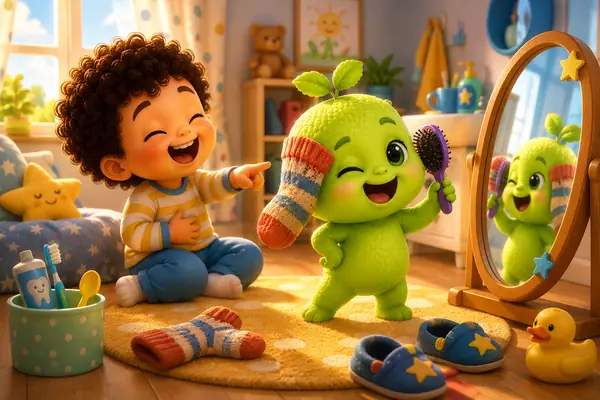
A mirror has a very smooth, shiny surface that bounces light back in a neat, organised way instead of scattering it, which is exactly why you can see a clear reflection of yourself in it. Light from you hits the mirror and bounces straight back to your eyes at a matching angle, so your reflection lines up perfectly with the real you. A rough or bumpy surface would scatter that same light in every direction, which is why only smooth surfaces make good mirrors.

🌟
Talk about itWhat do you notice first when you look in a mirror?
Did you know?A calm lake or puddle can act just like a mirror because its flat, still surface also bounces light in an organised way.
🎲
Try itLook at your reflection in a spoon, both the front and the back, and notice how differently your face looks.
🤖
Still curious?Why do we sometimes see colours differently from each other?Learn more in the full apparrow_forward

schedule2 minstarMediumgroupTogethercheck
Why do we sometimes see colours differently from each other? Revealexpand_more Flip to revealautorenew
Why do we sometimes see colours differently from each other?

Our eyes have tiny colour-sensing parts inside them, and everyone's eyes are built just a little bit differently, so the exact same colour can look slightly different from one person to the next. Lighting also changes how a colour appears, the same shirt can look bright blue in sunlight and almost grey in dim light. A small number of people cannot easily tell red and green apart, this is called colour blindness, and it happens when those colour-sensing parts work a bit differently.

🌟
Talk about itHas a colour ever looked different to you than it did to somebody else?
Did you know?A small number of people cannot easily tell red and green apart, this is called colour blindness.
🎲
Try itAsk someone else to describe the exact colour of an object next to you and compare it with what you see.
🤖
Still curious?How does light actually travel from place to place?Learn more in the full apparrow_forward
schedule2 minstarMediumgroupTogethercheck
How does light actually travel from place to place? Revealexpand_more Flip to revealautorenew
How does light actually travel from place to place?

Light travels in straight lines, incredibly fast, until it hits something that blocks, bends or bounces it. That is exactly why shadows have sharp, straight edges instead of curving around objects, the light simply cannot bend around a shape blocking its path. Light travels so fast that it could circle the entire Earth about seven times in just one second, which is why a light switch seems to light up a room instantly.

🌟
Talk about itWhat is the fastest thing you can think of, and how does it compare to light?
Did you know?Light travels so fast that it could circle the entire Earth about seven times in just one second.
🎲
Try itShine a torch at an angle onto the wall and notice how straight and sharp the edge of the light looks.
🤖
Still curious?Why do some things glow in the dark?Learn more in the full apparrow_forward
schedule2 minstarMediumgroupTogethercheck
Why do some things glow in the dark? Revealexpand_more Flip to revealautorenew
Why do some things glow in the dark?

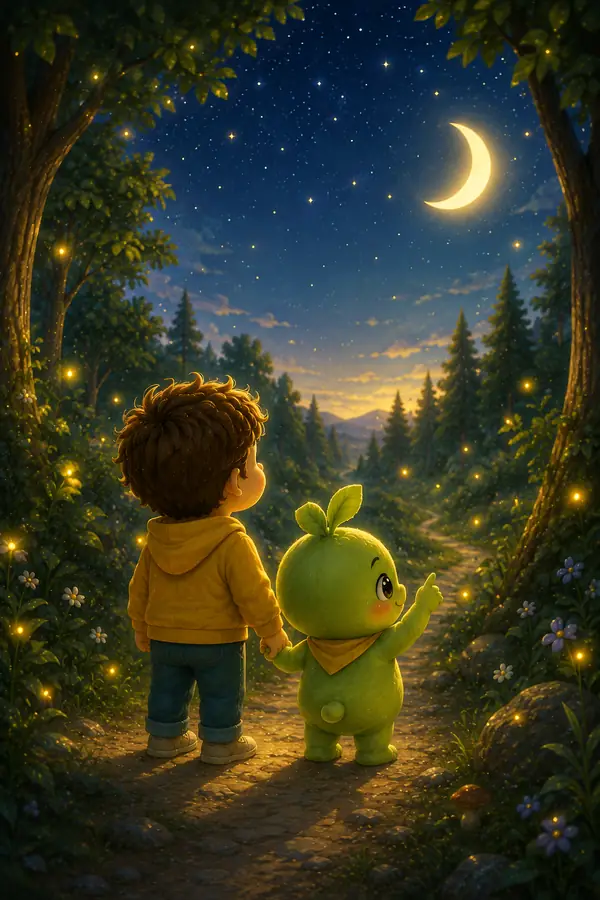
Some special materials can soak up light energy while the lights are on, then slowly release that stored energy back out as a soft glow once it goes dark. Glow-in-the-dark stars and stickers need to actually be "charged" under a bright light first before they will glow later, and the glow always fades as the stored energy runs out. That is different from something like a firefly, which makes its own glow using a chemical reaction inside its body, without needing to be charged by any outside light at all.

🌟
Talk about itWhat is the coolest glowing thing you have ever seen?
Did you know?Glow-in-the-dark stars and stickers need to actually be "charged" under a bright light first before they will glow later.
🎲
Try itCharge a glow-in-the-dark object under a bright lamp, then turn off the lights and watch it glow.
🤖
Still curious?Why do scientists need units of measurement?Learn more in the full apparrow_forward
swipeScroll sideways · tap a card to flip

More topics

Stories

When the questions run out, a story

Gentle stories where your child is the hero and Growy the friend.

All stories →

Sources

Answers are simplified for young children and checked against child-friendly science references.