 Kidy
- Anyone with a cold, cough, fever or cold sore visits later. Not "just for five minutes".
- Hands washed before every hold, and no kisses on the baby's face or hands.
- Short visits, small groups. Crowded rooms in winter are where young babies pick up viruses.
- Ask your pediatrician what protection your baby has: an RSV antibody shot for the baby, or vaccines you had in pregnancy.
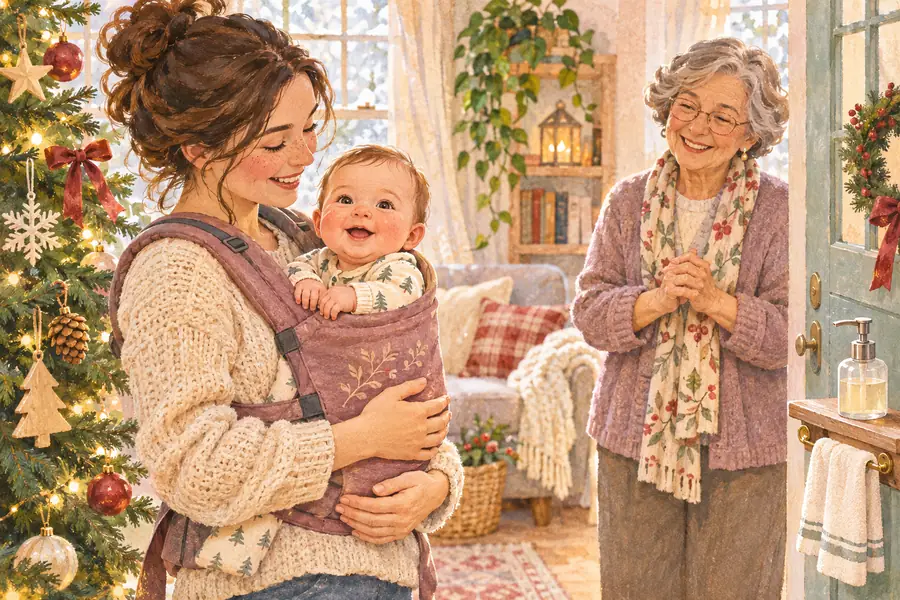
A baby's first Christmas sounds like a photo: grandparents, a tree, everyone wanting a turn. In real life it lands in the middle of RSV, flu and cold season, with a baby whose airways are tiny and who cannot have most vaccines yet. You do not have to cancel the holidays. You do have to set a few rules, say them out loud and not feel guilty about them. This guide is about the first months of life. For what RSV looks like once it is already in the house, read RSV and bronchiolitis in babies.
Quick reference: holidays with a young baby
| Situation | What to do |
|---|---|
| Visitor has a cold, cough or fever | Visit after they are well |
| Visitor has a cold sore | No kissing anyone, especially the baby |
| Big family lunch | Short stay, baby in your arms or a carrier, a quiet room to retreat to |
| Long drive to family | Thin layers in the car seat, blanket on top, regular stops |
| Church, shops, markets | Go at quiet times, keep it short |
| Baby born before or during RSV season | Ask your pediatrician about RSV protection |
Why the first winter is different
Bronchiolitis "occurs most often in infants because their airways are smaller and more easily blocked than in older children", as the American Academy of Pediatrics puts it. A cold that gives a grandparent two days of sniffles can make a six-week-old struggle to feed and breathe at the same time.
Newborns also cannot start their own whooping cough vaccine until about eight weeks of age. Until then they rely on the antibodies they got before birth and on the people around them not passing anything on.
That is the whole reason for the rules below. It is not about anyone's hygiene or how much you trust them.
The visitor rules that actually help
Sick means later. The AAP's advice is plain: "Keep your baby away from anyone who has a cold, fever, or runny nose." That includes the cousin who "only has a little cough" and the uncle who feels fine but whose kids were off school all week.
Hands before every hold. "Make sure everyone washes their hands before touching your baby" (AAP). Put soap and a clean towel by the door. People forget less when they see it.
No kisses on the face. This is the rule that causes the most hurt feelings, and it has the clearest reason. The NHS warns that "kissing a baby if you have a cold sore can lead to neonatal herpes, which is very dangerous to newborn babies." A kiss on the top of the head or the feet through a sock is a fair compromise for most families, but only from someone without a cold sore. Anyone with an active cold sore does not kiss the baby at all, not even on the head.
The baby comes back to you. Passing the baby round the table means a dozen sets of hands and faces in one afternoon. One or two holds, then the baby goes back to you, or into a carrier.
No smoke near the baby, including on clothes straight after a cigarette outside.
How to say no without a family fight
Most of the tension comes from saying it on the doorstep, in the moment. Say it earlier, in writing, and once to everyone. Something like:
"We can't wait to see you. Our only rules this year: if you have a cold, a cough or a cold sore, we'll see you in January. Please wash your hands when you arrive, and no kisses on the baby's face. Thank you for helping us through the first winter."
If it feels easier, let your partner send it to their side of the family. Blame the season, not the person. Say it as your own decision, with no excuse needed: "This winter we're limiting visits to reduce the baby's exposure to infections."
And when someone arrives sniffling anyway, you can be kind and still firm: "I'm sorry, let's pick a new date once you're well." You will survive one awkward afternoon. The baby's lungs come first.
Christmas lunches, church and markets
Crowded, warm rooms full of people from different households are exactly where winter viruses travel. You do not need to stay home for the whole season. Make it short and pick your moments.
- Go when it is quiet: a weekday morning at the shops, a less busy service, the market in daylight.
- Keep people from leaning over the baby and touching their face and hands, whether the baby is in your arms, a carrier or a pram.
- Leave before the baby is overtired. A tired baby feeds worse, and feeding well matters more than any photo.
- If it is cold outside, the article on how cold is too cold for a walk with a baby covers dressing for the trip.
Travelling to family
A long drive with a newborn is doable. Take thin layers in the car seat with a blanket over the straps, because a thick winter coat under the harness leaves slack that matters in a crash. Plan stops for feeds and nappies.
Sleeping somewhere new is where routines slip. The baby still sleeps on their back, in their own space, with nothing loose around them. If the house is warmer or colder than yours, how to dress a baby for sleep in winter helps you choose the layers.
Vaccines that protect the baby
Most of the protection a newborn has in the first winter comes from vaccines given to the mother in pregnancy or to the baby itself. What is offered depends on the country, so ask your midwife, GP or pediatrician what applies to you.
- Whooping cough in pregnancy. In the UK, the NHS offers it from 16 weeks and says the immunity "will pass to your baby through the placenta" until the baby's own vaccine at 8 weeks.
- Flu in pregnancy. The NHS offers it at any stage of pregnancy, and it helps protect the baby "in the first few months after they're born".
- RSV. There are two routes. A vaccine in pregnancy (the NHS offers it from 28 weeks), or an antibody shot for the baby. In the US, the CDC recommends the antibody for babies under 8 months whose mothers did not have the vaccine, and notes that "most babies do not need both."
The adults who will be closest to the baby can ask their own doctor whether their whooping cough and flu vaccines are up to date. It is a quiet way to help that needs no conversation at the dinner table.
When to call for help
You know the symptoms of bronchiolitis from the RSV article, and counting breaths and spotting chest retractions shows what laboured breathing looks like. The short version for the holidays:
Call emergency services now if your baby is struggling to breathe, has pauses in breathing, has blue or grey lips or tongue, or is floppy and hard to wake (NHS). Do not drive around looking for an open clinic first.
If a baby under 3 months has a temperature of 38 °C or more, contact a doctor immediately for urgent assessment. Fever in a baby this young always needs a doctor, which is covered in first fever in a tiny baby. Ask your pediatrician or out-of-hours service for urgent advice if the baby is feeding much less than normal, has far fewer wet nappies or has had a dry nappy for 12 hours. If other signs already worry you, don't wait for the 12 hours to pass. For the wider picture of a sick child at home, see when to call the doctor.
Common mistakes
- "It's only a cold." For the visitor, yes.
- Rules on the doorstep. Send them a week before.
- Letting the baby be passed round for the group photo, then again for dessert.
- Pushing through a long day so nobody feels left out. A baby who skips feeds pays for it that night.
- Assuming the baby is protected because "she had her jabs". Ask what was actually given.
Frequently asked questions
Should newborns have visitors at Christmas?
Yes, if the visitors are well, wash their hands and keep the visit short. The risk comes from people with a cold, cough, fever or cold sore, and from crowded rooms, not from family as such.
Can grandparents kiss the baby?
Not on the face or hands in the first months. A kiss on the head is a common compromise, but only from someone without a cold sore. Anyone with a cold sore should not kiss the baby at all, not even on the head, until it has completely healed.
Is it safe to take a newborn to a Christmas lunch?
It can be, if it is short, the baby stays with you or in a carrier, and nobody unwell is there. Leave before the baby gets overtired and feeds badly.
Does my baby need the RSV antibody if I had the RSV vaccine in pregnancy?
Usually not. The CDC says most babies do not need both. Your pediatrician will check, for example if the baby was born very soon after your vaccine or has other risk factors.
What if a relative turns up sick?
Say it kindly and keep the baby away from them. "Let's pick a new date once you're well" is enough. You do not owe a longer explanation.
How KidyGrow helps you
The holiday weeks blur. Who held the baby, when the first sniffle started, how the feeds went the day after the big lunch. Note feeds, nappies and any symptom in a few taps, and tell Grow what matters, for example that your baby already had the RSV antibody shot. The app remembers it and uses it in later answers. With urgent signs, don't wait for the app's answer: call. Grow is not a doctor and does not replace a call. It does keep the facts together for when the doctor asks.
Sources
- American Academy of Pediatrics, HealthyChildren.org. Bronchiolitis.
- NHS. Cold sores.
- NHS. Whooping cough vaccination in pregnancy.
- NHS. Flu jab in pregnancy.
- NHS. RSV vaccine.
- CDC. Protecting infants from RSV.
- NHS. Bronchiolitis.