Kidy
Kidy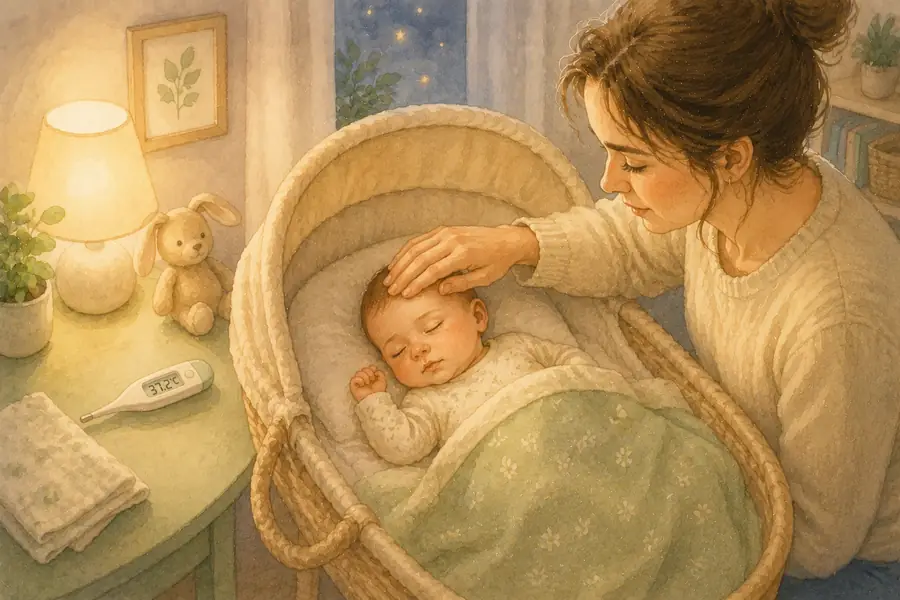
The first time a tiny baby runs hot, the rules are different from anything you'll read about toddlers. Here is what matters most in the first minute:
- Under 3 months: a rectal temperature of 38.0 °C (100.4 °F) or higher is a medical emergency. Call your doctor or go to the ER the same hour, even at 3 a.m. (AAP, 2024).
- At this age a fever can be the only sign of a serious infection, before any other symptom shows.
- Do not give fever medicine to an under-3-month baby unless a doctor tells you to. It can mask the one clue the doctor needs.
- Rectal is the only reliable method under 3 months. Forehead and ear readings miss too much.
- Most first fevers turn out to be a manageable virus. The point of the fast call is that you cannot tell which is which from home.
A first fever in a newborn is not a "watch and wait" situation the way a 2-year-old's fever often is. A young baby's immune system is still immature, so the same temperature that means "push fluids and rest" in a toddler can mean "needs to be seen tonight" in a six-week-old (NHS). This guide gives you the thresholds by age, how to take the reading correctly, the red flags that override any number, and what actually happens at the visit so it feels less frightening. If you're still in the newborn fog, our notes on the first night home with a newborn and what newborn sleep actually looks like pair well with this one.
Quick Reference: fever thresholds by baby's age
| Baby's age | Rectal reading that means act | What to do |
|---|---|---|
| Under 3 months | 38.0 °C / 100.4 °F or higher | Call doctor or ER now, any hour |
| 3–6 months | 38.9 °C / 102 °F or higher, or any fever with poor feeding/lethargy | Call the same day |
| Over 6 months | 39.4 °C / 103 °F, or fever over 2–3 days | Call during hours unless red flags |
| Any age | Fever plus a red flag below | Emergency, don't wait on the number |
The number alone never tells the whole story. A baby who looks fine at 38.1 °C still needs the call under 3 months, and a baby who looks very unwell needs help whatever the thermometer says.
Why a newborn fever is treated so seriously
In the first weeks of life, the systems that fight infection are not fully online. A fever can be the body's first response to a urinary infection, a blood infection, or meningitis, sometimes before the baby looks sick at all. Because the stakes are high and the early signs are subtle, pediatric guidelines set a deliberately low bar: any fever of 38.0 °C rectally under 3 months earns a full evaluation (AAP, 2024).
That low threshold is not the doctor being dramatic. It is the medical system buying certainty it cannot get from the outside. A six-week-old can't tell you their head hurts. The fever is the message.
How to take the temperature correctly
Get the reading right before you panic about it. A wrong method can invent a fever or hide one.
- Use a digital rectal thermometer. Lay the baby on their back or side, put a dab of petroleum jelly on the tip, and insert about 1.5–2.5 cm (no further). Hold still until it beeps.
- Don't add or subtract "to be safe." Read the rectal number as it is. 38.0 °C is the line.
- Skip the ear thermometer under 6 months. The canal is too small and curved for a reliable reading (NHS).
- Recheck if the room is hot or the baby was just crying or bundled. Remove a layer, wait 15–20 minutes, measure again. A truly feverish baby stays hot.
If you only have a forehead or armpit thermometer at 2 a.m. and it reads high, treat it as real and call. Confirm rectally if you can, but a young baby's possible fever is not the moment to wait for the "perfect" device.
Red flags that mean go now, whatever the number
Call emergency services or go straight to the ER if your baby has any of these, fever or not:
- Hard to wake, floppy, or won't make eye contact
- Breathing fast, grunting, or pulling in at the ribs
- A rash of small red or purple spots that does not fade when you press a glass against it
- Fewer than the usual wet diapers, no tears, sunken soft spot (dehydration)
- A bulging or tight soft spot on the head
- Inconsolable, high-pitched crying, or unusual limpness
- Cold, mottled, or bluish hands and feet with a hot trunk
Fragment of advice that's worth more than a paragraph: if your gut says this is not normal for your baby, that counts as a red flag too.
Common mistakes parents make with a first fever
- Bundling a hot baby in extra blankets. It traps heat. Dress in one light layer and keep the room comfortable.
- Giving acetaminophen or ibuprofen to a newborn at home. Under 3 months, no fever medicine without a doctor's direction. Ibuprofen isn't used at all under 6 months.
- Waiting until morning because the baby is sleeping. Under 3 months, the fever itself is the reason to call now.
- Sponging with cold water or alcohol. It causes shivering, which raises temperature, and alcohol is dangerous on baby skin.
- Trusting a forehead scan over a clearly unwell baby. The child in front of you outranks the gadget.
I'll be honest, I've been lucky, I never had one of those terrifying high fevers people describe. What actually calmed me wasn't luck, though, it was finally learning where the line is. With my older kids, a fever under about 39 and not dragging past three days was usually a watch-and-comfort situation, and once I knew that, I stopped panicking at every warm forehead. We'd go in when there was an extra reason, a fever that climbed or wouldn't quit, or other symptoms alongside it. And more often than not, with the older ones, one dose of fever medicine brought the floppy, won't-eat little person back to life, at least while it lasted, which is worth remembering: the medicine eases the misery, it doesn't treat what's causing it.
But here is the part I wish I'd known from the very first week: for the littlest babies, the ones this whole article is about, the rule flips. Under three months, a fever isn't a wait-and-see, it's a call now, whatever the number on the thermometer. The calm I earned with my older kids is exactly why I'd underline this exception the hardest, because it's the one time you don't wait.
When to seek professional help
Under 3 months, "when" is simple: at the first confirmed fever, full stop. For 3–6 months, call the same day for any fever, and sooner if feeding drops or the baby is hard to rouse. At any age, the red-flag list above overrides the thermometer. Once your baby is older and a fever comes alongside a cough or cold, the calculus shifts toward watchful waiting, which we cover in fever and cough: when to monitor and when to call.
At the visit for a young baby, expect a careful exam and often some tests, which can include urine, blood, and sometimes a spinal fluid sample, to find or rule out a bacterial infection (CDC). Before you go, it helps to walk in with your child's own data ready for the pediatric visit, so you can answer when it started and what else changed. It feels like a lot. It is the system being thorough precisely because a newborn can't point to what hurts.
Emergency numbers (US): 911. In the UK, 999 or 111. Keep your pediatrician's after-hours line saved before you need it.
Frequently asked questions
What temperature is a fever in a newborn?
38.0 °C (100.4 °F) or higher measured rectally. Under 3 months, that exact number is the threshold to call your doctor or go to the ER right away, even if the baby otherwise seems okay (AAP, 2024).
Can I give my 2-month-old paracetamol for a fever?
Not without a doctor's instruction. Under 3 months, fever medicine can hide the very sign that helps the doctor decide how serious things are. Call first; let them guide dosing if any.
My baby felt warm but the thermometer was normal. Should I still worry?
Warmth from bundling, a hot room, or crying is common and not a fever. Undress a layer, wait 15–20 minutes, and remeasure rectally. If the number is under 38.0 °C and the baby feeds and settles normally, you can relax and keep watching.
Is teething causing my newborn's fever?
Teething can raise temperature slightly but does not cause a true fever, and most babies don't teethe this early anyway. Never blame a newborn fever on teething. Get it checked. (See our guide on baby teething signs and what actually helps.)
How long can I wait if it's the middle of the night?
Under 3 months, you don't wait. A confirmed 38.0 °C at 3 a.m. is a same-hour call. Older than 6 months and otherwise well, you can usually wait for morning unless red flags appear.
Will my baby be okay?
Most first fevers are a virus the baby clears in a few days. The fast call isn't about expecting the worst, it's that a newborn can't show you which fevers are dangerous, so the visit does the telling for you.
How KidyGrow helps you
In the blur of a first fever, the hardest question at the pediatric desk is often the simplest: "When did it start, and what else changed?" KidyGrow remembers what an exhausted parent at 3 a.m. can't. If you logged a slightly off feeding yesterday and a short nap this morning, the Daily Brief can hand you that timeline instead of you guessing.
By the second week of use, the app stops saying generic things and starts noticing your baby's own pattern: that the fussy evening followed a skipped feed, or that this is the first temperature reading it has ever recorded for your child. That last point matters, because "first fever, no prior pattern" is exactly the context a doctor wants.
Sometimes the app won't find a useful pattern, and an early fever is one of those moments when the answer is simply "get seen." What it can do is hold the thread of the last few days so that when you're standing in the clinic, the question moves from "what did this week even look like" to "this is what it was."
Sources
- American Academy of Pediatrics (HealthyChildren.org), "Fever and Your Baby." https://www.healthychildren.org/English/health-issues/conditions/fever/Pages/default.aspx
- NHS, "Fever in children." https://www.nhs.uk/conditions/fever-in-children/
- Centers for Disease Control and Prevention, "Fever." https://www.cdc.gov/
- NICE (National Institute for Health and Care Excellence), "Fever in under 5s: assessment and initial management" (NG143). https://www.nice.org.uk/guidance/ng143