 Kidy
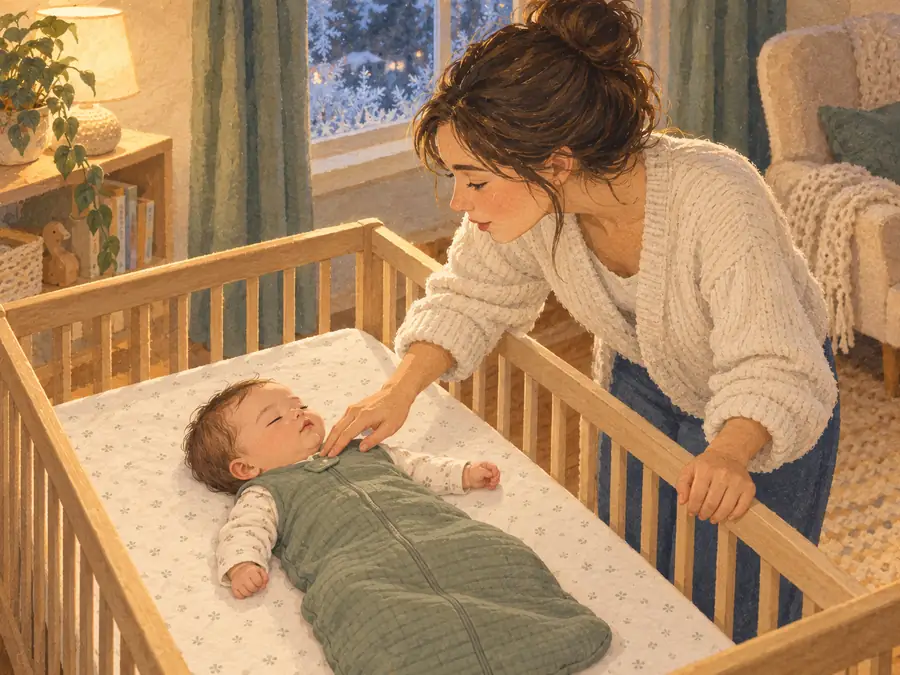
- UK guidance puts the baby's room at about 16–20 °C. The AAP gives no number and says to dress a baby in one layer more than you would wear.
- Check the chest or the back of the neck, not the hands. Cool hands and feet are normal (NHS).
- No hat for sleep indoors and no duvet or pillow in the first year.
- There is no official TOG chart. The Lullaby Trust declines to publish one, so the TOG table on the sleeping bag label is the maker's guidance.
When the heating goes on in November, the question changes overnight: is she cold, or is the room too warm? The worry is not only comfort. Overheating is one of the factors linked to sudden infant death syndrome (SIDS), so winter is the season where piling on layers feels kind and is not always safe.
Quick reference: room temperature and what to wear
| Room temperature | What the Lullaby Trust suggests | Avoid |
|---|---|---|
| Below 16 °C | an extra layer of clothing or a higher TOG sleeping bag | blankets on top of a sleeping bag, a hat |
| 16–20 °C | a babygrow and a sleeping bag, or a babygrow and a firmly tucked lightweight blanket | duvets, quilts, pillows |
| Above 20 °C | a lightweight layer, such as a short-sleeved bodysuit | a winter sleeping bag "because it's winter" |
The table is UK advice from the Lullaby Trust, a SIDS charity. In the US, the AAP does not set a room temperature and asks you not to use any blankets in the crib.
Why overheating matters
The NHS lists overheating among the things that can raise the risk of SIDS. Babies can overheat from too much bedding, too much clothing, or a room that is too hot (NHS). The AAP's 2022 safe sleep policy includes avoiding overheating alongside back sleeping, a firm flat surface and room sharing without bed sharing (AAP, Pediatrics 2022).
None of this means a slightly warm baby is in danger. It means warmth comes from the room and from what the baby wears, and not from extra things in the cot.
What room temperature is right for a baby's sleep?
The NHS and the Lullaby Trust both suggest about 16–20 °C and a room thermometer, because guessing is unreliable. The AAP does not give a number. Its rule of thumb is one layer more than you would be comfortable in (AAP, HealthyChildren).
In winter the problem is often the reverse of what parents expect: a bedroom with the radiator on all evening can sit well above 20 °C by bedtime. Keep the cot away from radiators, heaters and direct sun. The Lullaby Trust says it is rarely necessary to leave the heating on all night. If you do, keep it low and no higher than 20 °C (Lullaby Trust).
What does TOG mean on a sleeping bag?
TOG is a measure of how much warmth a fabric holds. Higher TOG, warmer bag.
This is the surprise: the Lullaby Trust, the UK's main safe sleep charity, refuses to publish a chart matching room temperature to TOG. Its reason is that every product is made of different materials, the heat trapped between layers changes the warmth a lot, and every baby is different (Lullaby Trust). So the neat table on the label is the manufacturer's guidance, not a medical rule. Use it as a starting point and then check your baby.
Three things the Lullaby Trust does say about sleeping bags:
- most are sized by weight, not age, so check the maker's guidance
- the neck and shoulders should fit well so the baby cannot slip down inside
- do not add blankets on top of a sleeping bag
How to check if your baby is too hot or too cold
Feel the chest or the back of the neck. Do not go by the hands and feet, which are usually cooler, and that is normal (NHS). If the skin is hot or sweaty, take off a layer, even if your baby is asleep. The AAP adds flushed skin to the signs of overheating.
Picture a three-month-old at 21 °C in a fleece sleepsuit and a winter bag. Hands are cold, so a parent reaches for socks. The back of her neck is damp. The socks are the wrong fix.
Hats, duvets and other things that do not belong in the cot
Hats. Take hats off as soon as you come indoors. Babies lose heat through the head, and a hat can make them too hot. Both the NHS and the AAP say no hats for sleep indoors.
Duvets, quilts and pillows. The Lullaby Trust says soft or bulky bedding has been shown to increase the risk of SIDS by three times and is not recommended under 12 months (Lullaby Trust).
Blankets. Here the advice differs by country. UK guidance allows a lightweight blanket tucked in firmly no higher than the shoulders, with the baby's feet at the foot of the cot. One blanket folded double counts as two. The AAP says no blankets in the crib and suggests a wearable blanket instead.
Weighted products. No weighted sleeping bags, swaddles or blankets (AAP, Lullaby Trust).
Decision guide for a cold or overheated room
- If the room is below 16 °C → add a layer of clothing or switch to a warmer bag. Do not add a hat or a blanket on top.
- If the room is above 20 °C → take a layer off first, then think about the heating.
- If the chest is hot or damp → remove a layer now, whatever the thermometer says.
- If your baby is unwell with a fever → do not bundle up to "sweat it out". Dress lightly and see how to measure a baby's temperature.
Common mistakes
Judging by cold hands. The most common reason a baby ends up in three layers.
Keeping the outdoor hat on after a car trip. It feels mean to wake her. Take it off anyway.
The winter bag on top of a fleece onesie in a warm flat. A higher TOG bag is for a cold room, not for a cold month.
A hot water bottle or heated pad to warm the cot. Germany's federal public health institute warns these can overheat a baby and cause scalds (BIÖG).
Some nights the room just swings: heating off at 11, cold by 4. You will get it wrong sometimes. That is why the check is the chest, every time, and not the plan you made at 7 pm.
When to call a doctor
Call your local emergency number straight away if your baby turns blue around the lips or face, is hard to wake, or has trouble breathing or pauses in breathing, especially with paleness or a blue colour. Germany's federal public health institute lists blue colour, paleness and breathing pauses among the signs that need urgent medical attention (BIÖG).
Call your pediatrician if your baby has a fever, especially under 3 months, or the sleepsuit is soaked with sweat at a normal room temperature. For a congested winter baby, see runny nose: when to call the doctor. The rest of the safe sleep picture is in the baby sleep guide 0–2 years, the newborn sleep guide and the biggest baby sleep mistakes.
Frequently asked questions
What should a baby wear to sleep in a 16 °C room?
UK guidance suggests a babygrow and a warmer sleeping bag, or an extra layer of clothing, and no blankets on top of the bag. Check the chest after you dress your baby. If it is warm and dry, that is enough.
What TOG sleeping bag does a baby need in winter?
There is no official answer. The Lullaby Trust does not publish a TOG chart because fabrics and layers vary too much. Follow the maker's guide for your room temperature, then adjust by feeling the chest or the back of the neck.
Should a baby wear a hat to sleep in winter?
Not indoors. Babies release heat through the head, and the NHS and the AAP both advise taking hats off once you are inside. A hat is for the walk, not for the cot.
Is it normal for a baby's hands to be cold at night?
Yes. Hands and feet are usually cooler than the body. Check the chest or the back of the neck instead. If those feel warm, your baby is warm enough.
Should I leave the heating on all night for my baby?
Usually not. The Lullaby Trust says it is rarely necessary and an extra layer often works better. If you do leave it on, keep it low and the room no warmer than 20 °C, with the cot away from the radiator.
Can my baby sleep with a blanket in winter?
Advice differs. In the UK a lightweight blanket firmly tucked in at shoulder height, feet at the foot of the cot, is acceptable. The AAP says no blankets in the crib and suggests a wearable blanket. Duvets and pillows are out in both.
How KidyGrow helps you
The first cold week is when nights go sideways and nobody remembers whether it started before or after the heating went on. You log the nights in a few taps as usual. Once there are 7 days of sleep logs, the app shows the average night sleep over the last week, so a week after you change the sleeping bag you can see the number for yourself. It will not tell you the room was too warm. It just means the comparison is on the screen and not in your tired memory.
Sources
- NHS. Reduce the risk of sudden infant death syndrome (SIDS).
- The Lullaby Trust. Your baby's room temperature.
- The Lullaby Trust. How to dress your baby for sleep.
- The Lullaby Trust. Mattresses and bedding.
- Moon RY, Carlin RF, Hand I; AAP Task Force on SIDS. Sleep-Related Infant Deaths: Updated 2022 Recommendations. Pediatrics, 2022.
- AAP, HealthyChildren.org. A Parent's Guide to Safe Sleep.
- BIÖG, kindergesundheit-info.de. Vorbeugung gegen den Plötzlichen Kindstod (German).
- BIÖG, kindergesundheit-info.de. Schlafumgebung (German).