 Kidy
- Under 3 months: any temperature of 38 °C (100.4 °F) or more means calling the doctor right away for an urgent assessment, with or without other symptoms.
- Call if it lasts: more than 24 hours in a child under 2, more than 3 days (72 hours) in a child 2 or older (AAP).
- Five days or more of fever always needs a check, at any age (NHS).
- Urine: about 7 % of babies with fever turn out to have a urinary tract infection, often with no other sign.
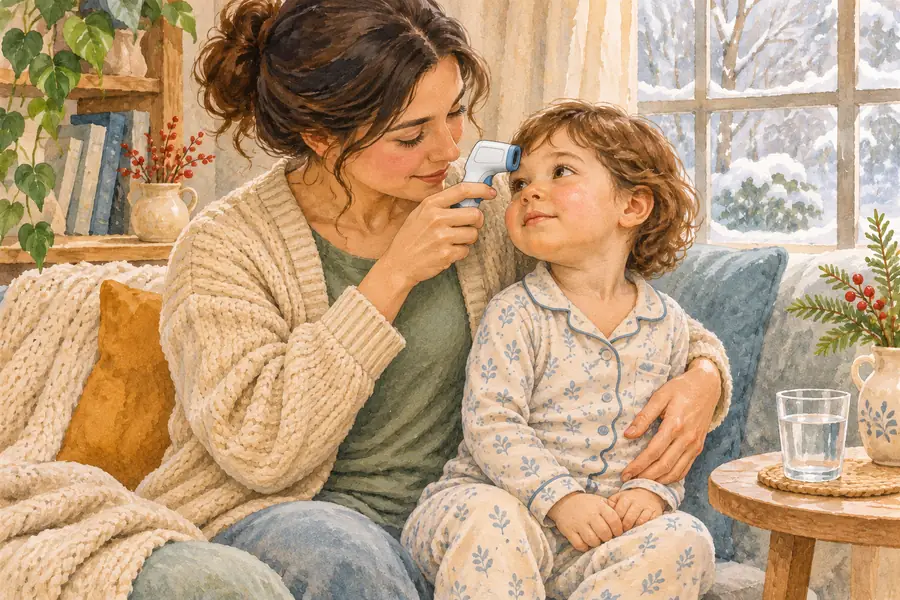
A fever with nothing else is unsettling in a particular way. No cough to explain it, no runny nose, no spots. Just a hot child, a number on the thermometer, and the feeling that something is being missed. Most of the time nothing is: a lot of viral infections start with fever alone, and the other symptoms show up a day later, or never. This guide is about children from 3 months up. For younger babies, read baby's first fever instead, because the rules are stricter.
Quick reference: fever without other symptoms
| Situation | What it usually means | What to do |
|---|---|---|
| Fever under 24 h, child drinks and plays | early viral infection, more symptoms may follow | fluids, rest, watch |
| 3 days of high fever, then a rash as fever drops | roseola (sixth disease) | usually nothing more, call if unsure |
| Fever with no clear source, baby or toddler | sometimes a urine infection | ask the doctor about a urine test |
| Fever 1–2 days after a vaccine | normal vaccine reaction | see our vaccination guide |
| Fever 5 days or more | needs assessment, whatever the cause | doctor the same day |
Why does my child have a fever but no other symptoms?
A fever is the body turning its own thermostat up to fight an infection. The AAP explains it that way, and it helps to remember that the fever is a response, not the illness. The question is what it is responding to.
The common answers, roughly from most to least likely:
A virus in its first day. Many colds and stomach bugs start with a temperature. The runny nose or the vomiting arrives the next morning. This is why the first evening of a fever is often the most confusing one.
Roseola. The NHS describes it as a very common infection in babies and toddlers: a high temperature for 3 to 7 days, and then a rash on the chest, tummy and back that spreads to the neck and arms and fades within 2 days. Parents often only get the diagnosis in hindsight, when the rash appears just as the child finally feels better.
A urinary tract infection. This is the one worth knowing about, because it hides. In a meta-analysis of 18 studies, about 7 % of babies who came in with fever had a urine infection. The rates were highest in girls under 12 months and in uncircumcised boys under 3 months. A baby cannot tell you it burns when they wee. The NHS lists a high temperature and appearing generally unwell, irritable or not feeding properly as the signs in young children.
A vaccine. A fever a day or two after shots is a known reaction. Our guide to fever after vaccination has the timelines by vaccine.
Less often, it is the start of something that needs treatment, like pneumonia, which is why the watching matters more than the number.
How high is too high?
Less important than you'd think. NICE, the UK body that writes guidance for doctors, says in its fever guideline for under-fives that in children older than 6 months, the height of the temperature alone should not be used to identify serious illness. A child at 39.8 °C who is watching cartoons worries a doctor less than a child at 38.4 °C who won't look at you.
There are age thresholds, though. The NHS wants you to call for a baby under 3 months at 38 °C or above, and for a baby of 3 to 6 months at 39 °C or above. The AAP adds a fever that repeatedly rises above 40 °C (104 °F) at any age. Check you are measuring properly first: our guide on how to take a temperature correctly covers which thermometer to trust at which age.
The paracetamol test that doesn't work
Here is the part that surprises most parents. You give paracetamol, the fever comes down, and you feel relieved: must be nothing serious. Or it doesn't come down, and you panic.
NICE tells doctors not to do either. When a child has had fever medicine, a fall or no fall in temperature should not be used to tell serious from non-serious illness. What the medicine does to the number says little about what is causing it.
What does tell you something is your child. Do they look at you, smile, respond to their name? Are they drinking? NICE's own checklist leans heavily on exactly these: response to social cues, colour, breathing, hydration. You are better placed to judge that than anyone, because you know what normal looks like for this child.
The same guideline says something else worth knowing. Fever medicine does not prevent febrile seizures and should not be given for that purpose. Use it when your child is miserable, not to chase a number at 3 am.
Watch or call: a simple decision path
- Older than 3 months (at 3–6 months only below 39 °C), fever under 24 hours, drinking and has good moments → stay home, offer fluids, keep notes, check on them at night.
- Under 2 years and the fever passes 24 hours → call the pediatrician (AAP).
- 2 years or older and the fever passes 3 days → call the pediatrician.
- Fever disappears and a rash appears → likely roseola; call if you are unsure or your child seems unwell.
- Any age, 5 days of fever → same-day check. NICE asks doctors to consider Kawasaki disease at this point.
- Floppy, hard to wake, breathing hard, non-fading rash → emergency, don't wait.
One evening is not a pattern. Three days of a hot, listless child who drinks less each day is a pattern, and that is the one to act on.
Common mistakes
Waking a sleeping child to give medicine. Let them sleep.
Alternating paracetamol and ibuprofen on a schedule. The NHS says not to, unless a doctor or nurse tells you to. Pick one, and switch only if the first is not helping.
Giving ibuprofen to the wrong child. Not under 3 months, not under 5 kg, not with chickenpox and not to a dehydrated child, per the NHS. Paracetamol is not for babies under 2 months.
Treating the number instead of the child. NICE says not to use fever medicine with the sole aim of lowering temperature. A comfortable child at 38.7 °C does not need a dose.
Undressing or sponging them down. The NHS says not to: a high temperature is a natural and healthy response to infection. Light clothes, a normal room, plenty to drink.
Forgetting to count wet nappies. Nappies that are not very wet, sunken eyes and no tears when crying are the dehydration signs the NHS lists. Over a long day it is easy to lose track.
When to see a doctor
If your baby is under 3 months with 38 °C or more, call the doctor right away; this needs an urgent assessment. Call your pediatrician the same day if your baby is 3–6 months with 39 °C or more, or if your child is under 2 with a fever lasting more than 24 hours, 2 or older with a fever lasting more than 3 days, or if the fever keeps going above 40 °C. If there is no source for the fever, ask whether a urine test makes sense; NICE recommends it for children with fever and no obvious cause.
Go to emergency care or call your emergency number if your child is floppy or very hard to wake, is breathing with effort or very fast, has unusually cold hands and feet, has a rash that does not fade when you press a glass against it, has a seizure, or has stopped drinking and weeing.
Before the call, note when the fever started, the highest reading, when you last gave medicine and how much they drank. Our guide on how to prepare for a pediatric visit has a short list. If a cough appears later, fever and cough: when to monitor picks up from there.
Frequently asked questions
Can a child have a fever with no other symptoms?
Yes, and it is common. Many viral infections start with fever alone, and other symptoms appear a day later. Roseola gives several days of fever before its rash, and a urine infection in a small child can show only as fever and general unwellness.
How long can a fever with no symptoms last before I worry?
The AAP advises calling if a fever lasts more than 24 hours in a child under 2, or more than 3 days in a child 2 or older. The NHS says any fever lasting 5 days or more needs a doctor. Call sooner if your child seems unwell.
Should my child's urine be tested?
If a baby or toddler has a fever with no obvious cause, it is a reasonable question to ask. NICE recommends urine testing for children with fever and no apparent source. In a meta-analysis, about 7 % of babies with fever had a urine infection.
Can teething cause a high fever?
Teething is often blamed for a fever, but a high temperature with no other explanation should be treated like any other fever. Follow the same age rules and call if it lasts beyond them, rather than waiting for a tooth.
Is 39.5 °C dangerous for a toddler?
The number on its own is not the main warning sign in children over 6 months. NICE says height of temperature alone should not be used to spot serious illness. How your child looks, drinks and responds matters more, though a fever that repeatedly goes above 40 °C is a reason to call.
Can my child go to nursery after the fever is gone?
Usually once they are fever-free and well enough to join in, without fever medicine masking it. Our guide on returning to daycare after illness covers the usual rules.
How KidyGrow helps you
Day two of a fever, and you honestly can't remember whether the last dose was at six or at seven. That gap is where a lot of the night's worry lives.
In KidyGrow you log the fever as a symptom with a note, in a few taps. The Daily Brief and the Tonight plan take the last 24 hours into account, so a feverish day changes what they suggest for the evening. Tell the app "had a febrile seizure last year" once and it remembers, and uses it in later answers. It doesn't diagnose and it won't tell you it is roseola. But when the doctor asks "since when?", the answer is written down.
Sources
- American Academy of Pediatrics, HealthyChildren.org. Fever Without Fear: Information for Parents. https://www.healthychildren.org/English/health-issues/conditions/fever/Pages/Fever-Without-Fear.aspx
- American Academy of Pediatrics, HealthyChildren.org. Fever: When to Call the Pediatrician. https://www.healthychildren.org/English/health-issues/conditions/fever/Pages/When-to-Call-the-Pediatrician.aspx
- NHS. High temperature (fever) in children. https://www.nhs.uk/symptoms/fever-in-children/
- NHS. Roseola. https://www.nhs.uk/conditions/roseola/
- NHS. Urinary tract infections (UTIs). https://www.nhs.uk/conditions/urinary-tract-infections-utis/
- NICE. Fever in under 5s: assessment and initial management (NG143). https://www.nice.org.uk/guidance/ng143/chapter/Recommendations
- Shaikh N, Morone NE, Bost JE, Farrell MH. Prevalence of urinary tract infection in childhood: a meta-analysis. Pediatr Infect Dis J. 2008;27(4):302–308. https://pubmed.ncbi.nlm.nih.gov/18316994/