 Kidy
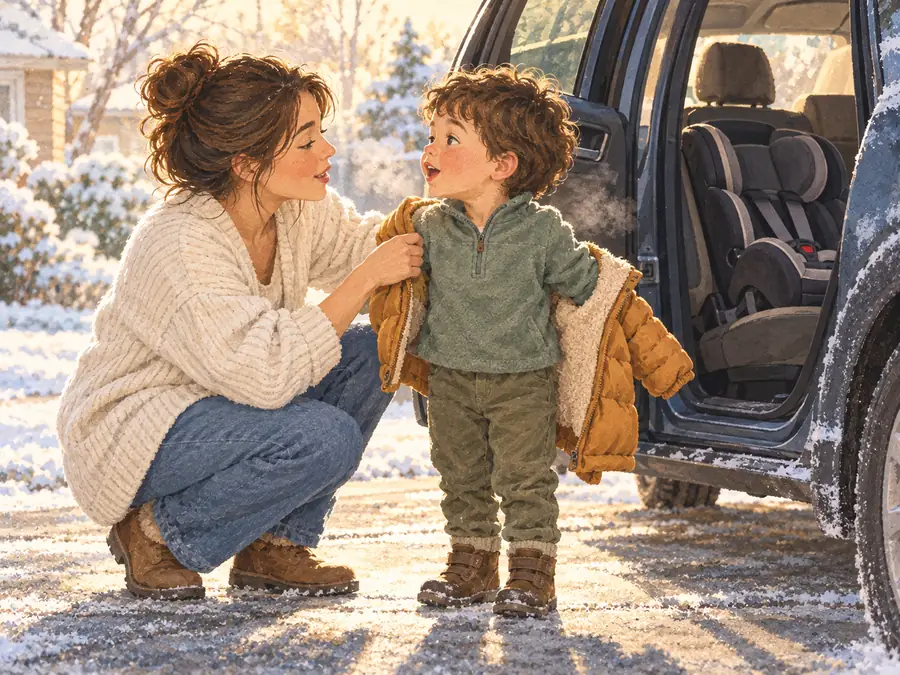
- The AAP advises against bulky coats and snowsuits under a car seat harness. In a crash the padding flattens, and the straps are suddenly loose.
- The pinch test: if you can pinch a fold of harness strap at your child's shoulder, it needs tightening (AAP).
- One or two fingers between chest and harness is the most that should fit, unless your seat's manufacturer says otherwise, and clothing changes this, so check every trip (RoSPA).
- In an ADAC sled test at 16 km/h (10 mph) with thick winter jackets, the lap belt cut deep into the dummies' bellies.
It is minus three, the car is an icebox and your toddler is already zipped into a snowsuit that took four minutes to get on. Taking it off again feels absurd. Here is why it is worth those four minutes, and how to keep a child warm without it.
Quick reference
| What your child wears | Under the harness? | Better |
|---|---|---|
| Puffy coat or snowsuit | no | take it off, put it back on over the buckled straps |
| Thin fleece jacket | usually fine, do the pinch test | close-fitting layers underneath |
| Bodysuit, leggings, sweater | yes | add a hat, mittens, socks |
| Blanket | never under the child | over the buckled harness |
| Car seat bag with a layer under the back | no | a cover with nothing beneath the child |
Why a puffy coat is a problem
A winter coat is mostly air. When you tighten the harness over it, the straps feel snug, but they are snug against padding, not against your child. In a crash, the AAP explains, that fluffy padding flattens out immediately from the force, leaving space under the harness, and a child can slip through the straps (AAP, HealthyChildren). The AAP's family guide says the same in one line: bulky clothing can compress in a crash and leave the straps too loose to restrain a child (AAP, HealthyChildren).
The part most parents do not expect is how little speed this takes. Germany's motoring club ADAC ran a sled test at 16 km/h with a child dummy and an adult dummy in thick winter jackets. In both, the lap belt sat loose and cut deep into the belly, a position that can injure organs such as the liver or spleen (ADAC). That was the speed of this one test, not a line below which nothing can happen. The point is that it took no motorway crash to show the problem.
This matters beyond winter. The AAP asks pediatricians to cover car seats at every checkup and to keep children rear-facing as long as possible (AAP, Pediatrics 2018).
The pinch test
Buckle your child in and tighten the harness. Then, at the shoulder, try to pinch the strap between your thumb and finger. If you can grab a fold of webbing, it is too loose. Tighten until you cannot. If your seat has a chest clip, as most US seats do, the AAP places it at armpit level; many European seats have no chest clip at all. Either way, always check the position of the straps and buckles against the instructions for your own car seat (AAP).
The UK road safety charity RoSPA puts it another way: only one or two fingers should fit between the child's chest and the harness (unless your seat's manufacturer says otherwise), and because clothing affects the fit, it should be checked on every journey (RoSPA).
A two-minute check at home
This one is our suggestion, not an official test, built on the pinch test above. Put your child in the seat wearing the winter coat and tighten the harness properly. Unbuckle without loosening anything, take the coat off, and buckle again. If you now see a gap you could slide your hand into, that gap is what the coat was hiding. Most parents only need to see it once. It shows the problem; it does not prove a fit is safe. A smaller gap is not fine either: the harness should be adjusted as your seat's instructions say and pass the pinch test.
How to keep a child warm and buckled
The AAP's winter advice, in the order you will use it (AAP, HealthyChildren):
- Bring the infant carrier inside when you are not using it, so it starts at room temperature.
- Dress in thin layers: tights or leggings, a long-sleeved bodysuit, then trousers and a sweater. A thin fleece on top is fine.
- Babies need one more layer than you. If you are wearing a coat, your baby probably needs a coat and a blanket, just not under the straps. Thin, close-fitting clothes can go under the harness; anything bulky goes over it.
- Coat on backwards. Once the harness is buckled, put the coat on back to front over it, arms through the sleeves.
- Blanket over the straps, with the face uncovered.
- Hat, mittens, socks or booties. They warm without touching the harness.
- Start early. Everything takes longer in the cold, including you.
Make the top layer easy to take off. Cars warm up quickly, and once they do, a baby under a coat and a blanket can overheat.
Ponchos, car seat covers and inserts
The AAP notes that some parents use poncho-style coats or jackets that unzip at the sides so the back flips forward over the harness. A shower-cap style cover over the seat is acceptable only if there is no layer underneath the baby. Nothing bulky should go under your child's body or between the body and the straps (AAP).
The same page is blunt about the bundling bags sold for car seats: being on a shop shelf does not make a product safe, and the safer rule is simple: do not add inserts, padding or winter bags between the child and the seat or harness unless your car seat's manufacturer has explicitly approved them for that model. Stroller footmuffs and sleeping-bag inserts stay in the stroller.
How to decide
- If the coat is puffy or quilted → off before buckling, back on over the straps.
- If it is a thin fleece → keep it on, but the pinch test decides.
- If the trip is two minutes to nursery → still off. Crashes do not check the distance.
- If your child is in a booster with the adult belt → open the coat and pull it out from under the lap belt, so the belt sits low on the thighs. ADAC gives the same advice to anyone belted in while wearing a coat.
Common mistakes
Tightening over the coat until it "feels firm". Firm against padding is not firm against the child.
Forgetting the adults. The AAP points out that a puffy coat on you adds space between your body and the seat belt too.
A blanket tucked behind the baby's back. Over the harness, never behind or under.
Setting off with wet mittens. Wet layers make a child colder, so keep a spare pair in the car.
When your child fights the coat coming off
Some toddlers scream at the idea of losing the warm coat, and then scream again at the buckle. A predictable routine helps: coat off at the door, child in the seat, buckle, coat back on backwards, the same order every time. If the car seat itself is the battle, toddler refuses car seat every time goes through it, and the wider approach to limits that do not move is in what gentle parenting actually is.
For longer drives, car travel with a baby to the coast has the planning side. And if winter brings the usual colds, baby runny nose: when to call the doctor helps you sort the ordinary from the not.
Frequently asked questions
Can my child wear a winter coat in the car seat?
Not a puffy one under the harness. The AAP advises that bulky coats and snowsuits come off before buckling, because the padding compresses in a crash and leaves the straps loose. Put the coat on over the buckled harness, backwards, instead.
Is a fleece jacket OK in a car seat?
A thin fleece is usually fine. Do the pinch test after tightening: if you can still pinch a fold of strap at the shoulder, the fleece or the harness needs adjusting.
How tight should car seat straps be?
Tight enough that you cannot pinch any slack at the shoulder. RoSPA says no more than one or two fingers between chest and harness. Check every trip, since clothing changes the fit.
Are car seat ponchos and covers safe?
A poncho that goes over the buckled harness, or a cover with no layer under the baby, is what the AAP describes as acceptable. Products that add padding behind or under the child can loosen the fit, so skip them unless your seat's manufacturer has approved them for that model.
My baby gets cold in the car. What should I do?
Keep the infant carrier indoors, dress the baby in thin layers plus a hat and socks, and lay a blanket over the buckled straps. Babies generally need one more layer than adults. Thin, close-fitting clothes are fine under the harness; the extra warm layer, a coat or blanket, goes over it.
Does this apply to older children in boosters?
Yes, in a different way. With an adult belt, a thick coat lifts the lap belt onto the belly. Open the coat and pull it out from under the belt so the belt lies low on the thighs.
How KidyGrow helps you
Winter mornings are already a negotiation, and nobody remembers on day three that the hat was the thing that ended the screaming. In KidyGrow you can tell the app things like that once: gets overheated in the car, hates the coat coming off, calms down with a particular song. It remembers those facts and takes them into account when you ask about outings or tricky moments later. It will not buckle anyone in for you. It just means the next answer starts from what you already learned this week, not from zero.
Sources
- American Academy of Pediatrics, HealthyChildren.org. Winter Car Seat Safety Tips.
- American Academy of Pediatrics, HealthyChildren.org. Car Seats: Information for Families.
- Durbin DR, Hoffman BD; AAP Council on Injury, Violence, and Poison Prevention. Child Passenger Safety. Pediatrics, 2018.
- RoSPA. Using Child Car Seats.
- ADAC. ADAC warnt: Keine dicke Winterjacke im Auto (German), 2023.