 Kidy
- Cold, dry air weakens the skin barrier. A review of the research concluded that low humidity and low temperatures make atopic eczema flares more frequent and more severe.
- Small changes in the air show up on the skin. In 177 children aged 5 and under, symptoms were 12.8% lower on days 5 °C warmer and 3.3% lower when humidity rose by 5 points.
- Indoor humidity: aim for roughly 30–50%, never above 60%.
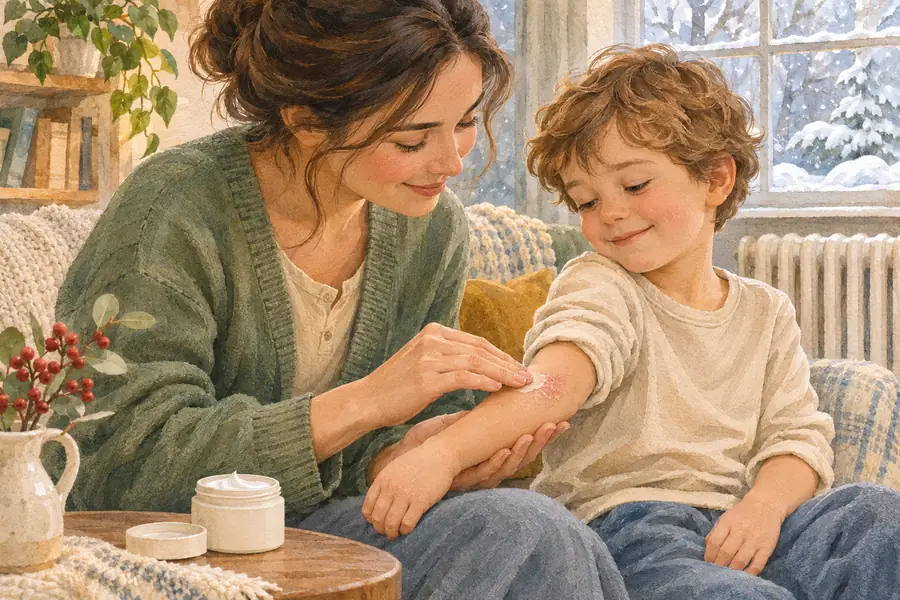
- Moisturizer at least twice a day, the first coat straight after a 5–10 minute lukewarm bath.
The heating comes on in October and by mid-November the backs of the knees are cracked again. This article is about that winter pattern in children who already have eczema (atopic dermatitis): what the heated, dry air does, why heat and sweat can make the itch worse too, and which small changes are worth making first.
Quick reference: winter triggers and what to change
| Winter trigger | What it does to eczema skin | What to change |
|---|---|---|
| Heated, dry indoor air | Skin loses water faster and cracks | Hygrometer, aim for 30–50% humidity |
| Overheating, sweaty pajamas | Heat and sweat set off itching | Cooler bedroom, lighter layers |
| Long hot baths | Strip the skin's oils | 5–10 min, lukewarm, moisturize right after |
| Wool hats, scarves, sweaters | Rough fibers rub and itch | Cotton next to the skin |
| Cold wind, then a warm room | Temperature swings worsen eczema | Moisturize before going out |
Why does eczema get worse when the heating comes on?
Cold air holds very little water. When the heating warms that same air, its relative humidity drops, and indoor air in a heated flat can feel like a desert by evening. Skin with eczema already holds water poorly. Many children with eczema are short of filaggrin, a protein that helps the outer layer of skin hold in water and keep irritants out (AAP, HealthyChildren.org).
A review in the Journal of the European Academy of Dermatology and Venereology put it plainly: low humidity and low temperatures lower skin barrier function, make the skin more reactive to irritants and allergens, and cold, dry weather raises the risk of flares in atopic dermatitis.
The numbers from one panel study are worth knowing. Researchers followed 177 children with eczema, all aged 5 or younger, for 17 months, with parents recording symptoms every day. Every 5 °C rise in outdoor temperature was associated with 12.8% fewer symptoms that day, and every 5-point rise in humidity with 3.3% fewer. It was done in Seoul, outdoors, so it does not tell you what your living room is doing. It does tell you the air matters.
The NHS lists "heat or changes in temperature" among the things that make eczema worse. Winter supplies both, several times a day: frost at the school gate, a radiator on full at home.
Moisturizer for the skin, treatment for the flare
Before the room, one thing to keep straight. Moisturizer is daily care: it covers the skin with a film that holds water in (NHS), and it belongs on good days too. A patch that is red, inflamed and itching hard is a different job. The AAP says steroid creams are what heal that inflammation, usually twice a day while the rash is flaring, and that they are very effective and safe when used appropriately. Your doctor picks the right one for your child's skin (HealthyChildren.org).
So if your child already has a treatment plan, use it. Turning the heating down helps, but it is never a reason to wait out an active flare.
Heat and sweat can make itching worse too
Here is the twist. A lot of winter itching is not caused by cold at all. It is caused by a warm child.
We bundle children up for the walk, then forget to strip the layers indoors. The bedroom gets the radiator on full because it feels cold at 7 pm. By 2 am the child is sweaty under a thick duvet and scratching in their sleep. The NHS advice is short: keep cool, because being hot makes eczema more itchy. The AAP lists heat and sweat among the common triggers.
If you only change one thing this week, check the bedroom. A cool room, light cotton pajamas and a sleep bag or blanket that fits the room temperature (our guide to dressing a baby for sleep in winter has the TOG table) can cut down the flares that come from overheating. They work alongside the daily moisturizer and any treatment your doctor prescribed, not instead of them.
The bath and moisturizer routine that works in winter
The AAP's version is simple: a bath or shower every day or every other day, for 5–10 minutes, in lukewarm water, then moisturizer on the whole body while the skin is still damp (HealthyChildren.org). Skip soap except where it is really needed. The NHS adds the frequency: at least twice a day, and use an emollient as a soap substitute.
At our house the cream comes out as soon as we see eczema season starting, and I put a little bath oil in the kids' bath. An honest note on the oil: in the BATHE trial, 482 children with eczema from English GP practices did no better over 16 weeks when bath additives were added to their usual care, which already included leave-on moisturizer. So the cream after the bath does the real work. And oil makes the tub slippery, which the NHS warns about too, so keep a hand on a small child climbing out.
Now the part that surprises most parents. You have probably heard that thicker is better, ointment beats cream beats lotion. A trial of 550 children in 77 English GP practices randomly gave families a lotion, cream, gel or ointment and followed them for 16 weeks. There was no difference in eczema severity between the four types. Ointments stung less often (9% of children, against 17–20% for the others).
So the best winter moisturizer is the one your child lets you put on twice a day. A greasy ointment that ends in a fight every evening loses to a cream that goes on in 40 seconds while you talk about the snowman. In winter you may simply need more of it, more often.
Two winter habits help on top of that:
- Before going out: a layer of the usual moisturizer on cheeks, chin and hands, which take the wind.
- After coming in: off with the wet gloves and the scarf that rubbed the chin. Rough, damp wool against eczema skin for an hour is a classic December flare.
Does a humidifier help eczema?
It can take the edge off very dry air, but it is not a treatment. Think of it as one part of the room, not the fix.
If you use one, three rules matter more than the brand. Pick a cool-mist model, because warm-mist humidifiers and steam vaporizers can burn a child who gets too close (Mayo Clinic). Clean it as the manual says. And watch the number: the US EPA advises keeping indoor humidity below 60%, ideally 30–50%. Above that you feed mold and house dust mites, and dust mites are an eczema trigger of their own.
I would buy the hygrometer before the humidifier. It costs about as much as a tube of cream, and it tells you whether the air is actually the problem. Sometimes it reads 45%, and then the radiator is probably not the main culprit.
Decide tonight: what to change first
- Itch is worst at night, room feels warm → turn the bedroom heating down, lighter pajamas, check the sleep bag TOG.
- Hygrometer under 30% → turn the radiator down a notch first, then a cool-mist humidifier if needed. Laundry drying on a rack in the room helps too.
- Hygrometer already 40–50% → the air is not especially dry. Look at baths, clothes and how often the moisturizer actually goes on.
- Cheeks and hands worst → moisturizer before every outing, cotton under wool, dry gloves.
- Flare started with a new sweater or detergent → wash new clothes before wearing, go back to the old detergent for 2 weeks.
Common mistakes
Long hot baths "to warm up". It feels kind. It dries the skin for the rest of the evening.
Moisturizing only when it looks bad. The NHS says to keep going even when the eczema improves. Quiet days are when the barrier gets rebuilt.
Long nails at night. Keep them short. Babies can wear anti-scratch mittens.
Overdressing at night. Check whether your child is overheating. An extra layer can make the itch worse.
Changing three things at once. New cream, new detergent and a humidifier in the same week, and you will never know which one helped. When you are looking for a trigger, change one optional thing at a time and wait a week. Keep any prescribed treatment and the basic care going as planned.
Stopping a prescribed steroid cream too early because the skin looks better after two days. Follow the plan your doctor gave you.
When to see a doctor
See your pediatrician if the routine above has not calmed things within about 2 weeks, if itching keeps waking your child, or if you are not sure it is eczema at all. Night itching around the bottom in a school-age child, for example, is more often pinworms than eczema. Our guide to baby rash types helps sort the rest.
Ask for an urgent appointment the same day if the eczema is blistered, crusty, leaking fluid or has spots filled with pus, if it is painful, swollen or warm, if it suddenly gets much worse, or if your child has a fever or seems unwell. The NHS names these as signs of infection or of eczema herpeticum, a herpes infection of eczema skin that needs treatment quickly. Honey-colored crusts are also typical of impetigo.
These are reasons for a same-day appointment, or the out-of-hours service in the evening, not usually for an ambulance. Call your emergency number only if your child seems seriously ill, for example very drowsy, hard to wake or struggling to breathe, as you would with any illness.
Before the appointment, write down when the flare started, what changed at home and what you have tried. Our guide to preparing for a pediatric visit has a simple checklist. For eczema in summer and at the beach, see the sea and eczema in children, and for the very first patches on a baby's face, baby eczema vs. baby acne.
Frequently asked questions
Why is my child's eczema worse in winter?
Cold outdoor air and heated indoor air are both dry, and dry air pulls water out of skin that already holds it poorly. Add hot baths, wool and warm bedrooms that make children sweat, and winter stacks several triggers on top of each other. Most flares come from that combination, not from one cause.
What humidity is best for a child with eczema?
There is no eczema-specific number, but the general advice from the US EPA is to keep indoor humidity between 30 and 50% and never above 60%. Below 30% the air is very dry; above 60% mold and dust mites thrive. A cheap hygrometer tells you where you are.
Should I bathe my child less in winter if they have eczema?
Not necessarily less, but shorter and cooler. The AAP suggests a bath or shower every day or every other day for 5–10 minutes in lukewarm water, followed straight away by moisturizer on damp skin. The bath itself is fine; the long hot soak and skipping the moisturizer afterwards are the problem.
Is an ointment better than a cream for winter eczema?
Not necessarily. In a trial of 550 children, lotions, creams, gels and ointments worked equally well over 16 weeks, though ointments stung less often. Use the one your child accepts, and use enough of it, at least twice a day.
Can my child with eczema play outside in the cold?
Yes. Put moisturizer on exposed skin before going out, dress in layers with cotton next to the skin, and change out of wet gloves and scarves as soon as you are back. Then take the layers off indoors before your child starts sweating.
Will my child outgrow winter flares?
According to the NHS, eczema symptoms tend to get better as children get older, but it is hard to predict for one child. Winter flares often keep happening for as long as the eczema does. What changes is that you learn which of your child's triggers matter most.
How KidyGrow helps you
It is 2 am, your child is scratching, and you cannot remember whether it was the new pajamas or the radiator that started this round. Next winter you will not remember either.
You can tell KidyGrow things like "the ointment stings, the cream is fine" or "wool hats make the cheeks flare". The app remembers those facts about your child and uses them in later answers, so you are not explaining the whole history at every flare. You can also log a flare as a symptom with a short note. It does not work out the cause for you, and some winters just look messy. But when the pediatrician asks what you have already tried, the answer is written down.
Sources
- Engebretsen KA, Johansen JD, Kezic S, Linneberg A, Thyssen JP. The effect of environmental humidity and temperature on skin barrier function and dermatitis. J Eur Acad Dermatol Venereol. 2016;30(2):223–249. https://pubmed.ncbi.nlm.nih.gov/26449379/
- Kim YM, Kim J, Han Y, et al. Short-term effects of weather and air pollution on atopic dermatitis symptoms in children: a panel study in Korea. PLoS One. 2017;12(4):e0175229. https://pubmed.ncbi.nlm.nih.gov/28384276/
- Ridd MJ, Santer M, MacNeill SJ, et al. Effectiveness and safety of lotion, cream, gel, and ointment emollients for childhood eczema: a pragmatic, randomised, phase 4, superiority trial. Lancet Child Adolesc Health. 2022;6(8):522–532. https://pubmed.ncbi.nlm.nih.gov/35617974/
- NHS. Atopic eczema. https://www.nhs.uk/conditions/atopic-eczema/
- American Academy of Pediatrics, HealthyChildren.org. Eczema. https://www.healthychildren.org/English/health-issues/conditions/skin/Pages/Eczema.aspx
- American Academy of Pediatrics, HealthyChildren.org. How to Treat and Control Eczema Rashes in Children. https://www.healthychildren.org/English/health-issues/conditions/skin/Pages/How-to-Treat-and-Control-Eczema-Rashes-in-Children.aspx
- Mayo Clinic. Cool-mist humidifiers: Which is better for a child with a cold? https://www.mayoclinic.org/diseases-conditions/common-cold/expert-answers/cool-mist-humidifiers/faq-20058199
- US Environmental Protection Agency. A Brief Guide to Mold, Moisture and Your Home. https://www.epa.gov/mold/brief-guide-mold-moisture-and-your-home
- Santer M, Ridd MJ, Francis NA, et al. Emollient bath additives for the treatment of childhood eczema (BATHE): multicentre pragmatic parallel group randomised controlled trial of clinical and cost effectiveness. BMJ. 2018;361:k1332. https://pubmed.ncbi.nlm.nih.gov/29724749/
- NHS. Emollients. https://www.nhs.uk/tests-and-treatments/emollients/