 Kidy
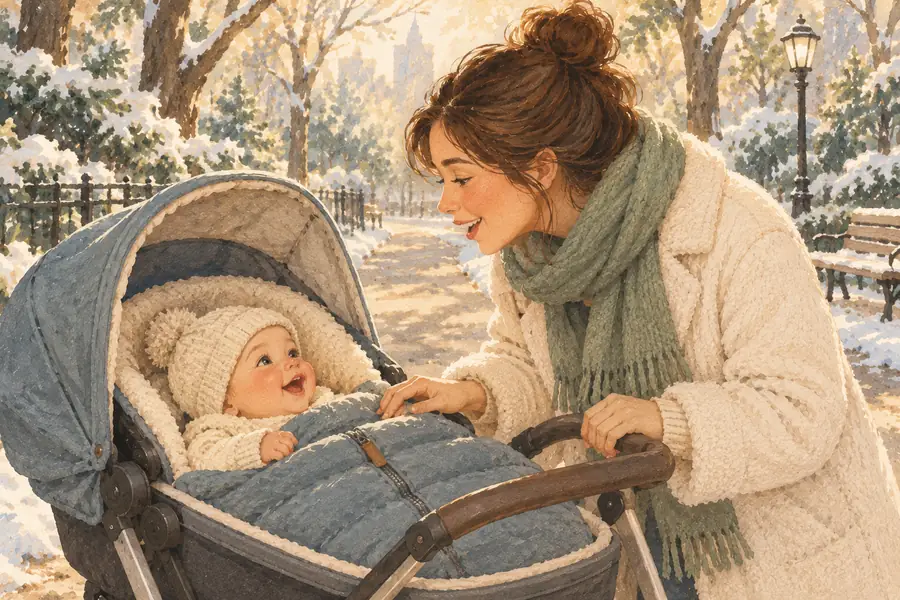
There is no official temperature below which a baby must stay indoors. We looked. The AAP, the NHS and Germany's public health institute all talk about layers, warning signs and wet clothes, but none of them names a number for a stroller walk. What you get instead is a handful of solid anchors:
- Conditions decide, not just the thermometer: wind, wet, your baby's age and health, and how fast you can get back somewhere warm.
- Rule of thumb for layers: one more than you are wearing.
- Cold hands tell you little. Feel the back of the neck or between the shoulder blades, and look at the face, the skin colour and how your baby is acting.
Quick reference: the conditions that decide
| Condition | Why it matters | What to do |
|---|---|---|
| Newborn, premature or unwell baby | More caution applies | Short outings, and ask your pediatrician or health visitor before longer walks in real cold |
| Wind | Cools skin faster than the temperature alone | Shorten the walk, pick sheltered routes, turn the hood into the wind |
| Rain, wet snow, damp clothes | Wet clothing pulls heat away fast | Postpone or shorten, carry dry mittens and a dry hat |
| Distance from somewhere warm | Sets how quickly you can react | On colder days, a shorter loop close to home |
| How often you check your baby | You only see a change if you look for it | At every stop: neck, face, skin colour, behaviour |
| Length of the outing | Skin cools faster the colder it is | Shorter in cold and wind, longer in mild weather |
This table is not a rule from any health authority. It lists the conditions the sources below talk about.
Is there an official temperature limit?
No, not for babies and not for strollers. The only number we found is the AAP's: in general, playing outside in temperatures or wind chills below -15 °F (about -26 °C) should be avoided, because at that point exposed skin begins to freeze within minutes (AAP, HealthyChildren.org). That figure was written for children playing outside. The page says nothing specific about infants, so don't read it as a safety limit for a baby in a stroller.
So for babies there is no number, and the conditions make the call. We went for walks in winter too: we bundled up and went out. A baby in a lined footmuff behind a windbreak, five minutes from home, is in a very different situation from the same baby in a carrier on an exposed bridge, at the same temperature.
Wind matters as much as the thermometer. A still -5 °C day can feel milder than a windy +2 °C, and the AAP counts wind chill in the same breath as air temperature for exactly that reason.
What the Finnish pram-nap studies found
In northern Finland babies nap outside in their prams through winter, and researchers in Oulu observed it. In a survey of 116 parents, the temperatures children slept out in ran from +5 °C down to -27 °C (Tourula et al., 2008). At 0 °C, almost half of the children had sweaty necks. How warmly babies were dressed did not change with the air temperature, so they were overdressed on milder days and underdressed on colder ones (Tourula et al., 2011). Their skin cooled faster the colder it got, and clothing only partly made up for it (Tourula et al., 2010).
It is worth being clear about what these studies are not. They are observations, not trials. They mostly measured healthy babies of about three months, in a culture with generations of practice. They do not show that sleeping or walking in the cold is safe for every baby. Their useful lesson is a narrow one: the same snowsuit for every kind of weather is a common mistake.
How to dress a baby for a cold walk
The AAP's rule of thumb is that infants wear one more layer than adults (AAP). Thin layers beat one thick one, because you can take one off when the café turns out to be warm.
- Base layer: a long-sleeved bodysuit, wool or cotton.
- Middle layer: fleece or a knit.
- Outer layer: a snowsuit or pramsuit, or a lined footmuff in the stroller.
- Hat, mittens, warm socks or booties. Wet mittens make a child colder, so swap them.
Then tuck the blanket around the body, not over the face, and keep the hood up against wind.
A baby in a carrier gets your body heat on the torso while legs, feet and head stay exposed. Cover those. A bulky snowsuit also has to come off before the car seat, since it leaves slack under the harness; the AAP suggests a coat or blanket over the buckled straps instead.
Toddlers who fight the hat are a separate battle, and a familiar one. Our piece on a toddler who refuses to get dressed has the tactics that work for mittens too.
How to tell if your baby is too cold (or too warm)
Hands and feet are often cool in babies who are perfectly warm overall, which is why Germany's federal health institute suggests checking between the shoulder blades instead (BIÖG). The back of the neck works the same way and is easier to reach under a hood. Touch is one sign, though, not the whole check. Look at several things together:
- Neck or back: warm and dry is a good sign. Sweaty means too many layers, cool means time to go in.
- Face: red cheeks in the cold are ordinary. Pale, white or gray patches are not.
- Hands: they can be cooler, but should stay pink.
- Clothes: wet mittens, hat or footmuff cool a baby down, so swap them or head home.
- Behaviour: a calm baby who responds to you is fine. An unusually quiet, floppy or sleepy one is not.
Cheeks going red in the cold is ordinary. Skin that turns pale, white or gray, or feels hard, is not. Frostbitten skin can look white or pale gray and may blister (AAP). In infants, hypothermia can show as bright red, cold skin and very low energy (CDC).
Fussing on a walk has a dozen possible causes. A baby who goes unusually quiet is the one to check.
Decision guide
- Neck warm and dry, face a normal colour, baby content, no strong wind → carry on.
- Neck sweaty → one layer off, open the footmuff a little.
- Neck cool, pale patches on the face, wet clothes, or baby crying and hard to settle → head home now.
- Strong wind or wet snow → shorten the walk, or postpone it. Wet clothing pulls heat away fast.
- Baby under a few weeks old, premature, or unwell → ask your pediatrician what is sensible before long outings in real cold.
If you want ideas for what to actually do out there once everyone is dressed, our list of outdoor play ideas for babies works in winter too, minus the sandbox.
Common mistakes
- Judging by the hands. Cold fingers alone are not a reason to turn back.
- The same outfit at 0 °C and -10 °C. That is exactly what the Finnish measurements caught.
- Staying fully bundled indoors. Babies overheat quickly, as the BIÖG puts it, and a heated shop after a cold street is the classic setting. Open the snowsuit as soon as you are inside.
- Leaving wet mittens on. Once they are wet they make a child colder, not warmer. Carry a dry pair.
- Assuming a crying baby is cold. Check the neck, face and clothes before adding anything.
None of this is a reason to stay home all winter. Fresh air and a change of scene help a lot of parents through the dark months, and a walk is usually the easiest outing there is. For the bigger picture of handling refusals and limits without a fight, see what gentle parenting actually is.
When to get help
Call emergency services if you think your baby has hypothermia. The NHS lists the signs in babies as cold to the touch, floppy, and unusually quiet and sleepy, possibly refusing to feed (NHS).
For possible frostbite: get indoors, do not rub the area, and warm it gently in warm, not hot, water (NHS). Do not use a radiator, a hot water bottle or a heat lamp. If pain or numbness lasts more than a few minutes after warming, call your pediatrician.
A runny nose or cough the day after a walk usually has nothing to do with the walk. If a fever follows, here is how to take a baby's temperature correctly and how to tell a cold from the flu.
Frequently asked questions
Can a newborn go for a walk in winter?
The guidance we read does not rule out winter walks for newborns, and it gives no number either. For a healthy baby, start with short outings close to home, with layers and frequent checks. If your baby was premature, is unwell, or you are unsure, ask your pediatrician or health visitor first.
How many layers should a baby wear in the stroller?
The AAP's rule of thumb is one more layer than you are wearing. In practice that is a bodysuit, a warm middle layer and a snowsuit or footmuff, plus hat and mittens. Alongside counting layers, check the neck, the face and whether clothes are dry.
My baby's hands are cold. Is my baby too cold?
Not necessarily. Babies' hands and feet are often cool even when they are warm enough overall. Feel the back of the neck or between the shoulder blades, and look at the face and how your baby is acting. Warm, dry skin, pink hands and a calm baby are good signs.
Is it safe for a baby to nap outside in the cold?
In Finland and other Nordic countries it is a common practice. The Finnish studies observed healthy babies and found skin cooling faster in colder air and clothing that did not change with the weather. They do not show it is safe for every baby. If your baby naps outside, keep them where you can see and hear them, and check the neck, face and clothes regularly.
At what temperature should I keep my toddler inside?
In general, the AAP advises avoiding outdoor play when temperatures or wind chills are below -15 °F (about -26 °C). That figure is for children playing outside, not a safety limit for a baby in a stroller. Even in much milder cold, keep outings shorter in wind and wet, and bring a dry spare pair of mittens.
How long can a baby stay outside in winter?
None of the health authorities we read gives a time limit. In the Finnish studies, healthy babies' skin cooled faster as the air got colder. So fit the length to the conditions: shorter in wind, wet and harder cold, with a check on your baby at every stop.
How KidyGrow helps you
A pram nap on a cold morning can run long, and then the afternoon goes sideways. You log it like any other sleep, in a couple of taps. The Tonight plan looks at the last 24 hours of sleep, so a long outdoor nap or a missed one changes what it suggests for this evening.
You can also tell the app things it should remember, like "her hands get cold fast" or "he hates the hat", and it keeps them for later answers. It does not know the weather outside. You still check the weather, and your baby.
_Editorial note: written by Marija, founder of KidyGrow and a mom. Every source was opened and read on 19 October 2026. This article was not reviewed by a doctor and does not replace your pediatrician's advice._
Sources
- American Academy of Pediatrics, HealthyChildren.org. "Winter Safety Tips." https://www.healthychildren.org/English/safety-prevention/at-play/Pages/Winter-Safety.aspx
- American Academy of Pediatrics. "AAP Winter Safety Tips: Puffy Coats Should Not Be Worn in Car Seats." https://www.aap.org/en/news-room/news-releases/health--safety-tips/aap-winter-safety-tips-puffy-coats-should-not-be-worn-in-car-seats/
- Tourula M, Isola A, Hassi J. "Children sleeping outdoors in winter: parents' experiences of a culturally bound childcare practice." Int J Circumpolar Health, 2008. https://pubmed.ncbi.nlm.nih.gov/18767347/
- Tourula M, et al. "Infants sleeping outdoors in a northern winter climate: skin temperature and duration of sleep." Acta Paediatrica, 2010. https://pubmed.ncbi.nlm.nih.gov/20377534/
- Tourula M, et al. "Evaluation of the thermal insulation of clothing of infants sleeping outdoors in Northern winter." Eur J Appl Physiol, 2011. https://pubmed.ncbi.nlm.nih.gov/20949360/
- Centers for Disease Control and Prevention. "Preventing Hypothermia." https://www.cdc.gov/winter-weather/prevention/index.html
- NHS. "Hypothermia." https://www.nhs.uk/conditions/hypothermia/
- NHS. "Frostbite." https://www.nhs.uk/conditions/frostbite/
- Bundesinstitut für Öffentliche Gesundheit (BIÖG), kindergesundheit-info.de. "Die richtige Schlafumgebung für das Baby." https://www.kindergesundheit-info.de/themen/schlafen/0-12-monate/schlafumgebung/