 Kidy
Kidy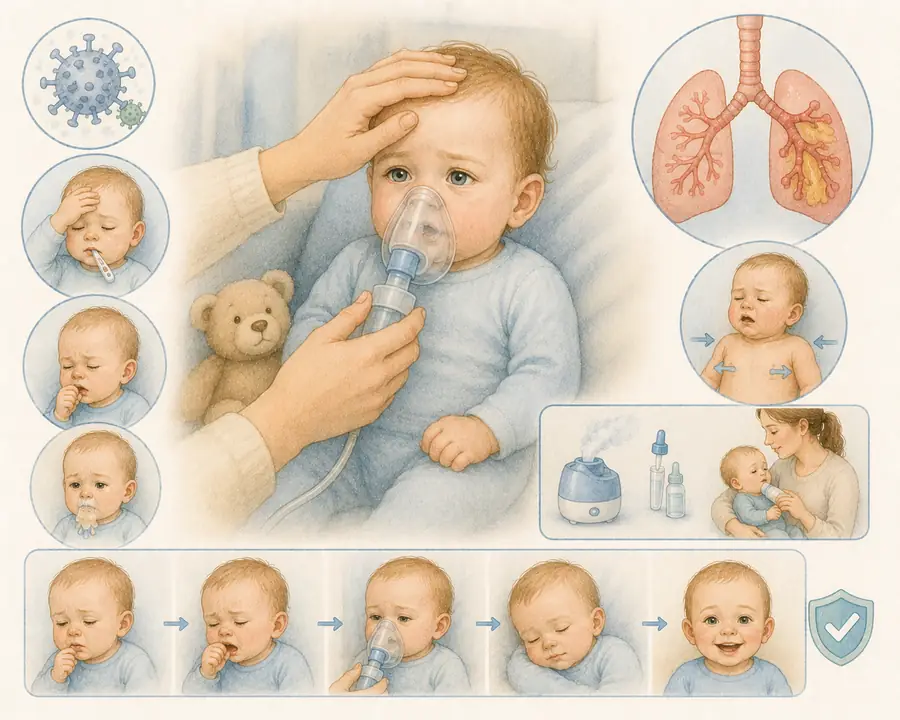
Any parent who has watched a baby breathe fast and wheeze with every breath knows how frightening that picture can be. In the first year of life, the most common cause of it is RSV, and the illness that follows when the virus reaches the deeper airways is called bronchiolitis (NHS, 2023).
RSV and bronchiolitis in babies, in short:
- RSV (respiratory syncytial virus) is the most common cause of lower-airway infections in infants and young children.
- Bronchiolitis starts like an ordinary cold, then moves into a cough with fast, labored breathing.
- Most babies recover at home within 1–2 weeks; only a minority need hospital care.
- Red flags that mean call now: ribs pulling in, bluish lips, pauses in breathing, very poor feeding.
- Antibiotics do not help, because the cause is a virus, not bacteria.
This article is here so you know what to watch, how to help your baby at home, and, maybe most important, when to stop waiting and call the doctor.
Quick reference: RSV and bronchiolitis
| What | Details |
|---|---|
| Cause | Respiratory syncytial virus (RSV), sometimes other viruses |
| Typical age | Hardest in the first 6 months; possible up to age 2 |
| Season | Fall and winter (October–April) |
| Course | 1–3 days cold, then 2–5 days cough + labored breathing, recovery in 1–2 weeks |
| Care | Fluids, nose clearing, more upright position; hospital if dehydration or severe symptoms |
| Antibiotics | No; no effect on a viral infection |
| Higher-risk babies | Premature, under 3 months, heart or lung conditions |
What RSV and bronchiolitis actually are
RSV is a virus that circulates every winter, and by age two almost every child has caught it. In older kids and adults, RSV passes as a regular cold. But in babies, especially those under six months, the virus can reach the small airways (bronchioles) and cause bronchiolitis: inflammation and swelling of the tiny tubes that carry air into the lungs (WHO, 2024).
Swelling and mucus narrow tubes that are already tight, so the baby has to work harder to pull in air. That is where the fast, visibly "harder" breathing comes from. The body is working more, but in most cases that is a protective response, not an immediate danger.
Bronchiolitis is not the same illness as bronchitis (inflammation of the larger airways) or pneumonia, though all three can develop as complications of RSV.
How the illness progresses
Bronchiolitis unfolds in phases, and it helps to know what is normal on which day.
Days 1–3, the cold picture. A runny or stuffy nose, a slightly raised temperature, maybe a smaller appetite. It is hard to tell what makes this a "different" cold, and often it isn't different yet. Only over the next few days does it become clear whether RSV has reached deeper.
Days 2–5, bronchiolitis in full swing. The cough gets more frequent and sharper. Breathing speeds up. You may hear a whistle or wheeze on the way out, a sound clinicians call wheezing. The baby may be irritable, feed less (because sucking and breathing at once is hard), and sleep in short bursts. The fever is usually moderate.
Days 5–7 and on, the turn. Symptoms slowly start to ease. The cough can hang on another week or two, and that is normal: it is the airways clearing. Total time to recovery is most often 12 to 14 days from the first symptoms (NHS, 2023).
Respiratory viruses have taught me how different three kids can be. My eldest was the one who scared me. The first cough of a cold was my early warning: I knew that by nightfall the cough would take over and she'd be working hard to breathe, and the nights were always the worst, some of them she couldn't sleep at all. It was never wheezing or asthma. A pulmonologist checked her over, found nothing unusual, and eventually prescribed an inhaler that opens the airways, which is what got her through the hardest nights. This year, finally, it has eased.
The same winter virus never read the same in our house. My eldest would cough herself to the edge of gagging. One of the twins, a boy, would sometimes bark like a little seal, more his voice box than his chest. The other twin sailed through untouched. Same virus, three children, three completely different illnesses. It's why I stopped judging a cold by the cough and learned to watch the one thing that actually matters here: the breathing, and how the nights go.
Caring for your baby at home
Treating bronchiolitis at home is not passive waiting. There are concrete things that help, and a few you should not do.
Fluids, smaller and more often. Fluids are the priority. If your baby breastfeeds or takes a bottle, offer more often in smaller amounts. A baby who cannot drink is a sign that should not pass without a checkup.
Clearing the nose. Saline (drops or spray) and a soft bulb syringe help the baby breathe without having to mouth-breathe. A small nose that breathes more freely means a baby who can drink.
A more upright position. A slightly raised head (for example, prop the bassinet or wedge one side of the mattress with something stable) makes breathing a little easier. Do not put pillows inside the crib. Achieve the upright angle by lifting under the mattress, not inside the sleep space. Babies, especially under 6 weeks, should sleep on their backs with nothing soft in the crib, the same safe-sleep rule covered in our guide to surviving the first night home with a newborn.
Track temperature and breathing. Do you know the normal number of breaths for a baby this age? Newborns normally breathe 40–60 times a minute, babies in the first year 30–40. More than 60 breaths a minute at rest is a sign to have checked.
What NOT to do
- Don't give antibiotics unless a doctor confirms a bacterial infection. Bronchiolitis is viral, antibiotics have no effect on it, and they can cause digestive upset. If your baby has been on antibiotics for something else, it helps to know whether babies need probiotics after antibiotics.
- Don't give cough or decongestant medicines to children under 2 without a doctor's advice. These medicines are not approved for that age and can be dangerous.
- Don't smoke around the baby or in any space the baby comes into. Tobacco smoke clearly worsens symptoms and slows recovery.
- Don't reach for a bronchodilator inhaler without a checkup first. In bronchiolitis they often don't help the way they would for asthma, and a doctor needs to make that call.
- Don't wait if you see the warning signs described below.
When to call urgently or go to the ER
These symptoms need an urgent checkup. Not tomorrow's appointment, but now:
- Ribs or the soft tissue between them pulling in with every breath, visible to the naked eye while the baby breathes
- Nostrils flaring on the in-breath as a sign of extra effort
- Bluish lips, tongue, or fingertips, which can mean poor oxygenation
- Pauses in breathing (apnea), where the baby stops breathing for a moment; especially dangerous in newborns and premature babies
- More than 60 breaths a minute at rest
- The baby can't drink or has taken far less than usual. Dehydration develops fast in babies; fewer wet diapers than normal is an early sign
- The baby seems very floppy, not reacting normally to your voice or touch
- Symptoms worsen quickly instead of slowly easing
If you are not sure whether something is urgent, the rule holds: for any concern in a baby under 3 months, call the doctor. Pediatricians would rather examine a baby who turns out fine than miss something. For more on when to watch a temperature and cough calmly and when to call, see fever and cough: when to monitor and when to call the doctor.
Who is at higher risk
Bronchiolitis hits harder in:
- Premature babies (especially born before 32 weeks), because their lungs are less developed
- Babies under 3 months, whose immune system is not fully built yet
- Children with congenital heart disease or chronic lung disease (for example, bronchopulmonary dysplasia)
- Children living with smokers or exposed to polluted air
For high-risk children, in some cases a preventive antibody (palivizumab) is recommended. That is a conversation with a neonatologist or pediatrician, not something you buy at the pharmacy.
Prevention
There is no RSV vaccine for the general child population (there are protection programs for high-risk babies), but you can cut exposure a lot:
- Wash hands often, yours and everyone who holds the baby; RSV spreads by droplets and on hands (HealthyChildren.org/AAP, 2023)
- Avoid crowds and sick people in the baby's first weeks, especially in virus season
- Disinfect surfaces we touch often (phone, fridge handle, door handles)
- Don't smoke and don't let others smoke near the baby
- Breastfeeding, antibodies in breast milk help newborns fight infections more easily
Like vaccination, RSV prevention is not a one-time act. It is small habits that add up.
Frequently asked questions
Is bronchiolitis the same as bronchitis?
No. Bronchitis is inflammation of the larger airways (bronchi), while bronchiolitis affects the much smaller airways (bronchioles) deep in the lungs. Bronchiolitis is typical of babies; bronchitis is more common in older children and adults.
How long is my baby contagious?
RSV spreads while symptoms are present, usually 3–8 days from the start, and in young infants up to 4 weeks. Handwashing and avoiding close contact with other children during that window reduces spread.
Can my baby go to a well-child visit with bronchiolitis?
Call your pediatrician and describe the symptoms. They will tell you whether to move the appointment or come in now. Non-urgent visits are usually rescheduled until the baby is well. It helps to come with notes on symptoms and how long they have lasted, much like the prep in our first night home with a newborn guide.
Can a baby get bronchiolitis more than once?
Yes. An RSV infection does not give lasting protection, so it is possible to get sick more than once, sometimes even in the same season. Each later infection usually passes more easily as the immune system matures.
If my baby eats poorly while sick, should I worry about weight?
There is no reason to panic if a baby loses a little weight during an acute illness. Appetite usually returns right after recovery. If the loss drags on, that is a reason to talk to the pediatrician. For more on when poor appetite needs watching, see baby not eating much: when to worry, what to do.
Is it normal for a cough to last weeks after bronchiolitis?
Yes. A cough lingering 2–4 weeks after the acute phase is common and usually means the airways are still recovering. If the cough does not stop after 4 weeks, or it gets worse, it is worth a checkup.
How KidyGrow helps you
Bronchiolitis is an illness where one thing matters most: watching how your baby breathes and drinks, and having something to compare against. Did the baby drink as much today as yesterday? How many wet diapers were there last night?
KidyGrow remembers that thread without you having to keep a chart. When your baby gets sick, the app already knows how much they ate and slept over the past few days, and it can show you whether something actually changed or it just feels worse than it is. If, night after night, you note the portions and how sleep went, then before that morning phone call to the pediatrician you have a concrete picture instead of a vague "it seems like she's eating less."
Sometimes the app won't find anything useful. The baby is fine and the symptoms pass. But when your heart is racing at 3 a.m. while you count breaths per minute, the difference between "maybe I'm imagining it" and "it's 58, last time it was 42, and that one passed in a day" is what either steadies you or sends you for help in time.
The app does not diagnose and does not replace a pediatrician. But it remembers the details an exhausted parent can't, and it gives you a base for a conversation with the doctor that takes a minute, not ten.
If you want to walk in even more prepared, our guide on preparing for a pediatric visit with your child's data covers what to bring and how to organize it before an illness like this one shows up.