 Kidy
- Fear of the dark is common. In one study of children aged 4 to 12, 73% reported nighttime fears, and their parents underestimated how often it happened (Muris et al., 2001).
- The content changes with age: the dark itself and being alone for toddlers, monsters and ghosts around 4 to 6, burglars and "something bad happening" in the early school years.
- What helps: a short, predictable bedtime, a very dim light, check-ins you promise and keep, and talking about the fear during the day.
- Get it checked when the fear spreads into the day, keeps getting worse, or started right after something frightening happened.
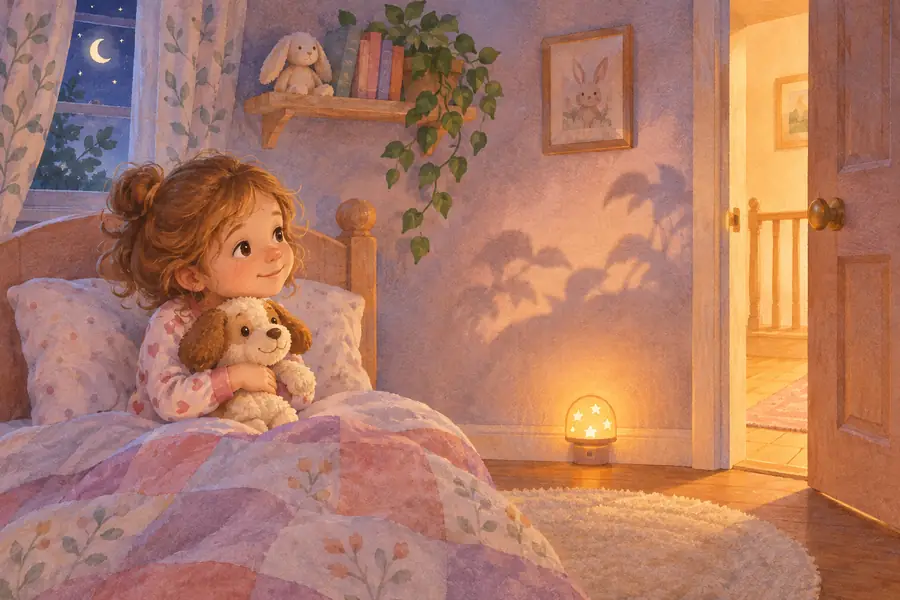
Fear of the dark usually arrives without warning. A child who went to bed happily for months suddenly needs the door open, the hall light on and one more check under the bed. It is rarely a sign that something is wrong. It is mostly a sign that your child's imagination has outgrown their ability to switch it off.
Quick reference
| Age (roughly) | What the fear is usually about | What tends to help |
|---|---|---|
| 2–3 years | The dark itself, being alone, you leaving | A short routine, a dim light, your voice from the hallway |
| 4–6 years | Monsters, ghosts, shapes in the shadows | Taking the fear seriously, a "guard" toy, checking together once |
| 6–8 years | Burglars, fire, something bad happening to you | Facts, a plan, less scary content before bed |
The ages overlap. Plenty of seven-year-olds still check the wardrobe.
Why does fear of the dark start?
Two things grow at the same time in the preschool years: imagination and the ability to picture what you can't see. Fears that a child describes through monsters and shadows tend to come later, as imagination grows. A three-year-old can fill the dark in seconds.
The line between "made up" and "real" is also still being drawn. In a study of 4- to 6-year-olds, children with severe nighttime fears were more likely to confuse fantasy and reality than children without them, and the gap was larger in the younger ones (Zisenwine et al., 2013). Telling a four-year-old that monsters aren't real is true. It just doesn't reach the part of them that is scared.
Where do the specific fears come from? When school children in the Muris study were asked, almost 80% traced their fear to something they had heard or seen, for example a scary story or a film (Muris et al., 2001). Frightening experiences mattered less often than you might guess.
What fear of the dark looks like at each age
Two to three. Often the fear has no words yet. It shows up as stalling, calling out "one more time", crying when you leave, or suddenly wanting your bed. At this age it overlaps heavily with separation: the dark is where you aren't. If bedtime has turned into a negotiation, our piece on toddlers stalling bedtime covers the part that is about limits rather than fear.
Four to six. This is the monster age. Shadows become shapes, the coat on the door becomes a person. Children can now describe the fear in detail, and the detail can be vivid. December adds its own cast, and if Krampus or a department-store Santa is the trigger, see what to do when a child is scared of Krampus or Santa.
Six to eight. Monsters fade and real-world dangers move in: burglars, fire, a parent getting ill. In the Muris study nighttime fears were common at 4 to 6 and even more frequent at 7 to 9. Among 8- to 16-year-olds, fear of intruders was the most frequently reported nighttime fear, and children reported nighttime fears more often than adolescents (79% vs 49%) (Gordon et al., 2007). So "my eight-year-old suddenly can't fall asleep alone" is not a step backwards. The fear has simply grown up.
The night light question
A light helps many children, and the AAP's HealthyChildren site says plainly to let a frightened child keep a light on if it makes them feel better (HealthyChildren.org). The catch is brightness.
Here is the part most parents don't expect. When researchers exposed 3- and 4-year-olds to an hour of light before their usual bedtime, melatonin, the hormone that helps the body get ready for sleep, was suppressed at every brightness tested. Even in the dimmest group, at 5 to 40 lux, it was on average about 77.5% lower than in the dim-light control condition (Hartstein et al., 2022). Two things are worth keeping in mind. Melatonin is a signal, not a measure of how well or how long a child sleeps. And the study looked at the hour before bed, not at a light left on all night. How much light actually reaches the eyes depends on distance, position and direction, so a faint light low by the floor is a different thing from a lamp beside the pillow. If a night light helps your child settle, there is no reason to take it away. The lesson is simpler: young children are sensitive to evening light, so keep the evening dim.
In practice:
- keep the last hour before bed dim, not just the moment of lights-out
- choose the faintest light that still settles your child, placed low and away from the face
- a door left open onto a softly lit hallway often works as well as a lamp in the room
What helps
Take the fear seriously, then shrink it. "I can see you're scared. I'm right here, and I'll keep you safe" works better than an argument about whether monsters exist. HealthyChildren also suggests checking whether something specific is scaring your child, like a shadow, and dealing with that one thing (HealthyChildren.org). Move the coat. Close the wardrobe.
Talk in daylight. Bedtime is the worst moment to reason. At breakfast your child can draw the monster, give it a silly name, or tell you what would make the room feel safer.
Keep the routine short and the same every night. Bath, pyjamas, book, light, goodnight. Predictability does a lot of the calming. Our step-by-step toddler bedtime routine has a version you can copy.
Promise check-ins and keep them. "I'll come back to check on you after I've loaded the dishwasher." Then come back, before your child calls. A child who knows you'll return doesn't need to keep calling to make sure you're still there. Over the following nights, the gaps can get a little longer.
Give your child a job. In a randomized study of 104 four- to six-year-olds with significant nighttime fears, children were given a puppy doll. One group was asked to look after it, the other was told the doll would protect them. Both versions reduced the fears, more than in a waiting-list group after a month, and the improvement held at six months (Kushnir & Sadeh, 2012). A stuffed animal on night duty is not a silly trick. It has data behind it.
Watch the evening screen. A film that was fine at 4pm can be the monster at 8pm. Our guide to screen time by age covers the evening part.
Monster spray: yes or no?
We found no direct study of monster spray, so there is no evidence that it helps. If you use one, don't present it as protection from real monsters: a spray that "kills monsters" quietly confirms there are monsters to kill. Some families call it "sleepy spray", a small bottle of plain water your child sprays as part of the routine, and keep the message to "there's nothing here, and I'm close by".
What doesn't help
- Mocking or shaming. "Big kids aren't scared of the dark" teaches your child to hide the fear, not to lose it.
- Forcing it. Closing the door and turning off every light to "get used to it" usually makes the next night harder.
- A nightly monster hunt that keeps growing. One quick look together is fine. Checking under the bed, then the wardrobe, then behind the curtains every night turns the search into the ritual.
- Long talks at lights-out. Keep it brief and warm, and save the real conversation for the morning.
Joining you in your bed is a separate decision. Some families are fine with it for a while. If you want to move back to separate beds, how to stop co-sleeping walks through it gently.
Is it fear of the dark, or a nightmare?
They often get mixed up. Fear of the dark happens before sleep: your child is awake, scared, and can tell you about it. A nightmare wakes a child up later in the night with a clear memory of the dream. Night terrors are different again: a child who screams but isn't really awake. If your child wakes frightened in the middle of the night, read night terrors vs nightmares and, for wakings in general, night wakings after age 2.
When fear of the dark is more than a phase
Most of it fades. The NHS lists the dark among the common fears of early childhood and says these fears usually go away gradually on their own (NHS). It also says when anxiety becomes a problem: when it starts to get in the way of everyday life, or is very strong, getting worse and not going away.
In the Muris study, nighttime fears were linked to one or more anxiety disorders in about 10% of the children. That is the minority, but it is not nobody.
Talk to your pediatrician if:
- the fear spreads into the day, or new fears keep adding on
- your child skips ordinary things because of it
- it began suddenly after a frightening event, like an accident, a burglary or a loss in the family
- sleep is so disrupted that your child is exhausted during the day
Your pediatrician can rule out other causes and, if needed, refer you to a child psychologist. Short, structured programs exist for children whose nighttime fears have tipped into something bigger. In one small study, a four-week program built around reading a book together helped eight of nine children with a diagnosed fear of the dark (Lewis et al., 2015). For the wider picture of what's typical in early childhood behavior, see our guide to toddler behavior.
Frequently asked questions
At what age does fear of the dark usually start?
Many children start to fear the dark somewhere around two to three, when imagination takes off. It often peaks in the preschool years, though the content changes rather than disappearing. Some children never show it at all, and that is normal too.
Should I leave a night light on all night?
If a light helps your child settle, use one, but keep it as dim as possible and out of their direct view. Young children are very sensitive to evening light, so the bigger win is keeping the whole last hour before bed dim. A softly lit hallway with the door ajar is often enough.
Is monster spray a bad idea?
We found no direct study, so there is no evidence it helps. If you use something like it, don't present it as protection from real monsters. Calling it "sleepy spray" and keeping the message to "there's nothing here, and I'm close by" avoids confirming that monsters exist.
Should I let my scared child sleep in my bed?
It is a family decision, not a mistake either way. If you do, decide in advance whether it is a one-night comfort or a new arrangement, because children notice the difference. If you'd rather not, sit by their bed for a few minutes instead and use check-ins.
How long does fear of the dark last?
For most children it comes and goes over months, often flaring after a scary story, a move or a new sibling. The monster stage usually fades by early school age, but fears about real dangers can follow. A fear that grows steadily for weeks is worth mentioning to your pediatrician.
Can fear of the dark be a sign of anxiety?
Usually not. It is one of the most common fears of childhood. It becomes a concern when it spreads to the daytime, comes with many other worries or physical complaints, or stops your child from doing ordinary things.
How KidyGrow helps you
Fear of the dark rarely arrives on a calm week. It turns up after a cousin's ghost story or the week the room changed, and by the fourth evening of calling out nobody remembers when it started.
In KidyGrow you log the rough bedtime in a couple of taps. The Tonight plan takes the last 24 hours into account, so a bad evening yesterday changes what it suggests for tonight. Tell Grow what helped, the dim lamp or the door open a hand's width, and the app remembers it for later answers.
It won't tell you why your child is scared. Some weeks there's no clear reason at all.
Sources
- Muris P, Merckelbach H, Ollendick TH, King NJ, Bogie N. Children's nighttime fears: parent-child ratings of frequency, content, origins, coping behaviors and severity. Behav Res Ther. 2001;39(1):13-28.
- Gordon J, King N, Gullone E, Muris P, Ollendick TH. Nighttime fears of children and adolescents: frequency, content, severity, harm expectations, disclosure, and coping behaviours. Behav Res Ther. 2007;45(10):2464-72.
- Zisenwine T, Kaplan M, Kushnir J, Sadeh A. Nighttime fears and fantasy-reality differentiation in preschool children. Child Psychiatry Hum Dev. 2013;44(1):186-99.
- Kushnir J, Sadeh A. Assessment of brief interventions for nighttime fears in preschool children. Eur J Pediatr. 2012;171(1):67-75.
- Hartstein LE, Behn CD, Akacem LD, Stack N, Wright KP Jr, LeBourgeois MK. High sensitivity of melatonin suppression response to evening light in preschool-aged children. J Pineal Res. 2022;72(2):e12780.
- American Academy of Pediatrics, HealthyChildren.org. Nightmares and Night Terrors.
- Lewis KM, Amatya K, Coffman MF, Ollendick TH. Treating nighttime fears in young children with bibliotherapy: evaluating anxiety symptoms and monitoring behavior change. J Anxiety Disord. 2015;30:103-12.
- NHS. Anxiety in children.