 Kidy
Kidy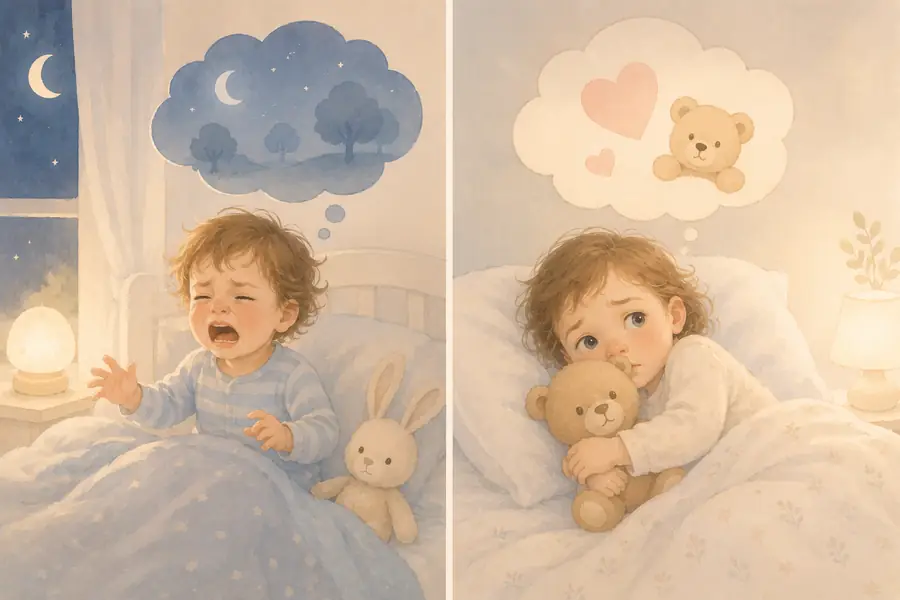
Both look scary at 2 a.m., but they are completely different events with completely different responses. Quick orientation:
🌙 Map out the day: enter your baby's age in the sleep schedule calculator for naps and a bedtime that fit their rhythm.
- Night terrors happen in the first 1–4 hours of sleep, during deep non-REM stage. Your toddler screams, sweats, kicks, and is not awake. They will not remember it (AAP, 2024).
- Nightmares happen in the second half of the night, during REM sleep. Your toddler wakes up actually awake, scared, and remembers the dream.
- Night terrors peak between ages 3 and 7 and affect about 30–40% of children at least once; about 3–6% have them frequently (NHS, 2024).
- Nightmares are much more common. Roughly half of children ages 2–6 report at least occasional nightmares; weekly nightmares affect about 5%.
It took me a long time to understand what was happening to my firstborn at night. It all blurred out of plain daytime overtiredness into something else, and I genuinely couldn't tell where one ended and the other began. So this guide walks the differences, the right response for each, what triggers them in toddlers, and the red flags that mean stop home strategies and call the pediatrician.
Quick Reference: Night Terrors vs Nightmares
| Feature | Night terror | Nightmare |
|---|---|---|
| When it happens | First 1–4 hours after falling asleep | Second half of night / early morning |
| Sleep stage | Deep non-REM (stage 3) | REM |
| Is the child awake? | No: eyes may open, but unresponsive | Yes: fully awake and oriented |
| Remembers it next morning? | No | Yes, often vividly |
| What helps in the moment | Stay nearby, don't wake them | Comfort, reassure, light on briefly |
| Typical age range | 3–7 years (rare under 18 months) | 2–6 years and up |
| Frequency that's "normal" | A few per year | A few per month |
What's actually happening in the brain
Sleep alternates between non-REM and REM cycles every ~90 minutes. The deep, slow-wave non-REM stage dominates the first third of the night, and that's where night terrors live. The brain partially wakes. Autonomic systems fire (heart rate, sweating, vocalizations) but conscious awareness does not. From the outside it looks like terror. The child is biologically not in distress and won't remember it (Petit et al., 2015).
REM sleep, where dreaming and nightmares happen, is concentrated in the second half of the night. By the time most nightmares occur, your toddler has been through their deepest sleep and now cycles closer to waking. That's why a nightmare ends with a real, awake, frightened child, and a night terror does not.
How to tell which one is happening
Walk this list mid-event:
- Time on the clock. Before midnight in most households = likely night terror. After 3 a.m. = likely nightmare.
- Are eyes open with no recognition? Open eyes, child looks through you, doesn't respond to their name → night terror.
- Can you comfort them? Comfort doesn't reach a night-terror child. Comfort works almost instantly for a nightmare.
- In the morning, do they remember? Night terrors leave zero memory. Nightmares often produce a story ("the dog with big teeth").
- Physical signs. Sweating, racing heart, dilated pupils, thrashing → night terror. Tears, clinging, talking → nightmare.
The lightbulb came on only when I caught the pattern. It never happened at her daytime nap or at daycare, only in the first hours of the night. She would be inconsolable for a while, then simply settle and sleep through to morning. The strangest part was the morning: she had no idea what I was talking about. She would cry and I had no clue what to do, so I did the one thing you should never do. I tried to wake her.
If you're still unsure: video a 20-second clip on your phone (parents often do this). Show your pediatrician. The difference is usually obvious to a trained eye.
What to do during a night terror
Whatever else you do, don't try to wake them. I learned this the hard way. Forcing wakefulness during deep non-REM extends the episode and can confuse a child into a longer, more agitated state.
- Stay in the room. Make sure they don't fall off the bed or hurt themselves on the rails.
- Speak softly or not at all. A calm presence is enough.
- Don't turn bright lights on.
- The episode typically resolves in 5–15 minutes. The child returns to quiet sleep on their own.
- In the morning, don't bring it up. Talking about it scares the child even though they don't remember it.
What to do after a nightmare
Here the rules flip. The child is awake, is scared, and will remember.
- Go in, turn on a low light, sit on the bed.
- Validate the fear without acting alarmed yourself ("That sounded really scary. You're safe. I'm here.").
- A short factual anchor helps: "It was a dream. Your room is here. The dog is in your story, not your room."
- Don't promise it won't happen again. Promise that you will be there if it does.
- Stay until the child is calm and drowsy. Avoid moving them to your bed if you can. Once that pattern starts, ending it later is harder. See toddler needs parent to fall asleep every time.
What triggers them in toddlers
Both:
- Being overtired. Insufficient daytime sleep is the single biggest trigger for night terrors. This is exactly why my firstborn's episodes blurred out of plain daytime overtiredness; on the days she skipped or fought her nap, the night went sideways. See the wake windows by age chart and when do toddlers stop napping.
- Disrupted routine: travel, illness, a new sibling, daycare transitions.
- Fever and certain medications.
- Sleep apnea or restless legs. Frequent night terrors in toddlers are sometimes the visible sign.
Nightmares specifically:
- Scary content before bed (a TV show, a story, a real event at daycare).
- Anxiety about a real-life thing (potty training, a new room, a parent's stress).
- Developmental imagination leap around ages 2.5–4, when "what if" thinking emerges.
If hourly wake-ups are also part of the picture, that's a separate problem. See why baby wakes up crying at night.
Common mistakes parents make
- Shaking the child during a night terror to "snap them out of it." This extends the episode and can produce real fear when the child finally surfaces.
- Removing the nightlight after a nightmare. Many toddlers are reassured by a soft light. Insisting on a dark room because "they should learn" backfires.
- Discussing the nightmare in detail at bedtime the next night. Re-activates the imagery right before sleep. Talk about it in the morning if at all.
- Cosleeping "just tonight" after every nightmare. A pattern can form within 3–5 nights. If you need cosleeping for safety or sanity, fine. Pick the rule and stick to it.
- Assuming all night-time crying is a nightmare. A toddler waking and crying at night might be teething, an ear infection, a wet diaper, or overheating. And a baby who wakes up screaming suddenly often has a different cause than a true night terror.
When to seek professional help
Call the pediatrician (not a sleep consultant) if any of these apply:
- Night terrors happen more than twice a week for more than a month.
- Episodes last longer than 30 minutes or include sleepwalking with injury risk.
- Snoring, gasping, mouth-breathing, or pauses in breathing during sleep. These can point to obstructive sleep apnea, which is treatable.
- Daytime behavior changes: irritability, exhaustion, loss of interest in play.
- The child has injured themselves during an episode.
- Nightmares are tied to a real traumatic event (a fall, a hospitalization, a frightening experience).
Frequently asked questions
At what age do night terrors usually start and stop?
Most begin between ages 3 and 4, peak around 5–6, and resolve by 8–10. About 50% of children who have night terrors stop by puberty; the rest do by adulthood. They are uncommon in children under 18 months.
Are night terrors a sign of something psychologically wrong?
No. Night terrors are a developmental sleep variation, not a psychological symptom. The AAP and major sleep medicine bodies treat them as a normal (if scary-looking) variant. Trauma or anxiety can worsen frequency but rarely causes them.
Should I wake my toddler before a predicted night terror to prevent it?
"Scheduled awakenings" (waking the child 15–30 minutes before the usual terror time for 7–10 nights) can work for very frequent terrors. Discuss with your pediatrician before trying it; it's a last-resort tactic, not a first move.
Are nightmares more likely if my toddler watches TV before bed?
Yes, especially screens within an hour of bedtime and any content with chase scenes, monsters, or jump-scares. Even "kid" content can trigger nightmares in highly imaginative 3–5-year-olds. Pull screens 60–90 minutes before bed and stick to slow, predictable stories. For full bedtime help, see the baby sleep guide 0–2 years.
My toddler used to sleep great and suddenly has nightmares every night. What changed?
Common triggers: a new room, a new sibling, daycare start, a parent's stress, an illness, a frightening event (a fall, a stranger's dog), a developmental leap around 3 years. If you can identify the trigger, name it gently in the daytime and the nightmares usually fade within 2–4 weeks.
Can a toddler have both?
Yes. A child going through a tired, disrupted phase can have a night terror at 11 p.m. and a nightmare at 4 a.m. of the same night. Treat each as its own event with the response for that type.
How KidyGrow helps
The thing I couldn't do back then was hold the whole picture in my head. An exhausted parent can't track 14 nights of naps and bedtimes and screaming spells across a fog of broken sleep. The app does. That's most of the job. KidyGrow learns your child specifically: their actual wake windows, what time they fell asleep on nights when terrors happened, how the daytime nap went on event days. It adjusts the tonight plan from that real history instead of from an average toddler.
Here's what that looks like. You log a week of sleep and mark the two nights that included a terror. By the end of the week the app may notice that both terror nights followed a skipped nap and a bedtime after 8:30 p.m. The Tonight plan then flags an earlier bedtime, suggests reinstating the rest-period if your toddler is dropping the nap, and prompts the wind-down ritual you already use. Plain words, not generic "follow wake windows" advice.
It needs 3–5 days of logged data first. Night one's plan is age-based; by night four or five it's tuned to your child. And sometimes it won't find a clean pattern at all, because some weeks really are just illness and chaos. But when there is a thread to catch, the app catches it before a tired parent would.
For broader sleep troubleshooting, see nothing helps my toddler sleep and the wake windows by age chart.
I wish I'd had then what I know now.
- Marija, KidyGrow
Sources
- American Academy of Pediatrics (AAP). Nightmares and Night Terrors. https://www.healthychildren.org/English/ages-stages/preschool/Pages/Nightmares-and-Night-Terrors.aspx
- NHS, 2024. Night terrors and nightmares. https://www.nhs.uk/conditions/night-terrors/
- Petit D, Pennestri MH, Paquet J et al., 2015. Childhood Sleepwalking and Sleep Terrors: A Longitudinal Study of Prevalence and Familial Aggregation. https://pubmed.ncbi.nlm.nih.gov/25938617/
- American Academy of Pediatrics. Healthy Sleep Habits for Children. https://www.healthychildren.org/English/healthy-living/sleep/Pages/default.aspx
- American Academy of Sleep Medicine, 2006. Behavioral Treatment of Bedtime Problems and Night Wakings in Infants and Young Children. https://pubmed.ncbi.nlm.nih.gov/17068979/