 Kidy
- Very common at 4–8: the AAP notes that in the early school years a child's wish to do well is especially strong.
- Cheating and changing rules are a normal part of how young children play games, not a sign of bad character.
- Games that are too hard make it worse: children cheat or invent rules when a game is beyond them.
- Luck-based games are often a good place to start, because nobody can be blamed for a dice roll. Cooperative games work just as well.
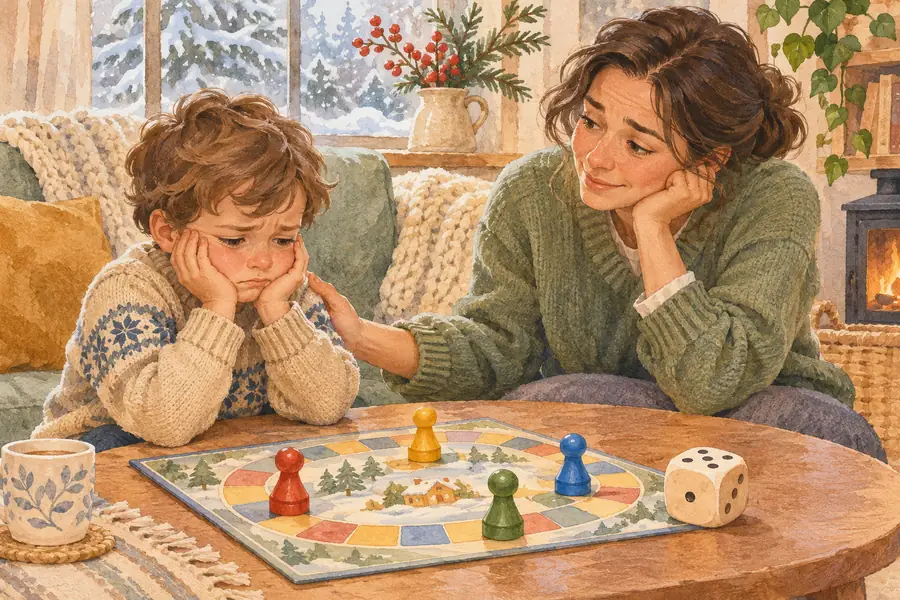
The board goes flying. Or the cards get swept off the table, or your 5-year-old announces that this is a stupid game and storms off, three moves from the end. Sometimes it's quieter: a child who simply refuses to play anything they might lose. Taking losing hard is one of the most ordinary things about this age, and it is also one of the most fixable. Not by making them lose more often. By making losing smaller.
Quick reference: losing at games by age
| Age | What it often looks like | What helps most |
|---|---|---|
| 3–4 | quits, cries, grabs the winning card | very short games, luck only, no score |
| 5–6 | changes rules mid-game, accuses others of cheating, storms off | rules agreed before, a "what we do when we lose" plan |
| 7–8 | sulks, says the game is stupid, avoids games they might lose | talk about effort, play team games, adult models losing |
| any age | worse when tired, hungry or after a long school day | play at a calmer time |
Why do children take losing so hard?
Partly because we taught them to. The AAP puts it bluntly in its piece on competition and cheating: competitiveness is commonplace in our culture and is rewarded, children learn that losing is bad, and especially in the early school years their wish to do well is very strong.
Put that wish next to a brain that is still learning to manage big feelings, and you get the board in the air. A 5-year-old does not lose the game. They lose, full stop, and in that moment it is the whole world.
The tiredness factor is real too. A game after a long nursery or school day starts with an empty tank. If the meltdowns cluster in the late afternoon, it may be less about the game and more about after-school restraint collapse.
Is cheating at games normal?
Mostly, yes. The same AAP article describes a lot of rule-breaking and conflict when young children play games together, and says that as children approach adolescence peers tolerate it much less. Watching a 6-year-old "find" a better card is watching social learning in progress.
Two details from that article are worth more than any rule chart:
- Children cheat, or set their own rules, when the game is too complex for them. If your child cheats at a strategy game meant for 10-year-olds, the game is the problem.
- Pressure feeds it. If a child feels they always have to perform well, cheating can become almost a self-defence. Excessive punishment rarely helps.
So when your child moves their piece two extra squares, a calm "that's not the rule, go back" works better than a lecture about honesty.
The game with the perfect name
Here is the most useful line in that AAP article, and the easiest to act on. Family games where chance is involved can teach children to compete without cheating.
It makes sense once you see it. In a dice game, nobody played badly. You rolled a two. It is losing with the blame taken out, which is exactly the size of losing a young child can practise with.
There is a classic one, the cross-and-circle race game with four coloured pieces and a die. In English it is usually called Ludo. In German it is "Mensch ärgere dich nicht", and the Croatian name says the same thing: roughly, "Don't get angry, man." Generations of grandparents have been handing children the lesson in the title and then watching them get angry anyway. That's fine. Getting angry and then playing the next round is the lesson.
Two honest caveats. Ludo can drag on, and being sent back home three times is brutal for a 4-year-old, so play a short version with one piece each. And not every child finds luck easier: some are most frustrated precisely because they can't influence anything. For them, start with a cooperative game instead.
What to say in the moment
Short is better. A child mid-meltdown can't hear a paragraph.
Name it. "You really wanted to win. It's hard to lose." The AAP's ideas for managing emotions through play recommend exactly this kind of labelling, and suggest a colour-zone language ("how can you get back to green?") instead of "stop being silly", which only makes children feel worse.
Hold the line on behaviour, not on the feeling. Angry is allowed. Throwing pieces at your sister isn't. "You can be cross. You can't throw. Let's take a break."
Leave the lesson for later. The talk about being a good sport works an hour later, on the sofa, not while the dice are still rolling under the fridge.
Lose out loud yourself. The same AAP page says children learn a lot from watching adults do their own emotional problem-solving. So when you lose: "Oh, that's annoying. I really wanted that one. Okay. Another round?" Slightly overacted is fine.
Should I let my child win?
Sometimes, and less over time. Very young children need to win often enough to want to keep playing. But a child who always wins never gets to practise the thing they find hard.
A middle path many families end up on: play games where the adult has a handicap, or team up against the game instead of each other. Cooperative games, where everyone wins or loses together, take most of the sting out and still teach waiting your turn. Play is how children practise this kind of thing anyway, as our piece on play and brain development explains.
The AAP's sports advice points the same way. In Parenting an Athlete it asks parents to redefine success so that disappointments are not taken personally, and in mental skills for sport it says children need to know that a bad game does not make them a bad or worthless person.
A plan for the next two weeks
- Before: pick a short luck-based game and agree the ending out loud. "Whoever loses chooses the next game" works surprisingly well.
- During: narrate small losses calmly, yours included. Praise good moves and good waiting, not only winning.
- After a meltdown: a break, then a return to the game if possible. Coming back is the skill.
- Later that day: one or two sentences about what happened. "You got really angry when I won. Then you came back and played. That was hard."
- Watch for: fewer flying boards, quicker recovery, a willingness to try games they might lose.
You usually don't notice the change on day three. You notice it the evening your child loses, sighs, and says "again".
Common mistakes
Shaming. "Sore loser" sticks. Describe the behaviour, not the child.
Banning games for days after a blow-up. It removes the practice exactly when it's needed. Stopping is different: if pieces are flying or someone isn't safe, end the round, and come back to practising once everyone is calm.
Games that are too hard. If cheating is constant, step down to a simpler game for a while.
Making every game a lesson. Some games should just be fun.
Forgetting your own reaction. A parent who gets visibly tense about losing a card game teaches more than any speech.
When to get help
Most children grow into losing with practice, but some need more support. The AAP says a child with a chronic cheating problem, or one who gets labelled a cheater at school, may need further help, because cheating is often a sign of an internal emotional struggle or peer problems. Talk to your pediatrician or a child psychologist if your child hurts others when they lose, if the reaction is getting stronger rather than weaker over months, or if it has spread from games to every mistake. The AAP's advice on helping children cope with conflict says the same about friendships: if your child keeps having trouble getting along with other kids, talk with your pediatrician.
If losing is one part of a bigger picture of anger, our guide to a child who is angry all the time goes further. If the hard part is that friends stop wanting to play, read when your child says nobody wants to play with them. For the wider picture of behaviour by age, see our guide to toddler behavior.
Frequently asked questions
Is it normal for a 5-year-old to cry every time they lose?
Yes, it is very common at that age. The wish to do well is strong in the early school years and the ability to manage disappointment is still growing. What matters more than the crying is whether your child recovers within minutes and is willing to play again.
At what age do children learn to lose gracefully?
There is no exact age. Many children get noticeably better somewhere in the early school years, especially if they have had plenty of low-stakes practice. Some stay sensitive to losing for longer, particularly children who are hard on themselves in general.
Why does my child cheat at board games?
Usually because the game is too hard or the pressure to win feels too big. The AAP notes that young children often cheat or invent their own rules when a game is too complex for them. Try a simpler game and keep your response calm.
Should I always let my child win?
No, but letting younger children win sometimes keeps them playing. Over time, mix in real losses, cooperative games and games of chance, so your child gets to practise losing in small doses.
What are good games for a child who hates losing?
Short games of pure chance, where a dice roll decides, and cooperative games, where everyone plays against the game together. They let your child lose without anyone being to blame, which is the easiest kind of losing to practise.
When is a sore loser a sign of something more?
When the reaction is violent, when it is getting worse over months instead of better, when cheating is constant, or when every small mistake brings "I'm stupid" or "I'm worthless". Then it is worth talking to your pediatrician or a child psychologist.
How KidyGrow helps you
Was it three meltdowns this week, or did it only feel like ten? After a long day, every board on the floor blurs into the same evening.
In KidyGrow you can log each one as a rough moment or a tantrum in a few taps. Insights then show how many there were over a period and per week, so you can see whether two weeks of dice games actually changed anything. The app also remembers what you tell it about your child, like "hates losing but bounces back fast". The app doesn't link the meltdowns to games for you, and some weeks will just look messy. But you are not guessing anymore, and that makes the next decision calmer.
Sources
- American Academy of Pediatrics, HealthyChildren.org. Competition and Cheating. https://www.healthychildren.org/English/family-life/family-dynamics/communication-discipline/Pages/competition-and-cheating.aspx
- American Academy of Pediatrics, HealthyChildren.org. 4 Play Activities to Help Children Manage Emotions. https://www.healthychildren.org/English/family-life/power-of-play/Pages/play-ideas-to-help-your-child-manage-emotions.aspx
- American Academy of Pediatrics, HealthyChildren.org. Parenting an Athlete. https://www.healthychildren.org/English/healthy-living/sports/Pages/Parenting-an-Athlete.aspx
- American Academy of Pediatrics, HealthyChildren.org. 3 Mental Skills Children Need for Sports. https://www.healthychildren.org/English/healthy-living/sports/Pages/Mental-Skills-Needed-for-Sports.aspx
- American Academy of Pediatrics, HealthyChildren.org. Everybody Gets Mad: Helping Your Child Cope with Conflict. https://www.healthychildren.org/English/healthy-living/emotional-wellness/pages/Everybody-Gets-Mad-Helping-Your-Child-Cope-with-Conflict.aspx