 Kidy
Kidy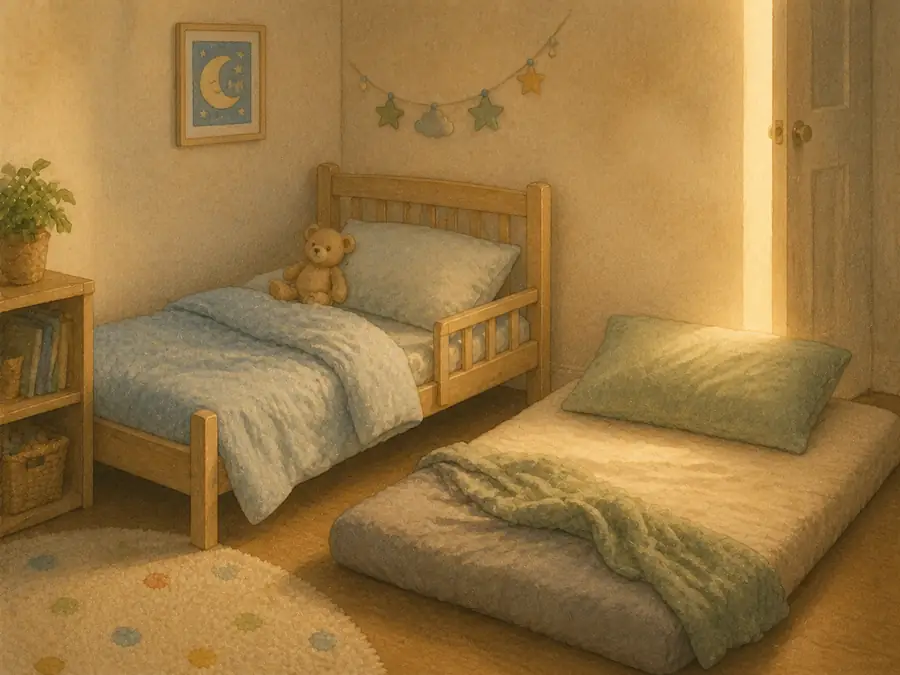
Almost nobody plans to bed-share for two years. It starts during one bad week and then it stays. In our house it stayed a lot longer than that.
What to expect:
- This is a habit, not a behavior problem
- A gradual change is easier for many families to sustain than an abrupt one
- Getting to know the new bed in daylight can make the evening change easier
- A wobble after a few good nights does not mean the plan is failing
- There is no medical deadline for ending bed-sharing
🌙 Start with the schedule: put your child's age into the sleep schedule calculator before you change anything about the bed. An overtired toddler fights every transition.
The hard part is rarely the first fall-asleep. It is the 2am return trip, when a half-awake toddler walks back to the only place sleep has ever happened.
Quick Reference: ending bed-sharing with a toddler
| Question | Short answer |
|---|---|
| Is there a "right" age? | No. Families stop anywhere between the first birthday and school age. |
| How long does it take? | Count in weeks, not nights. With my eldest it took months. |
| Gradual or all at once? | For a child who has never slept alone, gradual is usually easier to hold. |
| What if they walk back at 2am? | Same walk, same short line, every time. |
| Why does it slide back? | Usually because the boundary moves a little at a time, night by night. |
| When to postpone | Illness, teething flare, house move, new sibling, first month of daycare. |
Why this is harder at two than at eight months
An eight-month-old cannot leave the bed. A two-year-old can, and will, and can also argue about it in full sentences. That changes the problem from settling to returning, which is why plans written for babies tend to collapse here.
Behavioral approaches to bedtime resistance and night waking are among the longer-studied topics in pediatric sleep, and the finding keeps repeating: predictability matters more than the specific technique (Mindell et al., 2006). Your toddler is not testing whether you love them. They are testing whether the rule is the same on Tuesday as it was on Monday.
In our house the damage came from exactly that: the rule was not the same. My eldest would slip in during the night and take a little more room each time, and each time we let her, because it was 3am and you have nothing left. The boundary never collapsed in one night. It slid a centimetre at a time, for weeks, and only when the whole thing fell apart did I realize we had never actually made a decision. We just got tired.
Is there a right age to stop co-sleeping?
There is no age at which a pediatrician will tell you it must end. Safe-sleep guidance is strict for the first year, because the risk picture for infants is genuinely different. After twelve months, ending bed-sharing becomes a question of what the family can live with, plus a sleep-quality question.
One cross-sectional study of 276 Spanish children found that those who co-slept during the first year were more likely to fall into the poorer sleep-quality group as preschoolers (Garrido et al., European Journal of Pediatrics, 2024). Read that carefully: it is an association in one sample, not proof that co-sleeping caused it. Families who co-sleep longest are often the families whose children woke most in the first place.
If your child cannot fall asleep without you present anywhere, in any bed, start with the sleep-onset association first. Moving beds while that is unresolved just relocates the struggle.
Introduce the bed first, ask for the night later
Most plans start in the evening, which is the worst possible time to introduce anything new. Start in daylight. Two short sessions a day, five minutes each: books on the new bed, a stuffed animal put "to sleep" there. Five minutes of the two of you lying on it talking about nothing counts too.
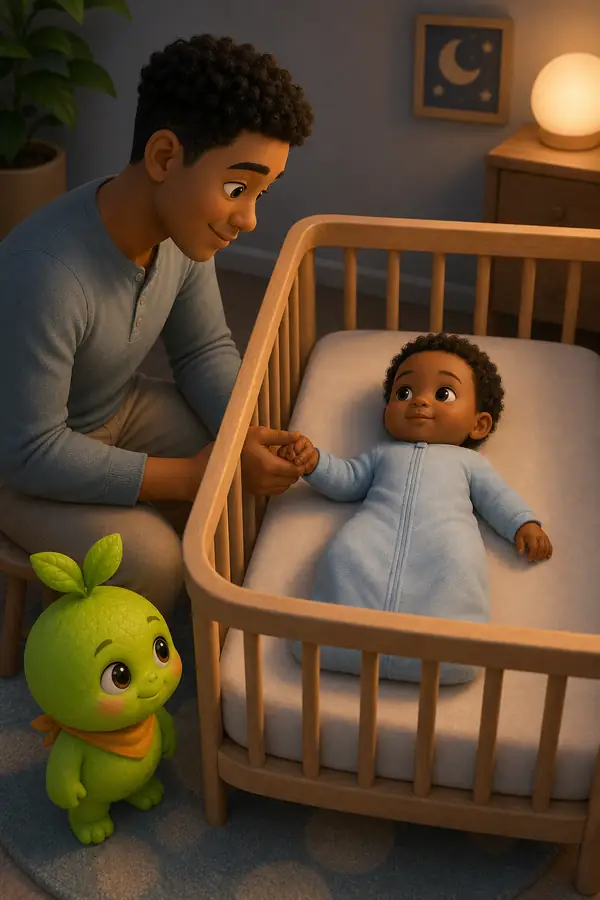
Bring the change in through a story as well. A few evenings before the first night, read Growy and the Very Big Bed together, ideally in the new bed itself. The story was written for the move out of the cot, but the problem is the same one: a bed that suddenly has no edge anywhere. Growy goes through the change before your child has to make it alone, and that is a very different thing from being told that big kids sleep by themselves. The goal is not to talk your child into it. The goal is for the new bed to be a familiar place before you ask them to spend a whole night in it.
You can also try a familiar pillowcase or another object that already belongs to your child's routine. A familiar smell and feel can make a new bed less strange. Just mind your child's age and what is safe to have in the bed, because the rules about what belongs in there are stricter for the youngest.
Our four-stage plan (roughly 10 nights)
This is not a protocol from a guideline. It is the KidyGrow four-stage plan, a practical running order so you are not improvising at 3am. Three nights per stage is not a medical rule. The point is to give your child a few repetitions before the next change.
- Mattress beside their bed. Your child sleeps in their own bed. You sleep on a mattress on the floor next to it. A hand on the back is allowed.
- Mattress moved back. Same room, roughly a metre further away, no touching. Voice only.
- Doorway. You sit or lie in the doorway until they are asleep. Visible, and very boring.
- Goodnight and go. You leave after the routine and come back for a brief check if needed.
Do not advance because one night went well. If your child starts testing the boundary again on the fourth or fifth night, that does not mean the plan is failing.
What to do at 2am when they come back
You will hear the feet before the door. Walk them back without turning on lights, say the same short line every time, tuck, leave. Six words is plenty: "It's still sleep time. I'm here."
Do not negotiate at 2am.
The first return of the night is usually the real one. The second and third are momentum. If your child is verbal enough to escalate ("water", "hug", "my leg hurts"), pre-solve those at bedtime: cup of water on the floor by the bed, one long hug in the routine, socks on if the room is cold. Then the 2am requests have nothing left to attach to.
This is where plans usually fall apart, and not dramatically. You don't give in once and watch it collapse. You give in five small times, and two weeks later you are back at the start with no single night you could point to as the one.
Some nights you will just get back in bed with them. Fine. Start again tomorrow.
Wait or act? The decision
- If your child is ill, in a teething flare, or less than two weeks out from a move, a new sibling, or the first month of daycare → wait
- If bedtime is already long and miserable → fix the timing first, see bedtime refusal
- If night wakings are frequent and unexplained → rule that out first with night wakings after two
- If you are the one no longer sleeping → that is a sufficient reason. Act.
- If you have started and quit twice already → shorten the stages rather than starting from zero again
Here is the part nobody tells you in time: some of this has nothing to do with your method. The same transition went far more easily with our twins, partly because we knew what we would not repeat, and partly because they simply slept better from the start. Same mother, same plan, different children.
Common mistakes
- Starting the week before a holiday, a hotel stay, or grandparents' visit
- Removing the parent, the pacifier and the night bottle in the same week
- Turning on the overhead light during the walk-back
- Offering a snack, which teaches the return trip to pay
- Switching methods after a single bad night
- Judging the plan on a Tuesday when nobody in the house has slept
When to talk to your pediatrician
Snoring most nights, mouth breathing, or pauses in breathing deserve a check regardless of where your child sleeps. So does a child who was sleeping well and suddenly cannot, or weeks of consistent effort with no movement at all. General sleep advice for babies and young children is summarized by the NHS, and the AAP's sleep-habit guidance covers age-appropriate totals.
If the plan is fine but you are not, that counts too. Parental exhaustion is a medical fact, not a character flaw.
Frequently asked questions
How long does it take to stop co-sleeping with a toddler?
Honestly, it depends. Count in weeks rather than nights, and count on longer if you have started and stopped before. With my eldest it took months, precisely because we kept giving a little ground. If you want one number that holds for every child, I don't have it and nobody does.
Is it too late to stop co-sleeping at 3 years old?
No. Older toddlers and preschoolers often go faster, because you can explain the plan and involve them in it. Let a three-year-old choose the pillowcase and the order of the routine. What you cannot do is give them a vote on whether the plan happens.
Should we move to a big bed at the same time?
Preferably not. One change at a time. If the crib is already unsafe because they climb, safety wins and you do both, but expect the adjustment to take longer.
What if my child cries the whole time?
Crying with a parent present, responding calmly, is different from being left alone to escalate. Our working rule is this: if the crying is long and intense several nights running, step back one stage rather than pushing through. That is not a medically established cutoff, it is a sign the stage was too big a jump for your child. The research on whether sleep training is safe is worth reading before you decide how much protest you are willing to sit with.
Do we have to be consistent on weekends?
Yes, for the first fortnight. After that, one relaxed night now and then usually costs nothing. Illness, travel and holidays will move things backwards anyway, and re-entry after a bad week is easier the second time.
What if the adult finds it harder than the child?
It happens more often than anyone admits. When our twins arrived, I moved into their room and my eldest stayed with her dad. She needed a short while. He needed a great deal longer, and it was genuinely funny to everyone except him. If the two of you cannot agree on the plan, agree on the script instead: the same words, the same walk back, from whoever goes.
How KidyGrow helps
Nobody remembers night three by night nine. That is the actual problem with a two-week plan run by two exhausted adults.
KidyGrow holds the thread for you. You enter bedtime and the wake-ups, then in the morning you mark whether the plan helped or not. That marking is the whole point: the app remembers what worked for your child and what didn't, and stops suggesting the second kind. Instead of an average, the Tonight plan tells you what changed since yesterday and in which direction, for example that bedtime has drifted about twenty minutes later than last week. For this particular transition that is the single most useful number there is, because the boundary goes exactly that way, in small shifts you don't catch on your own.
When there isn't enough data, the app says so instead of inventing a pattern. In the first few days you get a gentle starter plan and a note asking you to log one more sleep. That was my condition for shipping this at all.
The change parents notice first is not better sleep. It is waking up able to answer the question "was last week actually worse, or did it just feel worse".
Sources
- Mindell, J.A. et al. (2006). "Behavioral treatment of bedtime problems and night wakings in infants and young children." _Sleep_, 29(10). https://pubmed.ncbi.nlm.nih.gov/17068979/
- Garrido, F. et al. (2024). "Association between co-sleeping in the first year of life and preschoolers' sleep patterns." _European Journal of Pediatrics_, 183(5). https://pubmed.ncbi.nlm.nih.gov/38351212/
- American Academy of Pediatrics, HealthyChildren.org. "Healthy Sleep Habits: How Many Hours Does Your Child Need?" https://www.healthychildren.org/English/healthy-living/sleep/Pages/Healthy-Sleep-Habits-How-Many-Hours-Does-Your-Child-Need.aspx
- American Academy of Pediatrics, HealthyChildren.org. "Bedtime Trouble." https://www.healthychildren.org/English/healthy-living/sleep/Pages/Bedtime-Trouble.aspx
- NHS. "Helping your baby to sleep." https://www.nhs.uk/conditions/baby/caring-for-a-newborn/helping-your-baby-to-sleep/
Related: the full picture of naps, schedules and night wakings across the first two years is in our baby and toddler sleep guide.