 Kidy
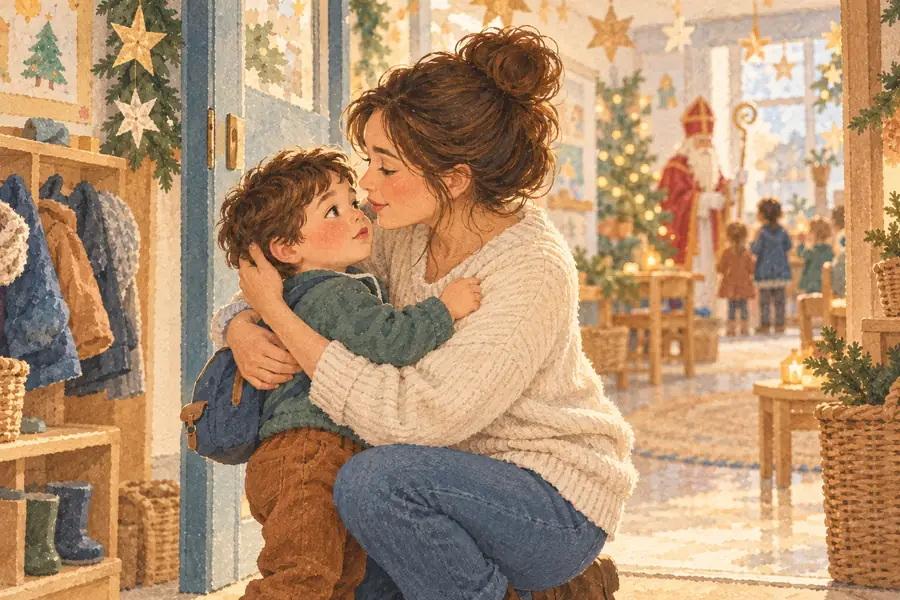
A man in a red suit, or a horned figure rattling chains, and your child goes rigid in your arms. Adults find it funny. At 3, it is not.
- Many young children fear fantasy figures. Four- to six-year-olds often fear monsters, ghosts and similar figures (BIÖG).
- Between about 3 and 5, a costume is not obviously "just a costume." Realistic thinking usually takes over from around 5.
- The most commonly reported source of children's fears is something they were told, not something that happened to them (Muris et al., 2000).
- Never force the lap or the photo. There is always next year.
This article covers both: Krampus and St. Nicholas, which are part of December in Austria, Bavaria, Croatia, Slovenia and nearby, and the Santa visit that most English-speaking families know.
Quick Reference: fear of Krampus and Santa by age
| Age | What is usually going on | What helps |
|---|---|---|
| Under 1 | Strangers and loud noise, not the character itself | Stay close, keep the visit short or skip it |
| 1–3 | A big stranger, a beard, a mask, a crowd | Watch from a distance, no lap, no pressure |
| 3–5 | Magical thinking: the figure can be real and can come back | Talk it through, no threats, a clear "we can leave" |
| 5–7 | Knows it is a person in costume, may still be scared | Let them decide how close to go |
| Any age | Fear spreads into sleep and daily life for weeks | Talk to your pediatrician |
Why a costume scares a 3-year-old
Adults see a man in a suit. A small child sees a stranger who is huge, loud, bearded, and treated by every adult in the room as if he matters a great deal. For many younger children, meeting Santa is simply an unfamiliar experience in a crowded place, with a stranger in a bright red suit, and they are expected to sit on his lap (Lurie Children's).
Krampus asks even more. Horns, fur, a long tongue, chains, a rod. In some places he walks with St. Nicholas into a kindergarten. In others there is a whole Krampus run through the town square at dusk.
Germany's federal public health institute, the BIÖG, describes the years between about 3 and 5 as a magical phase. In a child's mind Santa Claus and the Easter Bunny really do exist, and so do monsters and ghosts (BIÖG). For most children, realistic thinking gradually takes over from around 5. Until then, the honest answer to "is Krampus real?" lands differently than you think. Your child can hear "it's a costume" and still believe the thing inside it is coming for them.
Toddlers need to hear that the scary part is pretend. That is the AAP's advice for Halloween (HealthyChildren.org), and it carries straight over to December. Say it anyway. Just don't expect one sentence to fix it.
What a child hears can feed the fear
One study offers a useful clue. Researchers asked 190 Dutch children aged 4 to 12 where they thought their fears came from. For fears and scary dreams, the children most often named information: something they had heard or been told, rather than something that happened to them (Muris et al., 2000). The same study found that fears of imaginary creatures became less common as children got older. That is what children report, not proof that a fear of Krampus is learned or that someone caused it. Some children are simply scared of a big costume and a lot of noise.
Now think about what a child hears in late November. "If you're not good, Krampus will bring you the rod." "Santa is watching." "You'll get coal." Each one is a small piece of information, delivered by the people the child trusts most, about a figure the child will meet in a few weeks.
Nobody means harm with it. It still adds up.
If you want somewhere to start, this is a good place. Without the threat, the figure is often less frightening. For why threats teach less than adults hope, see natural consequences vs punishment.
Before the visit: prepare without building it up
A day or two before St. Nicholas Day, the kindergarten party or the mall trip, tell your child what will happen. Short and concrete.
- Who comes, what they look like, what they do.
- That a person is inside the costume and takes it off at home afterwards.
- That you will be right there.
- That they do not have to go close, sit anywhere or say anything.
The AAP's tip for Halloween, talking through what is going to happen and reading books about it, works here too (HealthyChildren.org). Pictures of St. Nicholas with his mitre and staff help. For Krampus, a friendly picture book is a gentler first meeting than a video of a Krampus run.
Don't overdo it. Three days of talking about Krampus is three days of thinking about Krampus.
If your child goes to nursery, have a quick word with the teacher too. You could say: "If my child is scared, please don't let Krampus or Santa come close, and no photos, please. Let them collect the treat bag with you or with me."
On the day: you are the safe base
If your child freezes, cries or hides behind your legs, that is information, not misbehavior. Stay close, crouch to their level, and name it: "That's a big costume. You're scared. I'm here."
Then offer a choice that has no wrong answer. Watch from here. Wave from the door. Leave the bag of treats with the teacher. Go home.
Small doses help. Watching other children meet Santa from across the room is already exposure, and small amounts of exposure can make the experience less intimidating (Lurie Children's).
What does not help is the lap. When a frightened child is held out towards a costume for a photo, the moment usually gets scarier and the next meeting gets harder. Stay close and let your child decide how near to go. If a child isn't ready to sit on Santa's lap, there is always next year.
Picture the queue at a shopping centre, forty minutes in, a photographer with a ring light, and a 2-year-old who has gone silent and grey in her father's arms. The family in front got their photo. This one leaves without it, and the afternoon is better for it.
After: when the fear follows them home
Some children are fine at the party and fall apart at bedtime. A figure seen once at 5 p.m. can turn up again at 2 a.m. Scary dreams are common in children: in the Dutch study above, 80% of the 4- to 12-year-olds reported them.
What helps at night:
- Keep the evening ordinary. Same routine, same light, same song.
- Listen first. Let your child tell you what scared them, in their words.
- Don't argue with the fear. "There's nothing there" rarely calms a 4-year-old.
- Give them a role. Some children like to "tell" Krampus to go away, or draw him small and silly.
If the waking turns into night terrors or repeated nightmares, our guide on night terrors vs nightmares helps you tell which one you are dealing with.
For a baby under one, the reaction is usually about the stranger and the noise rather than the figure. That is the same mechanism as ordinary stranger anxiety in babies, and it needs no explanation, only you.
Decision logic: go, adjust or skip?
- If your child is curious and asks questions → go, keep it short, let them choose how close.
- If your child is nervous but wants to go → go together, watch first, agree on a signal for leaving.
- If your child is already scared at the mention → skip the close encounter this year. A window, a distance, a picture book.
- If last year's visit ended in panic → start smaller than you think: a story, a toy figure, a short look from across the street.
- If the fear spreads to other things for weeks → talk to your pediatrician.
Common mistakes
Using Krampus or Santa as a threat. It slips out of everyone, especially in a busy November. But the child carries that sentence into the hall, so things go easier without it.
"There's nothing to be scared of." Germany's BIÖG explicitly advises against phrases like "you don't need to be afraid" and "there's nothing there", and recommends taking the fear seriously and talking about it instead (BIÖG).
Laughing or filming. The AAP is clear: do not belittle or ridicule a child's fears, particularly in front of other children (HealthyChildren.org). A video of your crying child is better kept off social media. One day they will see it.
Pushing them to be brave. The same AAP page warns against pressuring a child into being brave. A child who chooses to wave from the door has done more than a child who was coaxed all the way up to Santa.
Avoiding every December custom from now on. The opposite mistake. The BIÖG encourages helping a child face a fear rather than avoid it, and praising brave behavior. Small, chosen steps count.
When to seek professional help
Most fears of costumed figures pass on their own. The NHS notes that common early childhood fears, such as the dark, usually go away gradually on their own, and suggests getting help when anxiety is severe, persists and interferes with everyday life (NHS).
Talk to your pediatrician if:
- the fear is still strong weeks after the holidays are over
- your child refuses daycare, outings or sleep because of it
- you see frequent crying, withdrawal, poor sleep or trembling, the warning signs the BIÖG lists for fears that are taking over
- fear shows up in many unrelated situations
For the bigger picture of responding to feelings without punishment or permissiveness, read what gentle parenting actually is. The short version for December: connection before correction.
Frequently asked questions
At what age are kids scared of Santa or Krampus?
Fear of costumed figures usually shows up in toddlers and preschoolers. The BIÖG notes that 4- to 6-year-olds often fear fantasy figures, and that realistic thinking usually takes over from around 5. Babies under one react more to strangers and noise than to the figure itself.
Should I tell my child that Krampus isn't real?
You can say that the Krampus at the party is a person in a costume, and that the scary part is pretend. Between about 3 and 5 your child may still half-believe it, so expect to repeat it. What matters more is that you never use Krampus as a threat.
Is it OK to skip the Santa photo?
Yes. A pediatric psychologist at Lurie Children's puts it plainly: if a child isn't ready to sit on Santa's lap, there is always next year. A photo of your child waving from a distance is still a photo.
My child was fine last year and is scared this year. Why?
Fears change with development. A 2-year-old may not notice the mask, while a 4-year-old in the magical phase understands enough to imagine what the figure could do. A new fear at 4 after a calm year at 2 is not a step backwards.
Can a Krampus run cause nightmares?
It can be followed by a few nights of scary dreams, which are common in children. Keep the routine steady, listen, and give it some days. If nightmares continue for weeks or sleep keeps getting worse, talk to your pediatrician.
Should I take a 2-year-old to a Krampus run?
There is no rule against it, but a dark street, loud bells and masked figures running close is a lot for a 2-year-old. If you go, stand far back with an exit, and leave at the first sign of fear. Or wait until your child asks to go.
How KidyGrow helps you
The night after the kindergarten party, your child wakes up twice and asks if Krampus knows where you live. You won't remember next December how bad it got, or what finally helped. KidyGrow will. Tell the app what scared your child and what calmed them, and it remembers and uses it in later answers. If you log the rough evening, the Tonight plan takes it into account for the next night. It won't make the fear go away. It just means you start next December from what actually happened.
Sources
- Bundesinstitut für Öffentliche Gesundheit (BIÖG), kindergesundheit-info.de. Die magische Phase. https://www.kindergesundheit-info.de/themen/entwicklung/entwicklungsschritte/geistige-entwicklung/magische-phase/
- Bundesinstitut für Öffentliche Gesundheit (BIÖG), kindergesundheit-info.de. Kindliche Ängste. https://www.kindergesundheit-info.de/themen/entwicklung/entwicklungsschritte/emotionale-entwicklung/kindliche-aengste/
- Bundesinstitut für Öffentliche Gesundheit (BIÖG), kindergesundheit-info.de. Wie Ihr Kind seine Angst bewältigt. https://www.kindergesundheit-info.de/themen/entwicklung/alltagstipps/entwicklungsschritte/angst-bewaeltigen/
- Muris P, Merckelbach H, Gadet B, Moulaert V. Fears, worries, and scary dreams in 4- to 12-year-old children: their content, developmental pattern, and origins. J Clin Child Psychol, 2000. https://pubmed.ncbi.nlm.nih.gov/10693031/
- American Academy of Pediatrics, HealthyChildren.org. Fears & Phobias in Children: How Parents Can Help. https://www.healthychildren.org/English/health-issues/conditions/emotional-problems/Pages/Understanding-Childhood-Fears-and-Anxieties.aspx
- American Academy of Pediatrics, HealthyChildren.org. Easing Babies & Toddlers into Halloween Fun. https://www.healthychildren.org/English/safety-prevention/on-the-go/Pages/Easing-Infants-Toddlers-into-Halloween-Fun.aspx
- NHS. Anxiety in children. https://www.nhs.uk/mental-health/children-and-young-adults/advice-for-parents/anxiety-in-children/
- Lurie Children's Hospital of Chicago. How to Help a Child with a Fear of Visiting Santa Claus, 2023. https://www.luriechildrens.org/en/blog/how-to-survive-a-visit-to-santa-if-your-child-feels-anxious/
_Editorial note: written by Marija, founder of KidyGrow and a mom. Every source was opened and read on 19 October 2026. This article was not reviewed by a doctor and does not replace your pediatrician's advice._