Kidy
Kidy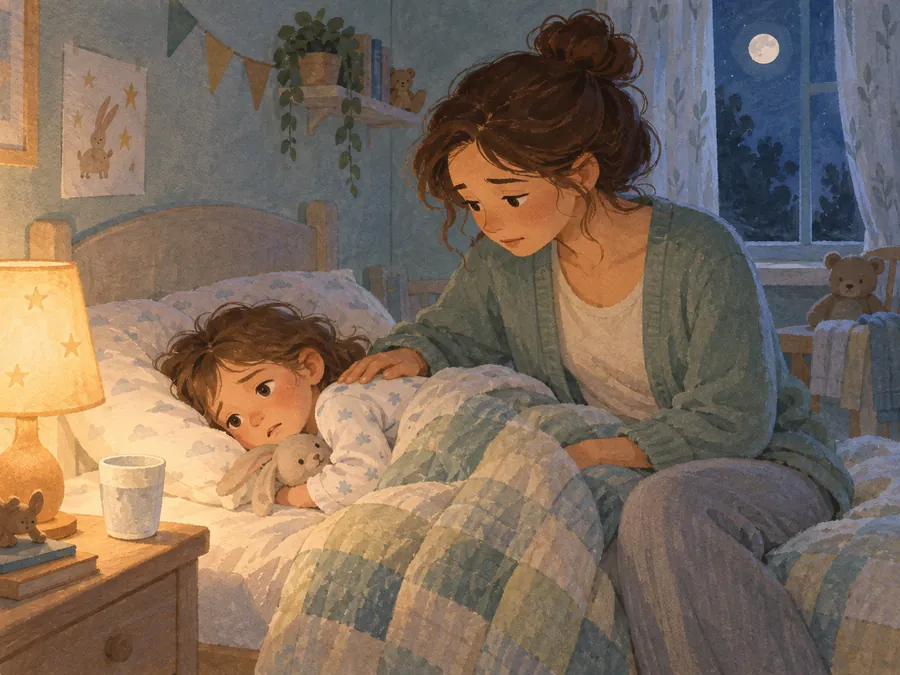
Third night in a row your child wakes up scratching their bottom. By morning everything looks normal, and by bedtime it starts again. If you have noticed that pattern, you probably already know what you are searching for.
Pinworms are the most common worm infection in school-aged and preschool children, and they say nothing about how clean your house is.
- The main symptom is itching around the anus, worse at night
- The worms are visible to the naked eye and look like short white threads that move
- Diagnosis is a tape test in the morning, not a stool sample
- Everyone in the household gets treated at the same time, symptoms or not
Quick Reference
| Question | Short answer |
|---|---|
| What do they look like? | White threads a few millimetres long, moving |
| Why is it worse at night? | Females come out at night to lay eggs around the anus |
| How is it diagnosed? | Tape test in the morning; stool tests miss it more often |
| Is it a hygiene problem? | No. It is the most common worm infection in young children |
| Who gets treated? | The whole household and caregivers, at the same time |
| Can they go to school? | Yes. There is no need to stay off |
| Is one dose enough? | The CDC recommends a second dose two weeks later |
Why the itching arrives at bedtime
This one detail explains almost everything else. The adult worm lives in the intestine and causes nothing during the day. At night the females travel out through the anus and lay their eggs in the folds of skin around it. That is where the itch comes from, and why mornings look fine.
So a child who plays normally all day and cannot settle at bedtime is not stalling. There is a mechanism.
The knock-on effect that parents rarely connect back to worms is sleep. German paediatric guidance is explicit that the itching disturbs sleep, which then shows up in daytime tiredness and poor concentration. If you have been trying to work out whether a run of bad nights is a phase or something else, the baby and toddler sleep guide helps separate the usual from the unusual.
What they look like and where to find them
Pinworms are white, thin, and a few millimetres long. The most useful description is that they look like short pieces of white thread that move, which is what separates them from anything else you might see.
Two places to look:
Around the anus, two to three hours after your child falls asleep. The CDC gives that exact window, because that is when the females are out (CDC). A torch, briefly, is all it takes.
In the stool. The NHS puts it plainly: you can spot threadworms in your poo, and they look like pieces of white thread (NHS). If you are unsure whether something is a worm or a bit of food, the thing that moves is not food.
The tape test
The test that actually works is not a stool analysis. It is a tape test: press clear tape against the skin around the anus first thing in the morning, lift it off, and take it in so the eggs stuck to it can be seen under a microscope.
Three details decide whether it shows anything:
- First thing in the morning, before washing and before a bowel movement. Once your child has showered, the eggs are gone.
- Lift it straight off. There is no need to leave it on.
- Keep it closed. German guidance suggests a sealed jar, which is more practical than carrying a sticky strip.
Stool samples are the weaker method here, so do not be surprised when the tape test is what gets asked for.
Treatment, and why everyone gets it
When pinworms are confirmed, treatment goes to everyone in the household and the caregivers, at the same time. Not because everyone is ill, but because close contacts are very likely carrying eggs without any symptoms, and treating one child while the others go untreated keeps the loop running for weeks.
Access differs by country. In the UK you can buy mebendazole for threadworms from a pharmacy without a prescription, and the advice is to treat everyone aged 2 and over in the household. Tell the pharmacist if you need to treat a child under 2, or if you are pregnant or breastfeeding. In Germany the route is through the doctor, who prescribes it. Either way, this is not a "try something from the cupboard" situation.
On the second dose: the CDC recommends two doses, with the second given two weeks after the first. The reason is the same as with lice. The medicine deals with the worms, not with the eggs already laid, and those hatch about a fortnight later. If your source or your pharmacist mentions only a single dose, that is worth one specific question rather than an assumption.
The hygiene that actually breaks the cycle
The medicine handles the worms. What stops the reinfection is the next two weeks, because the easiest way for a child to catch pinworms again is from themselves: scratch, eggs on fingers, fingers in mouth.
- Keep fingernails short. Eggs survive longest under nails.
- Handwashing before food and after the toilet, for everyone in the house.
- Shower in the morning, which washes off the eggs laid overnight.
- Change underwear daily.
- Wash bedding and underwear hot. German guidance says at least 60°C, and to change the bed linen the day after the evening dose.
- Work on nail-biting, thumb-sucking and pen-chewing. These are the habits that keep the cycle going.
The NHS puts a duration on it: keep the hygiene measures up for 2 weeks if you are taking the medicine, or 6 weeks if you are not.
School and nursery
There is no need to stay off nursery, school or work. The NHS says so directly, and German guidance agrees that a child with worms can keep attending.
What does help is telling the setting, so hygiene gets tightened and other families can check their own children. It is the same shape as head lice: one household cannot fix something that is circulating through a group.
If it feels like something is always going around, why kids get sick so often at daycare covers the arithmetic. And when a symptom does mean staying home, the thresholds are in fever and cough: when to monitor and when to call the doctor.
Common mistakes
- Treating only the child who itches. The others are very likely carrying it silently.
- Buying a medicine before there is a diagnosis. Itching around the anus is not always worms; eczema and simple irritation look similar.
- Bathing before the tape test. Washing removes exactly what the test is looking for.
- Hiding it from the nursery. It is the most common worm infection in this age group and has nothing to do with your housekeeping.
- Assuming one dose settled it. If the itching returns after ten days or so, that is information for your doctor, not a reason to start over online.
- Reading every rash as worms. Itching around the bottom is one thing; a spreading rash with fever is another, and chickenpox has a very different shape.
If the itching comes back after the second dose, the useful thing to bring to the appointment is dates: when each dose was given, when the itching returned, who else in the house has it. How to prepare for a pediatric visit using your child's data shows how to hand that over in two minutes.
Frequently asked questions
Do pinworms mean my house is not clean enough?
No. Pinworms are the most common worm infection in preschool and school-aged children and turn up in spotless homes. They spread by swallowed eggs, usually via hands and objects, not through any lack of washing.
Why does my child only itch at night?
Because the female worms come out through the anus at night to lay eggs in the skin folds around it. During the day the worms stay in the intestine and cause nothing, so the itch repeats every evening until treatment breaks the cycle.
Does everyone really need to take the medicine?
Yes. Once pinworms are confirmed, the whole household and caregivers are treated at the same time, because close contacts almost always carry eggs without symptoms. Treating one person on their own usually ends in reinfection.
Is one dose of medicine enough?
The CDC recommends two doses, with the second two weeks after the first, because the medicine does not kill eggs that have already been laid. Some sources mention a single dose, so ask your pharmacist or doctor what applies to the product you were given.
Can my child go to school with pinworms?
Yes. There is no need to keep them off nursery or school. Tell the setting so hygiene measures can be tightened, and keep nails short, handwashing regular and morning showers going to cut the risk of passing it on.
How do I know it is worms and not something else?
By appearance and by timing. Pinworms are white threads a few millimetres long that visibly move, and the itching is tied to the evening and night. Redness with no worms, or itching that runs all day, is more likely to be something else, and a doctor sorts that out quickly.
How it went for us
It reached us later than I expected. My oldest was six, old enough that I had long stopped checking. She called me over herself and said something felt odd. I looked, and I knew straight away.
We were at our pediatrician the same day. The prescription came for her and for the rest of us at home, and we took it on the schedule: one dose right away, the second fourteen days later. Anything that could not go through a hot wash I set aside for a few weeks, just in case.
You somehow get all of it done when you know there is nobody else to do it.
The good news, and the reason I can write about this without drama: we started immediately and everyone took the medicine. Nobody else ever developed a single symptom.
How KidyGrow helps you
This one is solved by a doctor and two weeks of consistency, not by an app.
What gets lost is when the first dose was, and the question of a second dose hangs entirely off that date. You log it in a few seconds and the app remembers it, so the Daily Brief raises it as the two-week mark comes up.
The more useful part happens before the diagnosis. If you have been noting the nights for a week, the app learns your child's pattern and can point out that the waking and the itching started landing on the same days. That is not a diagnosis and the app does not spot pinworms, but it is a sentence you can read out at the appointment instead of estimating.
Some weeks there is nothing to find, because teething, a cold and bad sleep all landed at once. Then it says so rather than inventing a pattern.
There is a second use that only shows up after treatment. If the itching comes back around day ten, you have the date of the first dose and the wake-up counts from before and after it, so the conversation at the appointment starts with two numbers instead of "I think it's back".
It will not do the tape test for you. It will know there were nine night wakings in the last ten days, which is not a number anyone has in their head at 7 AM.
Sources
- CDC: About Pinworm Infection (accessed 2026).
- NHS: Threadworms (accessed 2026).
- BIÖG, kindergesundheit-info.de: Madenwürmer bei Kindern (accessed 2026).
_Educational content. Not a substitute for medical advice._