 Kidy
Kidy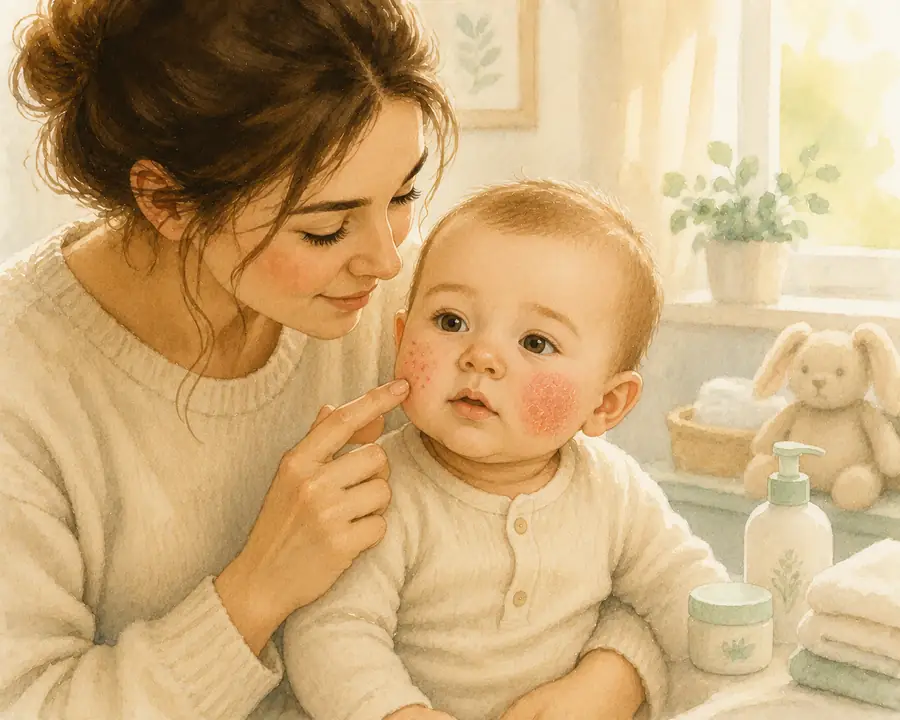
Something red appeared on your baby's cheeks, and the internet just offered you nine diagnoses. The two most common suspects are easy to separate once you know what to look for:
- Baby acne: small pimples and whiteheads, typically appearing at 2 to 6 weeks, gone on its own by around 3 to 4 months
- Eczema: dry, rough, itchy patches, usually starting between 2 and 6 months, coming and going in flares
- Acne doesn't bother the baby; eczema itches, and the baby shows it
- Acne needs nothing; eczema needs daily moisturizing and trigger detective work
Roughly 1 in 5 children develops eczema, per the NHS guidance on atopic eczema, while baby acne visits up to a third of newborns and leaves without a trace. Different timelines, different looks, very different jobs for you.
Quick reference: acne or eczema?
| Feature | Baby acne | Eczema |
|---|---|---|
| Typical start | 2–6 weeks old | 2–6 months old |
| Looks like | Small pimples, whiteheads, on a flat base | Dry, rough, red patches; can crack or weep |
| Where | Cheeks, nose, forehead | Cheeks and scalp first; later elbow and knee creases |
| Itch | None; baby is unbothered | The defining feature; baby rubs, scratches, sleeps worse |
| Course | Gone by 3–4 months, no treatment | Chronic, comes in flares, improves with care over years |
| Your job | Nothing: wash with water, wait | Moisturize daily, find triggers, treat flares |
When in doubt, the age and the itch decide most cases. A six-week-old with painless pimples is acne territory. A five-month-old rubbing rough red cheeks against the crib sheet is telling you it's eczema.
What baby acne looks like (and why it happens)
Tiny pimples and whiteheads scattered over the cheeks, nose and forehead, often most dramatic around week three or four. The cause is borrowed hormones: yours, finishing their last loop through her system, briefly switching on oil glands that weren't due to wake for a decade.
It looks worse after crying and warm baths, which is exactly when parents panic-photograph it. The baby, meanwhile, doesn't know it exists. No itch, no pain, no fever, feeding normally.
Treatment is deliberate inaction. Water, a soft towel, patience. No scrubbing, no squeezing, and none of the acne products that exist for teenagers; baby skin absorbs what you put on it, and benzoyl peroxide was never part of the plan, as the AAP's bathing and skin care guidance lays out. By the fourth month it's usually a forgotten chapter.
Two lookalikes worth ruling out: milia (pinhead white dots present from birth, also harmless, also self-resolving) and drool rash around the mouth and chin, which arrives with the salivary flood of early teething and responds to barrier cream rather than time.
What eczema looks like (and how it behaves)
Eczema is a skin barrier problem: skin that loses moisture too fast and lets irritants in too easily. It shows up as dry, rough, intensely itchy patches, classically starting on the cheeks and scalp between 2 and 6 months, later favoring the creases of elbows and knees, as described in the AAP's eczema overview.
The itch is the tell. Babies too young to scratch with precision rub their face against your shoulder, the mattress, anything with texture. Sleep gets worse; if night wake-ups have crept in alongside rough cheeks, the skin may be the suspect, not the usual nighttime causes.
Eczema is also moody. It flares and retreats. Cold dry weather, overheating, sweat, fragranced products, wool against skin, a new bath foam: all known provocateurs. One beta mom was sure her son's cheek patch was "spreading fast" until her notes showed it was the same two-centimeter patch all week, just angrier on the two evenings after bubble-bath nights. Same skin, different trigger exposure.
Eczema travels with the allergy family: children with it have higher odds of food allergies and asthma later. That's a reason for a pediatrician conversation, not a reason to start cutting foods from anyone's diet on your own.
How to care for eczema skin at home
- Moisturize like it's a medication, because it is. A thick, fragrance-free emollient at least twice daily, more in winter. The single highest-impact habit, per the AAP's guidance on treating eczema rashes. Moisturize. Again. Within three minutes of the bath, while skin is damp.
- Short, lukewarm baths. Five to ten minutes, warm not hot, fragrance-free cleanser only where needed. Hot water strips the little barrier function there is.
- Cotton next to skin, wool and polyester one layer out. And mind overheating: sweat is one of the most underrated flare triggers in babies.
- Fragrance-free everything. Detergent, softener, your own perfume where her cheek rests on your shoulder. "Sensitive" labels matter less than the actual word "fragrance" on ingredient lists.
- Keep nails short, consider cotton mittens for the night shift. Scratched eczema becomes infected eczema with depressing efficiency.
- What not to do: corticosteroid roulette. Steroid creams are effective and safe when prescribed for a flare and used as directed. Borrowing a tube from an adult's drawer, or fearing the prescribed one into a flare that rages for weeks, are the two classic ways this goes wrong.
Sometimes a flare has no trigger you'll ever find. The skin just has a bad week, like the rest of us.
Common mistakes with baby skin
- Treating acne like eczema. Moisturizer piled onto baby acne can clog things further. Acne wants less intervention, eczema wants more. Identify first, act second.
- Treating eczema like acne. Waiting for itchy patches to "pass on their own" hands the skin barrier weeks of avoidable damage and the baby weeks of avoidable itch.
- The daily product carousel. Switching creams every three days makes it impossible to know what helps and gives the skin a parade of new ingredients to object to. One change at a time, one week per experiment.
- Over-bathing. A daily long hot bath is a gift to neither condition. Babies aren't coal miners; most days, less washing is better skin care.
- Blaming the last meal. Food triggers for eczema are real but rarer than feared, and elimination diets without medical guidance cost nutrition while usually proving nothing.
When to see the pediatrician
Book a regular appointment when:
- You're not sure which one it is, and the itch question doesn't settle it
- "Acne" persists past 4 months or keeps worsening after 6 weeks
- Eczema isn't improving after 1 to 2 weeks of consistent moisturizing
- Patches weep, crust yellow-golden, or develop pus-filled spots: that's infected skin, and it needs same-day attention
- The itch is wrecking sleep night after night
Go faster when a rash comes with fever (the combined decision logic is in our fever guide), when a rash doesn't fade under a pressed glass, or when blisters cluster near the eyes or mouth in a baby under 3 months. Newborn rashes with fever skip the waiting room entirely.
A useful preparation habit for any skin visit: bring the timeline. When it started, what you applied, what changed. Rashes that look identical at 4 p.m. in an office have very different two-week stories, and outdoor time, weather and washing routines are part of them; even sun exposure on outdoor play days belongs in the story. For a fuller checklist on turning that timeline into an efficient visit, our guide to preparing for a pediatrician visit with your child's data walks through what to bring and how to organize it beforehand.
Frequently asked questions
At what age does baby acne appear, and when does eczema start?
Baby acne typically shows at 2 to 6 weeks and clears by 3 to 4 months. Eczema most often begins between 2 and 6 months, sometimes later. The starting age alone sorts many cases: a rash at three weeks is rarely eczema, and new "acne" at five months usually isn't acne.
Does baby acne need any treatment at all?
No. Wash with plain water, pat dry, and resist all squeezing and scrubbing. It resolves on its own without scarring. Adult or teen acne products have no place on infant skin, even diluted, even briefly.
How do I know the rash is itchy if my baby can't tell me?
Watch behavior: face-rubbing against sheets and shoulders, scratching marks, increasing fussiness when warm, and worsening sleep. An unbothered baby with spots points toward acne or milia; a baby fighting her own skin points toward eczema.
Will my baby outgrow eczema?
Many children improve substantially through childhood, and a large share see it fade by school age, though dry-skin tendencies often remain. Good daily skin care now also means fewer infected flares and better sleep while you wait for that improvement.
Can I prevent eczema flares completely?
No, and that's not the standard to hold yourself to. Daily moisturizing, fragrance-free products and avoiding known triggers reduce the number and severity of flares; they don't eliminate them. Occasional flares despite perfect care are the condition, not your failure.
How KidyGrow helps you
Skin questions are timeline questions. When did it start, what did you change, does it track with baths, weather, new foods, daycare weeks? Nobody holds three weeks of that in their head, and the pediatrician will ask for exactly that.
Log the small stuff as it happens (new detergent Tuesday, rough night Thursday, cheeks angry after the pool) and KidyGrow remembers it in order. After a few days of notes, the Daily Brief starts connecting what memory can't: "Red cheeks logged 3 times this week, each one the day after a bath-with-new-shampoo evening." Whether the pattern is real or coincidence is the doctor's call, but now there's a pattern to discuss instead of a guess. Give it 3 to 5 days of logging before expecting these connections; day one, it knows nothing about your baby's skin.
It won't diagnose anything, and some flares will stay unexplained no matter how clean your notes are. What changes is the appointment: "it started June 2nd, here's what we used and when it flared" is a seven-minute visit spent on treatment instead of archaeology.
Most cheek emergencies turn out to be three weeks of boring moisturizing. The notes are for the ones that don't.
Sources
- American Academy of Pediatrics / HealthyChildren.org - Eczema
- American Academy of Pediatrics / HealthyChildren.org - How to Treat and Control Eczema Rashes in Children
- American Academy of Pediatrics / HealthyChildren.org - Bathing and Skin Care
- NHS - Atopic eczema
- NHS - Rashes in babies and children