 Kidy

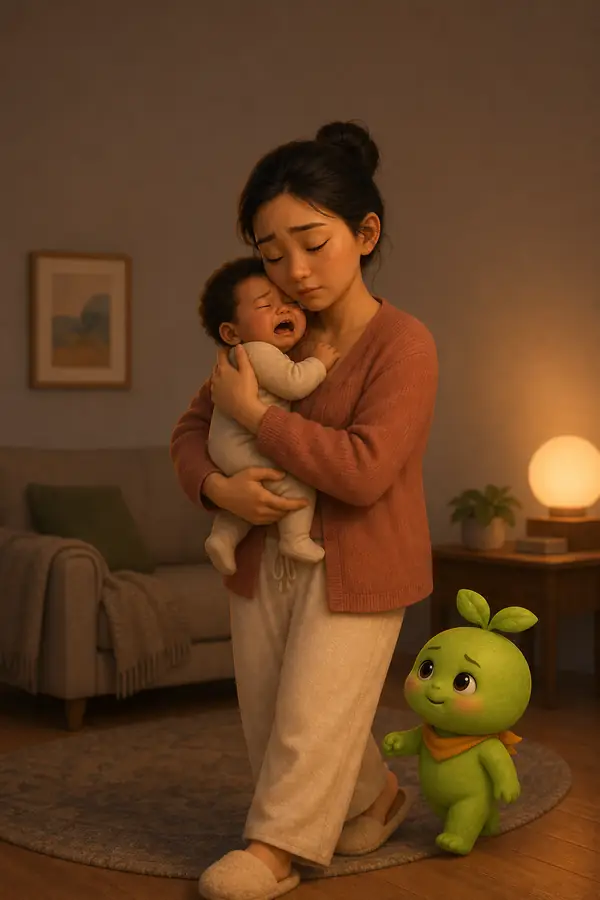
"Mommy. Mommmyyy. I want the bluuue one." It is 5:40, the pasta water is not boiling yet, and the same three notes have been going since you walked in the door.
What matters here:
- Whining is a normal toddler sound, and the AAP lists it among the typical feelings-driven behaviors of two-year-olds
- Hunger, tiredness and illness come first: CDC advice says these needs-based moments are not for ignoring
- For attention-seeking whining, CDC recommends briefly withdrawing attention and praising the clearer ask
- Expect it to get louder at first, before it fades
- In one small lab study, whining pulled adults' attention more than neutral speech, so your irritation is not a character flaw
Whining is not quite crying and not quite talking. That in-between is the point.
Quick Reference: what the whine is usually asking for
| What is behind it | What it looks like | First move |
|---|---|---|
| Hunger | Worst in the hour before a meal | Snack now, talk later |
| Tiredness | Late afternoon, after a short nap | Lower the demands, earlier night |
| Coming down with something | New, constant, clingy, off food | Comfort first, watch for fever |
| Wanting you | Starts the second you pick up your phone | Five minutes of full attention |
| Not enough words | Pointing, rising pitch, frustration | Give them the words to copy |
| It worked last time | Whines, you cave, whines again | Answer the clear voice only |
Why that sound gets under your skin
Here is the part nobody tells you. In one study, whining pulled attention unusually hard.
Thirty-seven adults, 20 without children and 17 parents, had to repeat a dull story in one ear while a second story played in the other. When the ignored story switched into a whine, they made more mistakes, remembered more of the whining words, and showed a higher skin response than with neutral speech (Chang & Thompson, 2010, PubMed). The authors suggest whining may belong to a group of sounds that draw in the people a child depends on.
A single study with a small sample, so hold it lightly. Still, it is a useful thing to know at 5:40. You are not unusually impatient. In that lab, at least, whining grabbed people the same way it grabs you.
Why toddlers whine so much
The American Academy of Pediatrics describes two-year-olds plainly: "They may whimper, whine or cling to you" (AAP, HealthyChildren). Normal, then. But normal is not the same as without a cause, and the cause decides what works.
A body need. The NHS names the obvious ones for tantrums, and they hold for whining too: a child may be struggling "because they're tired or hungry" (NHS). A toddler rarely says "I'm hungry." They say "I don't want the blue cup" in that voice.
You. Attention is the thing toddlers want most, and a whine is the fastest way to get it. CDC puts it bluntly: "even negative attention is still attention."
Words that do not stretch far enough yet. A child with a handful of words and a complicated wish has one tool left, which is tone.
It paid off. Nobody means to teach whining. But if the fourth whine got the cookie, the fifth one is coming.
Boredom also belongs on the list. Some afternoons are just long.
What actually helps
Work through it in this order. The order matters more than any single trick.
1. Fill the tank before you teach anything. If it is ten minutes before dinner, hand over the cucumber. No lesson lands on an empty stomach. CDC is explicit that redirecting attention "is not appropriate for needs-based behavior like when a child is hungry, tired, or sick."
2. Name it once, show the other voice. Get down to their level and say, quietly, "I hear you want the blue cup. Try it like this: 'Blue, please.'" Say it in the voice you want. A point, a sign or a single word counts too; a clear sentence is never the price of a basic need. A two-year-old copies far better than they follow instructions.
3. Answer the clear voice fast. The moment you hear anything close to a normal ask, respond, and say why: "You asked so clearly. Yes, here's the blue one." CDC's own example is almost word for word: "I really like how you asked me with your inside voice."
4. When the whine is for attention, briefly take yours away. Don't respond to the whining itself: no negotiating, no extra talk, no eye contact while it lasts. CDC describes it the same way, "Be silent," and then: "When the misbehavior stops, return your attention" (CDC, Essentials for Parenting Toddlers). You stay nearby and get on with the pasta. The moment your child pauses or asks more clearly, turn back warmly and say what you liked. CDC notes it "is usually most effective for minor behaviors like whining or interrupting." Not for a child who is hungry, tired, sick or truly upset.
5. Top up connection when nobody is whining. Five minutes on the floor before you start cooking can take the heat out of the next hour. Our piece on special one-on-one time has the full version.
It may get louder for a while. CDC warns about exactly this: "they may whine longer and louder to see if they can get your attention." If early on it sounds louder than ever, that does not mean the plan failed. It may mean the old route has stopped paying, though a louder phase on its own does not prove the method works. If your child becomes truly distressed, check the need again and offer comfort.
Some weeks nothing on this list touches it. Teeth, a new room at daycare, a sibling's birthday. Most of those pass. If the change is unusual for your child or does not settle, it is worth mentioning to your pediatrician.
Wait, or change something?
- Whining clusters before meals → move the snack earlier, not the lecture
- Whining starts when you are on the phone → a short "wait, then you" routine, and keep your word on the "then"
- Whining peaks straight after daycare → treat it as a reunion problem, see reconnecting after daycare
- Whining turns into full crying most of the day → read toddler crying all day for the sleep and food side
- Whining every time you say no → that is its own pattern, covered in toddler cries when told no
You usually do not notice the pattern on day two. You notice it the Thursday that sounds exactly like Monday.
Common mistakes
- Giving in on the fifth whine after refusing the first four, which teaches that five is the number
- Mimicking the whine back to them; it tends to shame more than teach
- Ignoring a child who is actually hungry, tired or ill
- Long explanations about why whining is annoying, delivered in your own whining voice
- Changing the rule every day depending on how tired you are (understandable, and still confusing for them)
- Expecting a one-year-old to "use words" they do not have yet
When to talk to your pediatrician
Whining that arrives suddenly alongside fever, obvious ear pain, ear discharge, poor sleep or refusing food, or in a child who simply seems unwell, deserves a look rather than a strategy. Ear tugging on its own is a weak clue: the AAP notes that "many babies and small children do this to self-soothe or simply play with their ears" (AAP, ear infections).
Speech is the other thing to watch. Among CDC's milestones for two years is "says at least two words together, like 'More milk'" (CDC milestones, 2 years). If your child is not doing that at two, speech is barely moving forward, or they are losing words or skills they already had, mention it to your pediatrician. The whining may then be about language, not behavior.
The NHS has a simple rule for behavior generally: "If you're seriously concerned about your child's behaviour, talk to your health visitor or GP." That includes being worn down to nothing yourself.
Whining is one small corner of a bigger stage. For the whole arc, from tantrums to limits, see our toddler behavior guide, and for the calm, firm version of saying no, setting boundaries with toddlers.
Frequently asked questions
At what age does whining usually stop?
There is no fixed end date. It tends to ease as a child's language grows, because words start to work better than tone. Most parents notice it fading once their child can explain what is wrong in a sentence, though it often returns briefly when they are tired or ill.
Should I just ignore whining?
Only the attention-seeking kind, only briefly, and only after you have checked that your child is not hungry, tired, sick or truly upset, since CDC advises against ignoring needs-based behavior. Stay close, skip the negotiating while the whine lasts, and respond warmly the moment they pause or ask in a clearer voice.
Why does my toddler whine more with me than with anyone else?
Very common. Small children often behave differently with different adults, and the AAP notes that even preschoolers, while learning appropriate behavior, "continue testing the limits of parents and siblings" (AAP). You are also the person whose attention they want most. Our piece on why toddlers act worse with mom goes further.
Is saying "use your big voice" enough?
Only if they know what the big voice sounds like. Show it: say the exact sentence you want to hear, in the tone you want, and let them copy you. Toddlers learn this by imitation far more than by instruction.
My toddler whines all day. Is something wrong?
Usually not, but all-day whining is worth a closer look at sleep, meals and health. If it came on suddenly, comes with fever, obvious ear pain or discharge, or your child seems unwell, talk to your pediatrician.
How KidyGrow helps you
By Thursday you cannot remember whether Monday was bad before lunch or after the nap.
Note a whiny stretch in KidyGrow as a Behavior event, one line and the time. Note the calm asks too, as Positive behavior. When the last day holds a couple of rough entries, the Daily Brief and the Tonight plan treat it as a harder day and suggest something calmer and shorter. The app remembers every one of those 5 pm stretches next to the naps and meals you logged, so your head does not have to.
Sometimes it shows nothing clear. That is information too.
Sources
- Chang RS, Thompson NS. "The attention-getting capacity of whines and child-directed speech." Evolutionary Psychology, 2010;8(2):260–274. https://pubmed.ncbi.nlm.nih.gov/22947795/
- CDC. "Tips for Redirecting your Attention." Essentials for Parenting Toddlers and Preschoolers. https://www.cdc.gov/parenting-toddlers/responding-to-behavior/ignoring.html
- CDC. "Positive Parenting Tips: Toddlers (2–3 years old)." https://www.cdc.gov/child-development/positive-parenting-tips/toddlers-2-3-years.html
- American Academy of Pediatrics, HealthyChildren.org. "Emotional Development: 2 Year Olds." https://www.healthychildren.org/English/ages-stages/toddler/Pages/Emotional-Development-2-Year-Olds.aspx
- NHS. "Temper tantrums." https://www.nhs.uk/baby/babys-development/behaviour/temper-tantrums/
- CDC. "Milestones by 2 Years." https://www.cdc.gov/act-early/milestones/2-years.html
- American Academy of Pediatrics, HealthyChildren.org. "Ear Infections in Children: Information for Parents." https://www.healthychildren.org/English/health-issues/conditions/ear-nose-throat/Pages/Ear-Infection-Information.aspx
- American Academy of Pediatrics, HealthyChildren.org. "What's the Best Way to Discipline My Child?" https://www.healthychildren.org/English/family-life/family-dynamics/communication-discipline/Pages/Disciplining-Your-Child.aspx