 Kidy
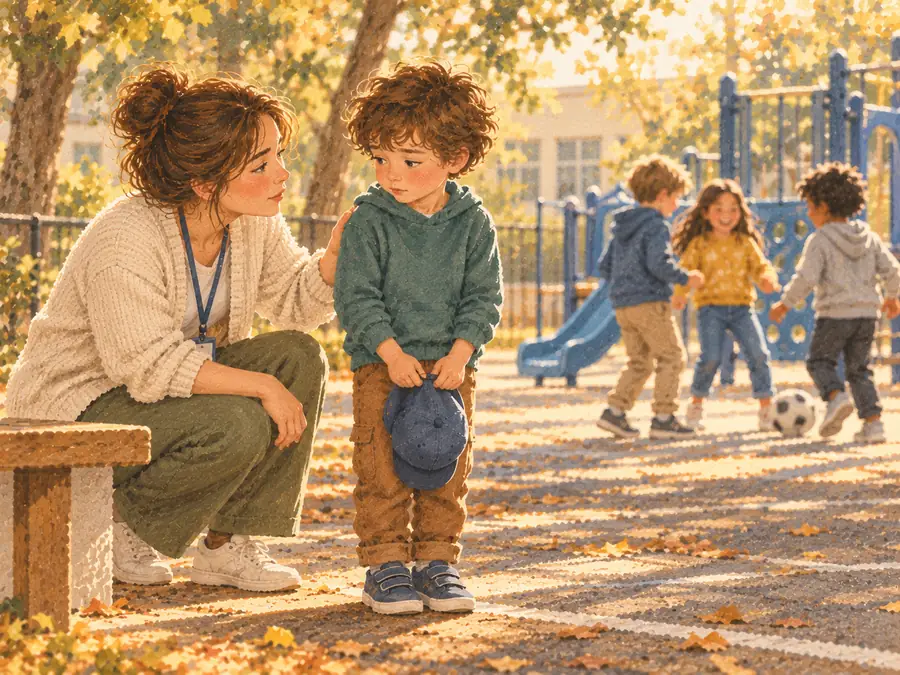
Peer conflict or bullying? At ages 4–8, three questions usually settle it:
- Is it repeated, or likely to be? Bullying often looks like a pattern: the same child, the same kind of hurt, week after week. It doesn't need a long history, though. The CDC counts behaviour that is repeated or "highly likely to be repeated", so one serious incident, like a threat or something taken by force, can be enough.
- Is the power uneven? Bigger, older, more popular, or several children against one.
- Can your child make it stop? In ordinary conflict both children have a say in how it ends. In bullying, one can't stop it. Hitting back doesn't change that: a child who finally lashes out can still be the one being bullied.
- Exclusion counts. Being deliberately and repeatedly left out of the group is a form of bullying, not only hitting or name-calling.
Most of what young children bring home is ordinary conflict, and it is how they learn to share, negotiate and make up. Bullying is rarer and different in kind, and it needs adults. You don't have to be sure which one it is before you talk to the teacher.
Quick reference
| Peer conflict | Bullying | |
|---|---|---|
| How often | Now and then | Repeated, or likely to repeat |
| Power | Roughly equal | Uneven: size, age, status, or a group against one |
| Who is upset | Both sides, usually | Mostly one child |
| After it ends | They play again soon | Your child avoids the place or the person |
| What the adult does | Coaches, lets them repair | Steps in and works with the school |
What actually separates conflict from bullying?
The US Centers for Disease Control and Prevention defines bullying as unwanted aggressive behavior by another young person or group that "involves an observed or perceived power imbalance and is repeated multiple times or is highly likely to be repeated" (CDC). Two words do the work there: power and repeated.
Conflict has neither. Two six-year-olds both want the red scooter. There's shouting, maybe a shove, someone cries, and ten minutes later they're digging in the sandpit together. Annoying. Normal. This is how children practise the skills adults keep telling them to use.
Now picture a seven-year-old whose hat gets taken off and thrown over the fence by the same two older boys every Tuesday and Thursday, and who has started asking to wear the hood instead. Nothing about that is mutual.
The NHS community guidance for primary school parents puts the line plainly: bullying "is a repeated behaviour that intends to hurt someone physically or emotionally" and "isn't simply a case of falling out with friends" (NHS Kent Community Health). Intent is harder to read in a four-year-old than in a nine-year-old, which is why repetition and power are the more useful tests at this age.
Is leaving a child out a form of bullying?
Sometimes. Among the common types the CDC lists are physical, verbal, damage to property, and "relational or social such as spreading rumors and leaving out of the group".
The trick is telling a small child's "you can't play" apart from the organised version. At four and five, play groups form and break apart all day. A child who gets turned away from one game and joins another an hour later is having a normal, slightly sad day.
It starts to look like bullying when:
- one child tells the others not to play with yours, and they listen
- the exclusion lasts for weeks, not for a game
- it comes with whispers, rumours or a "club" your child can never join
- your child stops trying, and plays alone on purpose to avoid the rejection
That last one is the quiet sign. A child who says "I like playing by myself" in October, after saying the opposite in September, is worth a gentle question.
Why the child who hits back still needs help
Here is the finding parents tend to remember. In a British study that followed more than 2,000 children, those who were bullied between ages 5 and 7 had more behaviour and school problems at seven, even after accounting for how they were doing at five. The children who were both bullied and bullying others, so-called bully-victims, had the broadest difficulties of all: more anxiety and sadness, more acting out, and fewer kind, helpful behaviours (Arseneault et al., Pediatrics, 2006).
So a note from the teacher saying your child pushed someone is not the end of the story. Ask what happened before the push. A child who has been picked on for weeks sometimes snaps, and gets caught on the one day they fight back.
What should you ask your child?
Keep it calm and short. A child who sees you panic often stops talking, to protect you.
- "Tell me about break time today." (Open, about a place, not about a person.)
- "Who did you play with? Was there anyone you wanted to play with?"
- "Has this happened before? When was the first time?"
- "What did you do? What happened next?"
- "Did a grown-up see?"
Then tell them two things. That they were right to tell you. And that telling an adult is not tattling. The American Academy of Pediatrics says it directly: "Seeking help for someone who's been attacked is not tattling" (AAP, HealthyChildren.org).
Don't promise to keep it secret. Promise to make a plan together.
What to write down for the school
Notes are not a waiting period. You can talk to the teacher the day something worries you, and keep notes alongside. Memory blurs fast, yours and your child's. A short note each time is worth more than one long, upset email.
- the date, and roughly when (break, lunch, the bus, the walk home)
- who was involved, and whether it was one child or a group
- what happened, in your child's words where you can
- whether an adult was nearby
- any injury (a photo helps) or anything damaged or missing
- how your child was afterwards: sleep, appetite, the next morning
A week or two of notes usually shows which column of the table above you're in. It also gives the teacher something concrete at the follow-up, instead of "I think something is going on".
Wait or act? A simple decision guide
- One incident, different children, your child bounces back: coach at home. Role-play what to say ("Stop. I don't like that."). Mention it to the teacher too if it keeps nagging at you.
- Same child or group, more than once: talk to the teacher now. Bring whatever notes you have.
- Any physical injury, threats, or things taken by force: tell the school the same day, in writing.
- School avoidance, new sleep trouble, or your child seems different at home: talk to the school and book a visit with the pediatrician.
- Talk of self-harm or not wanting to live, at any age: get help today (see below).
How to bring it to the teacher or kindergarten
Ask for a short meeting rather than catching the teacher at pickup. Share your notes, say what your child has told you, and ask what they have seen. Teachers often see half of it. Your child sees the other half, and the playground supervisor might have the piece that joins them.
Then ask three things: what the school will do, who your child can go to when it happens, and when you will check in again. Agree a date, one or two weeks out. If nothing changes after that, go to the head teacher or school counselor. The AAP's advice is the same: "If the bullying doesn't stop, do seek help from school leaders, counselors, teachers, coaches and others."
Starting school is already a lot. If your child has just moved from kindergarten to first grade, our piece on the transition to school covers what is normal in the first months, so you can tell adjustment from something worse.
Common mistakes
- Calling every fight bullying. The word loses its weight, and the school starts hearing it as noise.
- Calling real bullying "just kids being kids". If one child can't make it stop, it isn't a fair fight.
- Telling your child to hit back. It often lands your child in trouble and rarely stops the pattern.
- Confronting the other child or their parent yourself. Go through the school.
- Interrogating every afternoon. One calm question a day is enough. A child who falls apart at home may simply be tired; why children fall apart after school explains the difference.
When to get professional help
Bullying shows up in the body as often as in words. The AAP lists signs including headaches or stomachaches, hating or avoiding school, unexplained injuries, "sudden loss of friends", and "self-harm or talk of suicide". Some of these have other causes, so they are a reason to ask, not a diagnosis.
Book an appointment with your pediatrician if your child has stomach aches or headaches on most school mornings, new trouble sleeping or frequent nightmares, or seems flat and withdrawn for more than two weeks. A child psychologist can help with the fear and with rebuilding confidence, even after the bullying itself has stopped.
Any talk of self-harm, even from a five-year-old, even said in anger, gets a same-day call to your pediatrician. If your child is in immediate danger, call 911. In the US you can also call or text 988 for crisis support.
For the bigger picture on emotions and regulation in young children, see our guide to understanding and handling children's behaviour, and for the feelings that come out at home, validating your child's big feelings.
Frequently asked questions
Can a 4-year-old be a bully?
Four-year-olds hit, grab and exclude a lot, and most of it is impulse rather than a plan. The concern is a pattern: the same child targeting the same child, repeatedly, with the others joining in. At that age adults talk about the behaviour rather than labelling the child, and the teacher's job is to break the pattern early.
My child says "nobody plays with me". Is that bullying?
Not on its own. Young children say it after one bad break, and it can mean "my best friend played with someone else today". Ask who, how often and what happens when they try to join. If one child is telling others to keep yours out, week after week, that is relational bullying and worth raising with the teacher.
Should I contact the other child's parents?
Usually not first. Conversations between parents tend to turn into two parents defending two children. Go through the teacher, who can see both sides and act in the group, and let the school decide whether to involve the other family.
What if the teacher says it is just normal conflict?
Ask what they have seen and share your dated notes. Agree to check again in two weeks. If incidents keep happening with the same child or group, take your notes to the head teacher or school counselor.
How long should I wait before going to the school?
You don't need to wait. If something worries you, talk to the teacher now. Injuries, threats or things taken by force go to the school the same day, in writing. Notes over the next week or two are not a waiting period: they help you and the teacher see whether there is a pattern.
What if my child is the one bullying?
Stay calm and find out what happened, including what came before. Make clear the behaviour is not okay, help your child understand how the other child felt, and work with the teacher on making amends. Remember the bully-victim finding: some children who hurt others are being hurt too.
How KidyGrow helps you
Something comes out at bath time, a name, a game they weren't allowed in, and by Friday you can't remember if it was Monday or Wednesday. In KidyGrow you add a note in a few taps, and each one keeps its date. The app remembers what you tell it about your child, so when you ask Grow how to bring this up with the teacher, it starts from what you already said. It can't tell you what happened in the playground. That still takes a conversation. But you walk into the meeting with dates instead of a feeling.
Sources
- Centers for Disease Control and Prevention. About Bullying.
- American Academy of Pediatrics, HealthyChildren.org. Why Bullying Hurts All Children, and What Parents Can Do About It. Updated 2025.
- Arseneault L, Walsh E, Trzesniewski K, Newcombe R, Caspi A, Moffitt TE. Bullying victimization uniquely contributes to adjustment problems in young children: a nationally representative cohort study. Pediatrics, 2006.
- Kent Community Health NHS Foundation Trust. Bullying at primary school.