 Kidy
What gets a 4- to 8-year-old talking about school, in short:
- "How was school?" asks for a summary of six hours. That is a lot to ask of a young child on demand, so you often get "fine".
- Small, concrete questions work better: who they sat next to, what was loud, what someone said that was funny.
- Open questions give more room than yes/no ones. Yes/no is fine for checking one specific thing. But in one study of 5- to 9-year-olds, most children answered yes or no to questions they had no way of knowing.
- Timing matters as much as wording. After food and quiet, in the car, at dinner or at bedtime usually beats the school gate.
A child who tells you little about school is not necessarily hiding anything. Research on how adults talk with children suggests that the kind of question and the moment both matter, and many children simply need more time, a different moment or a smaller question. Sometimes it is more than that, and the difference often shows if you know where to look.
Quick reference
| Question type | Example | What you usually get |
|---|---|---|
| Whole-day summary | "How was school?" | "Fine." "Good." "Nothing." |
| Yes/no | "Did you have fun?" | A quick yes or no, sometimes even when they are not sure |
| One concrete moment | "Who did you sit next to at lunch?" | A name, often a story |
| Ranking or choice | "Best and worst part of today?" | Two short answers you can follow |
| Third person | "Was anyone sad today?" | Often the thing that bothered your child |
| Your turn first | "Something silly happened at my work..." | A trade: their story for yours |
Why does "How was school?" so often get "fine"?
Partly because it is a big question. You are asking a five-year-old to scan a whole day, pick what matters, put it in order and say it out loud, usually while they are hungry and in a coat.
Young children remember plenty. Many find it easier to pull a memory out when they get a hook. Research on how parents talk with children about shared past events points that way, though it did not test school-day questions as such. In a long-running study, mothers trained to ask open, detail-rich questions about shared events had children who gave richer memories a year later (Reese & Newcombe, 2007). A review of this work ties that elaborative style to language, memory and children's understanding of themselves and others (Fivush, Haden & Reese, 2006).
There is a second reason. Many children spend the school day holding it together, and the first hour home is when that runs out. If questions at the door end in tears or shouting, read why children fall apart after school before changing anything else.
Which questions actually get an answer, by age?
Ages 4–5
At this age the day is stored as things, people and feelings, not as a timeline. Ask about those.
- "What did you eat first at lunch?"
- "Who did you play with outside?"
- "Was anything really loud today?"
- "What did you build, draw or paint?"
- "Show me how the teacher sings the tidy-up song."
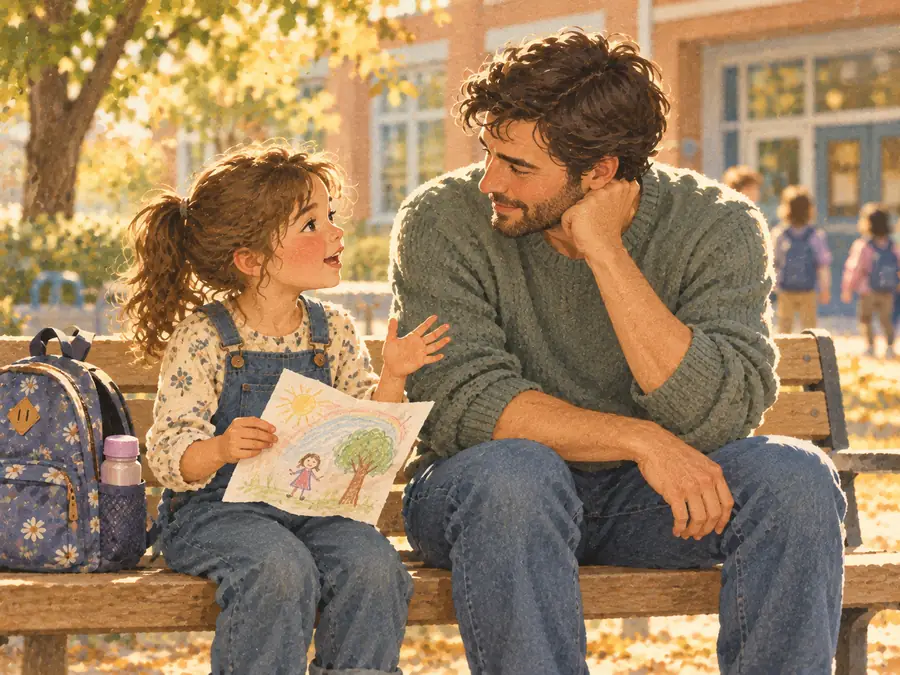
A drawing that came home in the bag is a gift here. "Tell me about this" opens more than any question. Some four-year-olds will act the day out with toys long before they describe it.
Ages 6–8
Children in the first years of school can compare, rank and imagine, so give them a frame rather than a blank.
- "What was the best part of today? And the worst?"
- "What's one thing you know now that you didn't know this morning?"
- "Who did you sit next to? Do you like sitting there?"
- "What game is everyone playing at break right now?"
- "Did the teacher get cross with anyone today?" (Not with you. With anyone.)
- "If you could do one part of today again, which one?"
- "Who would you like to invite over?"
Rotate them. The same question every day becomes a ritual answer within a week.
When yes/no questions help, and when they don't
Yes/no questions have their place. "Is your swimming bag still at school?" checks one specific thing, and a yes or no is all you need. The trouble starts when you want to know what happened. When researchers asked 5- to 9-year-olds questions that could not be answered from what they had heard, most children correctly said they didn't know when the question started with what or who. Asked the same kind of thing as a yes/no question, most of them picked yes or no anyway (Waterman, Blades & Spencer, 2001). That was one study, in a test setting, but the lesson carries over: an open question gives a child more room to tell you what was there, and to say "I don't know" when nothing was.
A later classroom study with 6- and 8-year-olds found two things that helped: telling the younger children beforehand that "I don't know" was an allowed answer, and letting them give their own account of the event before the questions started (Waterman & Blades, 2011).
For an ordinary afternoon that means two habits. Let your child tell it their way first, however rambling. And say out loud, once in a while, that "I don't remember" is a fine answer.
This matters most when you are worried. "Did someone push you?" can invite a yes. "Tell me about break time" invites what actually happened. The AAP's advice on suspected bullying is to ask exactly what happened and when, and to keep it open with "Can you tell me more?" (AAP, HealthyChildren.org).
When is the best time to ask: car, dinner or bedtime?
Not at the gate. Food first, then questions. Twenty minutes of quiet buys you more than any clever wording.
The car works for a lot of children because nobody has to look at anybody. Side by side is easier than face to face, especially for the hard things. Keep the radio low and leave gaps.
Dinner suits a shared format. Everyone, adults included, says one good thing and one annoying thing from their day. You go first, and you make yours real ("I spilled coffee on a printout five minutes before a meeting") rather than polished.
Bedtime is where the important things tend to come out. Lights off, nobody watching, the day finally over. A child who said nothing at four o'clock will suddenly mention that nobody let them play. Yes, sometimes it's a stalling tactic. Listen anyway, and pick up the thread the next afternoon if it needs more than five minutes.
The most serious sentence of the week may arrive wedged between a question about whether sharks sleep and a request for water. If it does, stay on the edge of the bed a few minutes longer, even with the dishes waiting.
Short, regular time alone with each child makes all of this easier. See special time with each child and five-minute connection rituals for versions that fit a working week.
What does the silence usually mean?
Read it as a pattern over a couple of weeks, not one afternoon.
- Quiet at pickup, chatty at bedtime: timing, not secrecy. Move your questions later.
- Talks about lessons, never about break or lunch: the social part is the one to follow, gently and without a spotlight.
- "I don't remember" to everything: usually tiredness or a too-big question. Go concrete.
- Answers, but gets angry when asked: the questions are landing in the crash window. Snack and quiet first.
- Used to tell you things and stopped, over weeks, with sleep or tummy aches changing too: that's a change in your child, not in your questions. Look closer.
One finding from research on older children is worth carrying into these early years. In a Swedish study of 14-year-olds, what parents knew about their children's lives came mostly from what the children chose to tell them, not from parents asking or checking (Kerr & Stattin, 2000). The habit of telling is built now, one unremarkable afternoon at a time.
Common mistakes
- Interrogating at the door. Five questions before the shoes are off.
- Fixing too fast. A child who mentions a hard moment and gets an instant plan, or a call to the teacher, learns to mention less.
- Big reactions to small news. Gasping at "Leo said I'm slow" teaches that school news upsets you.
- Asking only about performance. "Were you good?" and "What did you get?" make school sound like a report card.
- Leading questions when you're worried. Ask what happened, not whether the thing you fear happened.
- Phone in hand. Children notice where your eyes are.
Drop the follow-up lecture. When something hard does come out, naming the feeling usually helps more than solving it on the spot; validating big feelings covers how.
When is a non-answer worth following up?
Most quiet children are fine. Look closer when the silence comes with other changes. The NHS lists signs of anxiety in older children that include trouble concentrating, problems with sleeping or eating, angry outbursts and avoiding everyday things such as seeing friends or going to school (NHS). The AAP adds signs that can point to bullying: headaches or stomach aches, hating or avoiding school, injuries they can't explain, and belongings that come back broken or missing (AAP). Ongoing stress can also show as tiredness, poor sleep or slipping schoolwork (AAP, HealthyChildren.org).
If you see any of that, talk to the teacher first, since they see the part of the day you don't. If it persists or is affecting everyday life, book a visit with your pediatrician. If your child talks about hurting themselves, get help the same day.
If the first year of school itself is the big change, the move from kindergarten to school is worth a read. For the whole map of what's normal in children's behavior and what helps, see the behavior guide.
Frequently asked questions
Why does my child say "nothing" when I ask what they did at school?
Often because the question is big and comes early. Many 4- to 8-year-olds find it hard to summarise a whole day on demand, especially when hungry or tired. Try one concrete moment after a snack, and give it time: the real stories often come later, sometimes at bedtime.
What are good questions to ask a 5-year-old about school?
Keep them concrete and sensory: what they ate, who they played with outside, what was loud, what they made. A drawing from their bag is an easy opener. Keep yes/no questions for checking one specific thing. For what happened, an open question gives your child more room.
Is it normal for a 7-year-old not to want to talk about school?
Yes, on many days. Plenty of children this age prefer to talk later, side by side, or not at all after a long day. It is worth a closer look only when the silence is new and comes with other changes, such as dreading school, sleep problems or frequent stomach aches.
How do I ask about bullying without putting ideas in their head?
Ask open questions about the parts of the day where trouble happens, like break time, lunch and the walk home. "Tell me about break" is better than "Did someone hurt you?". If something comes out, ask what happened and when, stay calm, and talk to the school.
Should I just ask the teacher instead?
Do both. The teacher sees your child in the group, which you can't. Your child's version tells you how it felt from the inside, which the teacher can't. If the two stories are very different for weeks, that difference is worth a conversation.
My child only opens up at bedtime. Is it a stalling tactic?
Sometimes, and it can still be real. The dark, the quiet and the end of the day make hard things easier to say. Give it a few minutes, and if it needs more, promise to talk about it again the next afternoon, then do.
How KidyGrow helps you
Something small comes out at bedtime, a name, a game nobody lets them join, and by Friday you can't remember if it was Tuesday or Wednesday. In KidyGrow you note a rough after-school moment or a worry in a few taps, and the app remembers what you tell it about your child, so a later question to Grow starts from that, not from zero. The Daily Brief takes the last 24 hours into account. It won't tell you what happened at school. That part is still a conversation. But you won't be the only one holding the thread.
Sources
- Reese E, Newcombe R. Training mothers in elaborative reminiscing enhances children's autobiographical memory and narrative. Child Development, 2007.
- Fivush R, Haden CA, Reese E. Elaborating on elaborations: role of maternal reminiscing style in cognitive and socioemotional development. Child Development, 2006.
- Waterman AH, Blades M, Spencer CP. Interviewing children and adults: the effect of question format on the tendency to speculate. Applied Cognitive Psychology, 2001.
- Waterman AH, Blades M. Helping children correctly say "I don't know" to unanswerable questions. Journal of Experimental Psychology: Applied, 2011.
- Kerr M, Stattin H. What parents know, how they know it, and several forms of adolescent adjustment. Developmental Psychology, 2000.
- AAP, HealthyChildren.org. Why Bullying Hurts All Children, and What Parents Can Do About It.
- AAP, HealthyChildren.org. Helping Children Handle Stress.
- NHS. Anxiety in children.