 Kidy
Kidy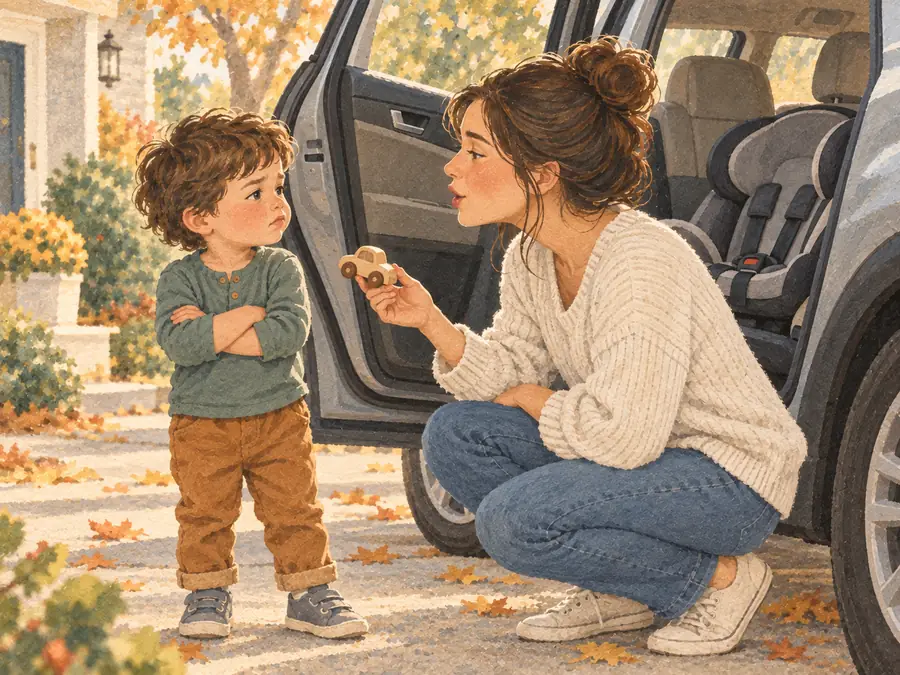
You have the door open, a bag over one arm, and your child goes rigid from heels to shoulders. The car seat fight is loud, it is public, and it lands on the morning you are already late.
What matters here:
- The arching tends to get worse somewhere in the second and third year, when refusal starts to work
- Check the seat before you change your approach: harness fit, hot buckle, bulky coat
- Car sickness sounds exactly like defiance from the driver's seat
- A warning, a job and the same order every time beat a new bribe every week
- The harness never flexes, however long the screaming lasts
Most advice jumps straight to distraction toys. Start lower down. Some of these fights are behaviour and some are something physical your child has no words for, and the physical ones are the easy ones to miss.
Quick Reference: why the car seat becomes the fight
| Cause | What it looks like | First move |
|---|---|---|
| Play interrupted | Protest starts at the front door | One-minute warning, then carry |
| Need for control | Says no to everything this week | Two real choices, both fine with you |
| Seat discomfort | Pulls at the straps once buckled | Check harness height, tightness, buckle temperature |
| Too hot or too padded | Sweaty neck, red face, thick coat on | Thin layers, coat over the harness |
| Car sickness | Fine at first, then pale and whiny | Fresh air, something to look at ahead |
Why it lands hardest around two
For the first year the car seat is something that happens to your child. Somewhere in the second year they work out that a body can refuse. The seat is an unusually good place to test that, because it removes every option at once: you cannot move, you cannot see much, and somebody else decides when it ends.
Then there is the timing. A drive almost always interrupts something. The block tower was there, and now there is a coat and a door and a strap. Same machinery as every other daily standoff, from getting dressed to the moment a toddler refuses every diaper change. Different room, same question about who decides what happens to my body.
The one rule that does not bend
Everything else here is negotiable. This is not.
A child is never driven unrestrained. Not for two minutes, not around the corner, not because the buckle is the only thing making the screaming stop. The American Academy of Pediatrics is blunt about rear-facing: "All infants and toddlers should continue to ride in a rear facing seat as long as possible until they reach the highest weight or height allowed by their car safety seat manufacturer" (AAP, HealthyChildren). Under the European i-Size standard (regulation ECE R129), height-based seats "must be rear facing until your child is 15 months old or over" (NHS).
Nothing extra goes through the straps either. The AAP says "do not use extra products unless they came with the seat or are specifically approved by the seat manufacturer," because those products "are not covered by any federal safety standards." A strap cover or clip that promises to stop an escape artist changes how the harness behaves in a crash. Skip it.
If the pull to just drive is getting strong, pull over instead. CDC child passenger safety guidance exists because these injuries happen on ordinary trips.
The coat is probably making it worse
Here is the part most parents have never been told. A bulky coat under the harness does not only make your child hot and cross. In a crash, "bulky clothing, including winter coats and snowsuits, can compress in a crash and leave the straps too loose to restrain your child, leading to increased risk of injury" (AAP winter guidance).
So the padding you added to make a cold seat bearable is quietly undoing the harness. Thin layers, buckle, then lay the coat over the top of the straps or put it on backwards.
While you are down there, run the pinch test: tighten until "you cannot pinch any slack between your fingers when testing the harness straps over the child's shoulders." A harness two clicks loose lets a determined toddler work an arm out, and that becomes a whole new fight at 80 km/h.
Check the buckle with the back of your hand in summer. Metal parked in the sun gets hot enough to make any child flinch, and a child who flinched once remembers that seat.
What works before you reach the car
The fight is usually decided in the hallway, not at the car door.
- One warning, one minute. Not five minutes and a countdown. One clear "shoes, then car", then you go.
- Give them a job. The keys, the unlock button, the water bottle. A child with a task is not a child being transported.
- Same order every time. Left arm, right arm, click, chest strap, done. A two-year-old who knows what comes next has less to resist.
- Two real choices. "This door or that one?" Both answers have to be fine with you, or they are not choices.
One family in beta noticed their evening pickup got easier the week they stopped asking "ready to go?" and started saying "shoes". The question had been an invitation to argue.
If your child falls apart at every handover, the wider pattern is in toddlers who get upset with routine changes, and the limit mechanics are in setting boundaries with toddlers.
When it is not defiance at all
Car sickness is the one most often missed, because from the front seat it sounds identical to a tantrum. The tell is the shape: fine at the start, steadily worse, especially on winding roads. The AAP is practical about it. If they have not eaten for three hours, "give your child a light snack before the trip," and "have her look at things outside the car, not at books or games" (AAP on car sickness). The NHS adds the one everybody forgets in February: "breathe fresh air if possible" (NHS).
Other physical suspects: teething, an ear that hurts more lying back, genuine overtiredness, or a harness nobody has raised since spring.
Wait, or change something?
- Protest stops within two minutes of moving → transition problem, work on the walk to the car
- Protest starts after ten minutes of driving → treat it as car sickness first
- Happens only with you → look at the order and the hurry, not at your child
- Started suddenly in a child who was fine → check fit, ears, teeth, anything new that week
- You are afraid of hurting them while buckling → stop, breathe, read the next section
Some of this simply passes. Not because you found the right trick, but because a three-year-old has better ways to say "I was not finished playing" than going rigid.
Common mistakes
- Escalating to force while both of you are already shouting
- A new bribe every week, which trains negotiation rather than ending it
- Buckling over a thick coat because it is faster
- Loosening the harness a little to stop the complaining
- Adding an aftermarket strap cover or anti-escape gadget that did not come with the seat
- Driving off unbuckled "just this once"
When to talk to your pediatrician
Vomiting on most journeys, going pale and clammy, or crying that ramps up once the car moves are worth mentioning, because the refusal is then a reasonable response to feeling awful. So is a sudden change in a child who used to be fine, especially alongside disrupted sleep or eating.
Ask for help too if buckling has become something you dread. That is not a character flaw.
Car seat refusal is one chapter of a longer stage. The rest is in our toddler behavior guide, and if the drives themselves are the problem, car travel with a baby to the coast covers pacing a long trip.
Frequently asked questions
How long does the car seat refusal phase last?
It usually shows up in the second year and eases as language and choice grow elsewhere, often during the third year. There is no fixed date. As a child gets more say in the rest of the day, the need to fight over this five minutes shrinks.
My toddler unbuckles the chest clip while I am driving. What do I do?
Pull over safely, re-buckle without conversation, drive on. Repeat every time with as little reaction as possible, because the reaction is often the point. Do not add an aftermarket clip or cover: those are not crash tested with your seat. If it keeps happening, get the harness fit checked.
Is it safe to hold a screaming child down to buckle them?
Steadying a thrashing child to close the harness is not the same as pinning them, and a closed harness is non-negotiable. But if force has become the everyday method, the buckling is no longer the problem. Change the ten minutes before the car instead.
Why does it only happen with me?
Very common, and rarely about you doing it wrong. It tracks the hurry, the time of day, and the fact that children save their hardest feelings for their safest person.
Does a screen in the car help?
Short term, often. Long term it has two costs: it tends to make car sickness worse, because the eyes lock on something still inside a moving car, and it becomes the only thing that works. Keep it for long drives.
How KidyGrow helps
Nobody remembers on Thursday what Monday's school run was like. Each of these small fights is forgettable, the pattern is not.
Note the rough ones as a behaviour event, one line each. The useful half arrives after the episode ends: you mark that the screaming stopped four minutes into the drive, three times running, and KidyGrow starts reading that as a pattern that begins before the car does. The Daily Brief points at the doorway, and the suggestion moves with it, to a job your child carries on the way out rather than one more thing to try once they are already rigid.
Sometimes it finds nothing. Some weeks really are teething and a bad rota.
Sources
- American Academy of Pediatrics, HealthyChildren.org. "Car Seats: Information for Families." https://www.healthychildren.org/English/safety-prevention/on-the-go/Pages/Car-Safety-Seats-Information-for-Families.aspx
- American Academy of Pediatrics, HealthyChildren.org. "Winter Car Seat Safety Tips." https://www.healthychildren.org/English/safety-prevention/on-the-go/Pages/Winter-Car-Seat-Safety-Tips.aspx
- American Academy of Pediatrics, HealthyChildren.org. "Car Sickness." https://www.healthychildren.org/English/health-issues/conditions/head-neck-nervous-system/Pages/Car-Sickness.aspx
- NHS. "Choosing a baby car seat." https://www.nhs.uk/conditions/baby/first-aid-and-safety/safety/choosing-a-baby-car-seat/
- NHS. "Motion sickness." https://www.nhs.uk/conditions/motion-sickness/
- CDC. "About Child Passenger Safety." https://www.cdc.gov/child-passenger-safety/about/index.html