 Kidy
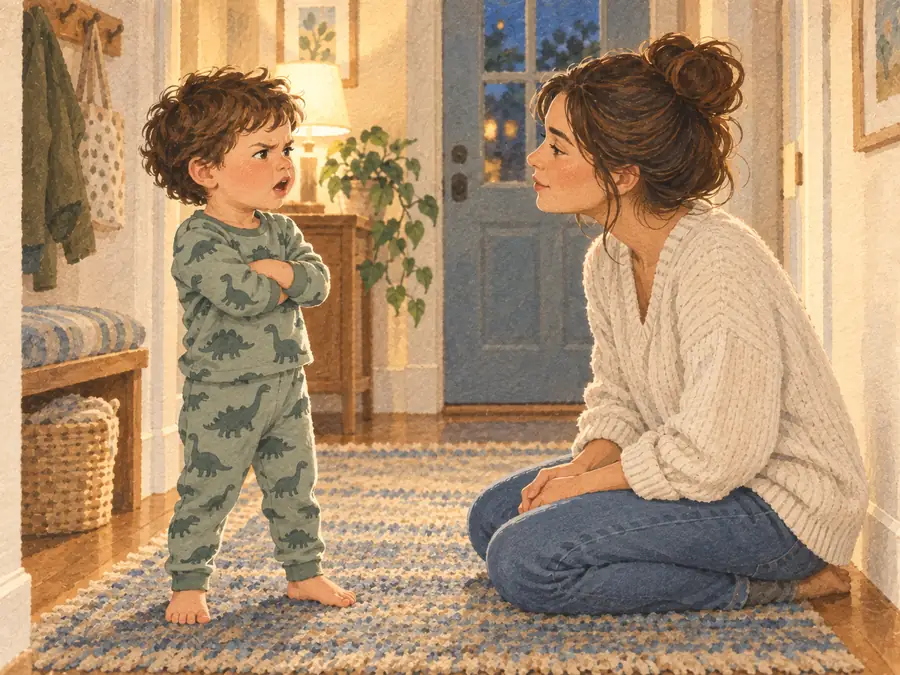
When a toddler or preschooler says "I hate you", it almost never means what it would mean from an adult. It is the biggest word they own for the biggest feeling they have, usually aimed at the person who just said no.
- Tantrums and big outbursts happen most between ages 1 and 3 and are a normal part of development (AAP).
- Naming the emotion you see gives your child a word for it and teaches that feelings can be talked about (CDC).
- Harsh words back, even from otherwise warm parents, lead to more misbehavior, not less (AAP).
- Much of it is simply a child who is tired, hungry, overexcited, frustrated or bored (NHS).
It still hurts. Knowing it is developmental does not stop your stomach from dropping when a three-year-old in dinosaur pyjamas says it with total conviction. Both things are true at once, and the rest of this article is about what to do with the second one.
Quick Reference
| Question | Short answer |
|---|---|
| Does my child really hate me? | No. It is a word for "I am furious and I don't have a better word" |
| Why me and not the babysitter? | The biggest reactions often land on the parent who sets the most limits and with whom your child feels safe |
| Should I punish it? | Punishing the feeling backfires. Respond to the words calmly, and hold the limit that caused them |
| What do I say? | One short sentence that names the feeling and keeps the limit |
| When does it fade? | As your child learns other words for anger, usually over months rather than days |
Why do toddlers say "I hate you"?
Because the feeling arrived before the vocabulary did. A two- or three-year-old can feel something enormous when the tablet goes off or the park is over, and "I hate you" is a phrase that clearly works: every adult in the room reacts to it.
Most children pick the word up somewhere. An older sibling, a cartoon villain, a kid at daycare. They notice it lands, so they try it at the next "no". That is less manipulation than research. The child is testing a new, powerful tool and watching what it does.
There is also a plainer reason. The NHS points out that a lot of difficult behavior happens because a child is tired, hungry, overexcited, frustrated or bored (NHS). Check the clock. A surprising share of "I hate you" moments land at 5:30pm, between the car and dinner.
And yes, it tends to be aimed at the parent who does most of the limits. If it is almost always you, that says more about who holds the rules than about how your child feels about you. Why toddlers act worse with one parent goes deeper on that pattern.
What it sounds like at different ages
At two, the phrase is mostly borrowed sound. Your child may not know what "hate" means, only that it is loud. The AAP describes anger and frustration at this age as erupting suddenly, in crying, hitting or screaming (AAP), and a borrowed phrase is just one more way out.
Around three and four, it becomes more targeted. "I hate you, you're the meanest" or "I'm going to live at Grandma's". Children this age are starting to understand that words affect other people, and they are experimenting with exactly how much.
By five, some children add bargaining to it ("I'll only love you if..."). Still not a threat. Still a child who cannot yet say "I am disappointed and I feel powerless", because that sentence is hard even for adults.
What to say in the moment
The goal in the moment is not to fix the feeling. It is to show that the feeling did not break anything.
1. Keep your face and voice boring. A big reaction teaches that the phrase is a powerful button. A flat, warm one teaches that it isn't. The AAP notes that ignoring bad behavior can be an effective way of stopping it (AAP), and here that means ignoring the word, not the child.
2. Name what you see. "You're so angry that the park is over." The CDC's advice is to describe the emotion your child seems to be having, which hands them a word for it (CDC).
3. Keep the limit. "We're still going home." If the shoes come off because of the phrase, the phrase just earned its place.
4. Say you're staying. "I'm right here." That is the whole answer to "I hate you" at this age.
Skip "Well, I love you anyway" in a wounded voice. It turns the moment into a conversation about your feelings, and a furious toddler cannot hold that.
What to do later, when everyone is calm
This is where the teaching happens. Not at the park gate.
Pick a quiet moment the same evening, bath time or the walk to daycare the next morning. Keep it short: "Earlier you were really mad at me. You said you hated me. What else could you say when you're that mad?"
Give them words they can use instead. "I'm so mad at you!" is allowed. So is "I don't like that!" or stomping three times. The AAP puts it simply: it's OK to feel mad, but not to hurt someone, and children need to be taught positive ways to deal with angry feelings, like talking about it (AAP). For more on accepting the feeling without accepting every behavior, see validating your toddler's big feelings.
You can also tell them, once and without guilt, that the words hurt. "When you said you hate me, that made me sad. I still love you. I'm not going anywhere." One sentence of honesty, then drop it.
Some families keep a phrase for this. One toddler's household settled on "I'm a volcano!" and it stuck for a year. It sounds silly written down. It worked because it was theirs.
If this happens, try this
- If it comes right after a limit: name the feeling, keep the limit, and move on. No debate.
- If it comes when your child is tired or hungry: deal with the body first. Snack, quiet, earlier bedtime. Talk about words tomorrow.
- If it is always aimed at one parent: that parent stays calm and consistent, and the other one backs them up rather than rescuing.
- If it comes with hitting or throwing: the hands get stopped first, gently and firmly, and words wait until your child has calmed.
- If you snapped back: repair. Repairing after yelling walks through how, and it matters more than getting it right the first time.
- If it happens many times a day for weeks: look at sleep, transitions and screen endings before you look at your child's character.
Common mistakes
- Taking it literally. Asking "Do you really hate me?" invites a three-year-old to answer yes, just to see what happens next.
- Punishing the word harder than the behavior. A time-out for "I hate you" but not for pushing a sibling teaches that words are the scarier thing.
- Shaming. "That's a horrible thing to say to your mother" loads guilt onto a child who cannot process it yet.
- Saying it back, even as a joke. Children cannot always tell a joke from a real threat when they are upset.
- Lecturing in the middle. Explanations during a meltdown sound like negotiation. Save them.
- Giving in to make it stop. Understandable. Also the fastest way to get more of it.
Harsh verbal discipline, even from parents who are otherwise warm and loving, is linked to more misbehavior and more mental-health problems in children (AAP). Warmth in the rest of the day does not cancel out yelling in the hard moment. The good news is that calm in the hard moment counts for a lot.
When to seek help
Most "I hate you" phases pass on their own once a child has other words for anger. Talk to your pediatrician if:
- aggression keeps repeating alongside the words, or a person or animal gets hurt
- your child seems angry, withdrawn or unhappy most of the time, not only after limits
- your child repeatedly says they are bad, stupid or want to hurt themselves
- daycare or preschool describe the same outbursts and they are getting worse
- you find yourself dreading time with your child, or your own anger scares you
The AAP also suggests talking with your pediatrician if you're concerned about aggressive behaviors like hitting, kicking or biting (AAP). If the bigger issue is anger in general, what to do when your child is angry all the time goes further. For where this fits among hitting, tantrums and refusals, see the toddler behavior guide.
Frequently asked questions
Is it normal for a 3-year-old to say "I hate you"?
Yes, it is common in the preschool years. Children at this age feel intense anger and have few words for it, so they grab the strongest one they know. Talking to a professional makes particular sense if it comes with repeated aggression, low mood most days, or talk of hurting themselves.
Should I ignore it when my toddler says "I hate you"?
Ignore the word, not the child. Stay calm, name the feeling ("You're really angry"), keep the limit, and stay close. Talk about better angry words later, when you are both calm.
Why does my child say "I hate you" only to me?
The strongest reactions often happen with the parent who sets the most limits and with whom your child feels safe. That tends to be a sign of where the rules live, not of how much your child loves you.
Should I tell my child that it hurt my feelings?
Yes, once, calmly and later, not in the moment. A short "That made me sad, and I still love you" teaches that words land on real people, without loading guilt onto a small child.
How long does the "I hate you" phase last?
It varies. For many children it fades over a few months as they learn other ways to say they are angry. If you answer it the same calm way every time, it usually loses its power sooner.
What should I do if my toddler says "I hate you" and hits me?
Stop the hitting first, calmly and firmly, and keep everyone safe. Words can wait until your child has calmed down. If hitting happens often, the article on co-regulation explains why your calm body does more than any sentence.
How KidyGrow helps you
The third "I hate you" of the week tends to blur into the first two. Was it before dinner every time, or only on daycare days?
Log it in KidyGrow as a behavior moment, with one line on what came just before. The app remembers what you won't. After three to five days it may notice the outbursts cluster on evenings after a short nap, and the Daily Brief may suggest an earlier dinner. Sometimes it finds nothing, and a hard week is just a hard week.
What changes is that you stop taking the phrase personally, because you can see it has a time of day.
_This content is for information and does not replace medical advice._
Sources
- AAP, HealthyChildren.org: Top Tips for Surviving Tantrums (accessed 2026).
- AAP, HealthyChildren.org: Disciplining Your Child (accessed 2026).
- AAP, HealthyChildren.org: Emotional Development, 2 Year Olds (accessed 2026).
- CDC, Essentials for Parenting Toddlers: Tips for Connecting and Communicating (accessed 2026).
- NHS: Dealing with child behaviour problems (accessed 2026).