 Kidy
Kidy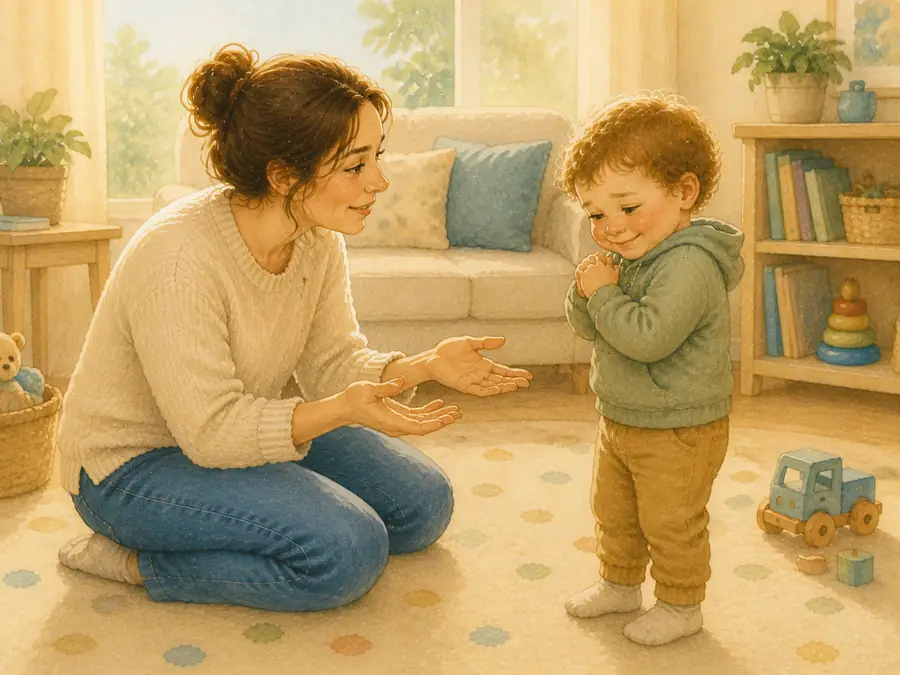
A toddler who laughs, smiles, or smirks while being corrected isn't mocking you. Researchers call this "incongruent affect," a positive-looking expression during a stressful moment, and it's been studied in young children as a possible self-regulation response, not defiance.
- Laughing or smiling during a scolding can be a common toddler reaction, not a sign your child doesn't care
- The behaviors researchers group under "incongruent affect" (smiling, laughing, or joking during a negative moment) have been studied in preschool and early-school-age children as a possible emotion-regulation strategy, not disrespect
- A toddler's brain still handles big, uncomfortable feelings through circuits that are far from mature, so a mismatched reaction is more likely than a composed, "serious" one
- The boundary you're setting still counts, even when the reaction on your child's face says otherwise
Quick Reference
| What you're seeing | What's likely happening | What helps |
|---|---|---|
| Giggling or smiling mid-correction | A stress response, not amusement at your expense | Stay calm, keep the correction short, don't chase the laugh |
| Smirking that looks defiant | Could still be discomfort, toddlers' faces don't always match what they feel inside | Name the behavior, not the face: "The hitting stops, not the smiling" |
| Laughing, then genuinely upset a moment later | The laugh was the first wave, not the last word | Give it a minute before deciding the correction didn't land |
| No emotional reaction at all, ever, to anyone's distress | Worth a conversation with your pediatrician | Track the pattern across settings before assuming it's just a phase |
Why does my toddler laugh when I'm trying to discipline them?
Cognitively, a toddler often knows they've done something they shouldn't have. Emotionally, they don't yet have a reliable way to act on that. The brain systems involved in managing big feelings, including the prefrontal cortex, are still under construction at this age, so what comes out doesn't always match what's actually happening inside.
Researchers studying what they call "incongruent affect", smiling, laughing, or joking during a stressful or disappointing moment, have looked at this in preschool and early-school-age children specifically. One review describes it as a possible active coping strategy: a way some children manage overwhelm rather than a sign they don't feel anything (see Sources). Toddlers weren't the specific age group in that research, but the underlying idea, that a young child's outward expression and inward experience can be mismatched, holds even earlier, when self-regulation is even less developed.
There's also a simpler layer to it. A toddler who feels caught, or senses your tone shift, may laugh the way some people laugh when they're nervous or embarrassed, not because the moment is funny, but because the body needs to do something with the tension. It's the same instinct behind a nervous giggle at a funeral or a laugh right after tripping in public, just running through a much less developed nervous system.
What this actually looks like
It rarely looks like calculated mockery, even though it can feel that way in the moment. More often it's a giggle right as you say "no," a grin while you're mid-sentence about not hitting, or a full laugh the second a toy gets taken away for throwing it.
Sometimes the laughing gives way to real upset within a minute or two, once the initial reaction passes and the actual disappointment catches up. Other times a toddler laughs, seems fine, and moves on entirely, which can be its own kind of confusing for a parent expecting more visible remorse.
Is it nervous laughter, or something else?
Most of the time, laughing during discipline is exactly what it looks like on the surface: an immature, mismatched stress response. Occasionally it's worth a closer look.
Nervous or stress-response laughter is likely if:
- It happens specifically around correction, not as a general reaction to other people's distress
- Your toddler still shows normal affection, concern, and connection at other times
- The pattern is inconsistent, some days there's laughing, other days there's crying or normal listening
Worth discussing with your pediatrician if:
- There's a broader pattern of little to no emotional response to hurting others or being corrected, not just laughing in this one context
- You notice this alongside other social-emotional differences you can't explain
- The behavior doesn't shift at all no matter how you respond, over a genuinely sustained period
See why does my toddler ignore everything I say if the bigger pattern feels more like tuning you out than a nervous reaction. If the behavior around discipline is escalating into hitting rather than laughing, what to do when your toddler hits other kids covers that specific version of the problem.
What actually helps in the moment
Keep the correction short and separate from the reaction on their face. "We don't hit. Hands are for helping" lands the same whether your toddler is crying, laughing, or staring blankly at you.
Don't escalate to match the laugh. Raising your voice or adding a second correction ("and stop laughing!") usually just adds a new thing to react to, not less confusion, more of it.
Give the moment a beat before deciding nothing sank in. Positive discipline works on a slight delay at this age; the lesson can still be landing even while the face in front of you looks unbothered.
Sometimes there's no visible reaction at all that tells you the correction worked, and that's uncomfortable to sit with. You won't always get the feedback you're looking for in the moment. The behavior changing over the following days is the actual signal, not the toddler's expression right now.
Common mistakes to avoid
Taking the laugh personally. It rarely has anything to do with whether your toddler respects you. Reacting as though it does tends to escalate a moment that was already going to pass on its own.
Honestly, I know this from both sides. I still laugh when I'm scared or feel threatened myself, less often than I used to, but it still happens. Knowing that doesn't help me one bit in the moment I see the same laugh on my own daughter's face. Even knowing what it probably means, I fall into the same trap and read it as defiance for a second anyway.
Adding punishment for the laughing itself. Setting boundaries with toddlers works best when the boundary stays about the original behavior. Punishing the reaction on top of the behavior teaches a toddler to hide the reaction, not to feel less overwhelmed.
Assuming the lesson didn't land because the face didn't match. A toddler's expression is not a reliable readout of whether a boundary registered.
Skipping connection afterward. Connection before correction still applies here. A brief reconnect once everyone's calm, a hug, a "we're okay," matters more than reading meaning into the laugh itself.
When to seek professional help
Occasional laughing or smirking during discipline in an otherwise warm, connected toddler is not a red flag on its own. Talk to your pediatrician if you're seeing little to no emotional response to correction or to other people's distress as a consistent pattern, not an occasional laugh, especially alongside other social or emotional differences that concern you. A pediatrician can help sort out whether what you're seeing is typical developmental mismatch or something worth a closer evaluation.
Laughing at a firm "no" belongs to the same family as testing limits at the table and at bedtime. The toddler behavior guide walks through that whole stage, including which responses hold up and which teach the wrong lesson.
Frequently asked questions
Is my toddler laughing at me on purpose?
They might be laughing partly because they've noticed your reaction, but laughing during a correction on its own isn't proof they're mocking you or don't care. What looks calculated is usually an immature stress response, not calculated mockery.
Does laughing mean the discipline isn't working?
Not necessarily. A toddler's expression in the moment isn't a reliable measure of whether the correction registered. Watch the behavior over the following days, not the face during the correction.
Should I ignore the laughing completely, or address it?
Address the original behavior, not the laugh. Naming the laugh directly ("why are you laughing, this isn't funny") usually adds confusion rather than clarity for a toddler who isn't laughing on purpose in the first place.
Is this connected to my toddler not seeming to care when they hurt someone else?
It can look similar from the outside, but they're usually different things. Nervous laughter during discipline is about the correction itself. A consistent lack of concern about hurting others, across many situations, is the pattern worth mentioning to your pediatrician.
Will my toddler grow out of laughing during discipline?
Self-regulation develops gradually through the preschool years, and expressions tend to match feelings more reliably as that develops. There's no fixed age when this specific reaction disappears for every child.
My toddler laughs with me but not with the other parent. Does that mean something?
Not necessarily anything specific. Kids often read tone, routine, and history differently with each caregiver, and that alone can explain a different reaction without pointing to a bigger issue.
How KidyGrow helps you
One laugh mid-correction doesn't tell you much. What tells you more is whether it's the same story every time, or whether it's actually one piece of a bigger pattern you haven't connected yet.
The app remembers what a parent juggling a dozen small moments a day can't hold onto by evening. Log a correction and what happened around it, the same way you'd track toddler behavior patterns generally, and it keeps the pattern separate from any single confusing moment. Day one, it might just note that the laughing happened during a hitting correction, right before dinner. By the second week, the Daily Brief might say something like: the laughing shows up most on days with a skipped nap, and settles into real listening once the wobbly stretch passes.
Sometimes a moment really is just a moment, a weird reaction on a random Tuesday with nothing behind it, and the app won't manufacture a pattern where there isn't one. The point isn't decoding every laugh. It's noticing if something's actually building, instead of guessing from one confusing evening.
Sources
- Sege, R.D., Siegel, B.S., American Academy of Pediatrics. "Effective Discipline to Raise Healthy Children." Pediatrics, 2018. https://pubmed.ncbi.nlm.nih.gov/30397164/
- American Academy of Pediatrics, HealthyChildren.org. "What's the Best Way to Discipline My Child?" https://www.healthychildren.org/English/family-life/family-dynamics/communication-discipline/Pages/Disciplining-Your-Child.aspx
- "Incongruent Affect in Early Childhood: Neurobiological Markers and Links to Psychopathology." PMC, National Institutes of Health. https://pmc.ncbi.nlm.nih.gov/articles/PMC10169541/