 Kidy
Kidy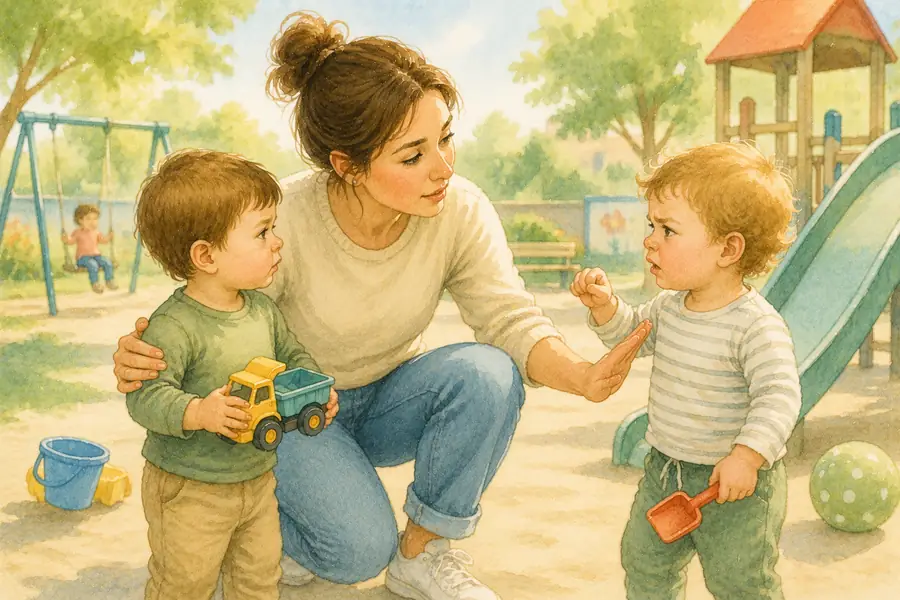
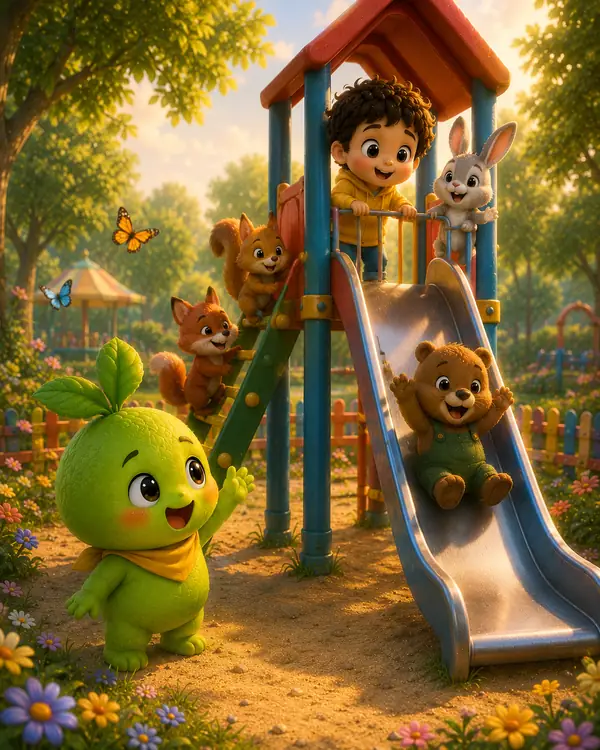
Your child just shoved another kid off the slide, and four parents are watching. Toddlers who hit other children usually do it because:
- It's the age for it: by 17 months the large majority of children hit, push or bite siblings, peers or adults at least sometimes (Tremblay et al., 2004).
- They don't have the words yet, so a hand says what a sentence can't.
- They're overwhelmed - too many kids, too much noise, too close together.
- They're testing what happens, the same way they test gravity by dropping food.
This is one of the most common behaviors at the playground and in daycare drop-offs, and it almost never means your child is aggressive or that you did something wrong. It means a small person with big feelings ran out of better options. Here is what to do in the moment, what to skip, and how to make it happen less often.
Related: The full toddler behavior management guide covers the bigger picture; what gentle parenting actually is explains the calm-but-firm stance behind every script below.
Quick reference: toddler hitting other kids
| Question | Short answer |
|---|---|
| Is it normal? | Yes. Most children are physically aggressive at times from around 17 months, and most learn alternatives before school |
| Why does it happen? | Immature impulse control, no words yet, overwhelm |
| First thing to do? | Get low, calm, protect the other child, few words |
| Does punishment help? | No - shame and hitting back make it worse |
| When to get help? | If it's frequent, intense, and not easing as your child gets older |
Hitting peaks early, and most children grow out of it
Here is the part that surprises parents. A Canadian study that followed 572 children from birth found that by 17 months the large majority were physically aggressive towards siblings, peers or adults. From there the children split into three paths: about 28% hit little or not at all, about 58% showed modest aggression, and about 14% followed a high, rising path. The authors' conclusion: most children start using physical aggression as toddlers, and most learn to use alternatives before they start school (Tremblay et al., 2004).
In other words, children don't learn to hit from the playground and then get worse. They start out hitting, and learn not to. Your job isn't to stamp out something unusual; it's to teach the alternative, many times, calmly.
The same study found that young siblings at home and a lot of family stress were among the things linked to the high path. If your household is stretched thin right now, the hitting may be telling you that too.
Why does my toddler hit other children?
Hitting peers is not the same as hitting at home. With another child involved, the trigger is almost always social load: a contested toy, an invaded personal bubble, a turn that ended too soon, or simply too many bodies in one small space. Toddlers act on impulse long before they can stop and think, so a feeling becomes a movement in well under a second.
There's also communication. A 22-month-old who can't yet say "that's mine" or "move back" often defaults to the fastest tool available - a push or a swat. The hit isn't a character flaw. It's a vocabulary gap.
And then there's the setting itself. A birthday party with fifteen overstimulated kids is a different planet from a quiet living room. A tired, hungry toddler has even less patience than usual, and a crowd takes away the space they would normally retreat into. Hungry, tired and crowded is the usual storm.
What to do the moment your toddler hits another kid
Speed and calm matter more than the perfect speech. The goal is to stop the harm, tend to both children, and keep your own nervous system steady so theirs can borrow it.
- Move in and stop it. Step between the two children or gently block the next swing. Calm body, low voice.
- Get down to eye level. Crouch. You are now a person, not a tower issuing commands.
- Tend to the child who was hit first. "Are you okay? That hurt." This teaches your child that the other person matters, without a lecture.
- Name it simply, for your child. "You were mad. We don't hit. Hitting hurts." Eight words, not eighty.
- Offer the do-instead. "You can say 'my turn' or come get me." Give the hand a job that isn't hitting.
- Move on. Redirect to a new activity. Lingering in the shame keeps everyone stuck.
That's it. No long negotiation. Toddlers don't learn impulse control through a courtroom summary - they learn it through hundreds of calm, boring repetitions of the same short script. This calm, named, redirect rhythm is the same backbone we use in our broader calm 3-step plan for toddler hitting, just applied to a peer setting.
The other family is right there: what to say
The hardest part of hitting at the playground isn't your child. It's the audience. Here is the part nobody tells you: a brief, warm acknowledgment to the other parent does more than any performance of strictness.
"I'm so sorry - we're working on hands." That's the whole script. You don't have to over-apologize, and you absolutely don't have to put on a loud disciplinary show to prove you're a Good Parent. The other parent of a two-year-old has been exactly where you are standing. If your child is verbal enough, a small repair - handing back the toy, a wave, a "sorry" they may or may not mean yet - is a fine model. If they're not, you do the repair for them. Repair is a skill you demonstrate before they can perform it.
Decision logic: when to step in vs. when to wait
Not every brush between toddlers needs a parent parachuting in. Quick read:
- If contact is about to happen or just did → step in immediately, body between them.
- If they're squabbling over a toy but no one's hurt → pause a beat; toddlers sometimes resolve it, and constant refereeing robs them of practice.
- If your child is escalating - stiff body, loud, winding up → move closer before the swing, not after.
- If they're clearly overwhelmed - covering ears, melting down, frozen → this is a sensory exit, not a discipline moment. Leave the situation, regulate, return later.
- If the same child is the target repeatedly → separate the pair for now and reset the play.
The judgment call is whether a body is at risk. Property disputes can sometimes simmer. A raised hand cannot.
What NOT to do
Good intentions backfire here more than almost anywhere.
- Don't hit back or "show them how it feels." Pinching or smacking to teach that hitting hurts only teaches that big people hit small people. The AAP says spanking often increases aggression and anger in children (AAP).
- Don't over-lecture. A three-minute speech about kindness lands as noise. In a charged moment, one short sentence is about all that gets through.
- Don't force a hollow "say sorry." A coerced apology teaches performance, not empathy. Model the repair instead; the genuine sorry comes later, on its own.
- Don't label the child. "You're being mean" or "bad boy" sticks to identity. "That hurt her - we use gentle hands" sticks to the behavior, which is the only thing they can actually change.
- Don't shame in front of the crowd. The AAP's policy on discipline puts yelling and shaming in the same group as physical punishment: minimally effective in the short term and not effective in the long term (AAP, 2018). Quiet and close beats loud and far.
If punishment is your instinct under all those watching eyes, our guide on how to stop hitting without punishment walks through why it backfires and what replaces it.
Drop the lecture. Tend the hurt child, name the rule, move on. The boring version works.
How to prevent hitting at the playground and daycare
Prevention is mostly about reading the setup before the swing happens. Most peer hitting clusters around predictable conditions: hunger, fatigue, a new or crowded space, and unstructured competition over the same toy.
- Time it right. A well-fed, well-rested toddler has a much longer fuse. The playground right before nap is a trap.
- Shrink the crowd when you can. One calm friend beats six wired ones for a child who's still learning to share space.
- Pre-load words. On the way there: "If you want a turn, you can say 'my turn' or tap my leg." Rehearsed phrases surface faster under pressure.
- Watch for the wind-up. The stiff shoulders, the grabbing, the rising pitch - that's your 10-second warning. Move in before, not after.
- Bring duplicates. Two shovels in the sandbox prevents more conflicts than any lecture about sharing.
One pattern parents notice: the Tuesday meltdown at daycare pickup often traces back to a skipped or too-short nap that day, not to the friend who took the dump truck. The trigger is rarely the obvious one. If biting is also in the mix, the same prevention logic applies - see what to do about toddler biting. And when the underlying mood is constant frustration rather than the odd flare, a child who's angry all the time is a closer fit.
When hitting other kids is beyond typical
Most peer hitting fades as language and self-control mature, and most children have learned alternatives before they start school. Talk to your pediatrician or a developmental specialist if you see:
- Frequent, intense hitting that isn't easing with age and consistent response.
- Hitting that seems unprovoked, cold, or aimed at causing harm rather than reacting to a moment.
- Hitting paired with delays in speech, eye contact, or play.
- Behavior that's getting your child excluded from daycare or playgroups.
The CDC's developmental milestone guidance is a useful baseline for what's typical at each age. A red flag isn't a single bad afternoon - it's a frequent, intense, non-fading pattern. If your gut says something's off, that instinct is worth a conversation, and it's never an overreaction to ask.
Frequently asked questions
Is it normal for a toddler to hit other children?
Yes. By 17 months most children are physically aggressive at times, while impulse control and language are both still under construction. It typically fades as both mature. Frequency, intensity, and whether it's improving with age matter more than the hitting itself.
Should I make my child say sorry to the other kid?
A forced "sorry" teaches performance, not empathy. Instead, model the repair yourself - check on the hurt child, hand back the toy, say the sorry your toddler can't yet mean. A genuine apology grows from seeing it modeled, over time.
My toddler only hits other kids, never at home. Why?
Home is calm and predictable; peer settings are loud, crowded, and full of competition over the same toys. The trigger is social load, not your child's character. Fewer kids, better timing around naps and meals, and rehearsed words all lower the odds.
What if it happens at daycare and I'm not there?
Ask the caregivers what tends to come right before it - the time of day, the activity, the other child involved. Daycare hitting often clusters around transitions, crowding, or the end-of-day tired window. A consistent, calm response from the same caregivers helps more than any single conversation at home.
Is hitting back ever okay to teach a lesson?
No. Hitting back teaches that big people hit small people when they're upset, which is the opposite of what you want. The AAP says spanking often increases aggression and anger (AAP). Calm, brief, and consistent beats forceful every time.
How long until it gets better?
With a steady, non-shaming response, many families see real progress within a few weeks. But some weeks are just teething plus a growth spurt plus chaos, and progress stalls. That's normal. The trend over a month tells you more than any single playground.
How KidyGrow helps
Hitting at the playground feels random in the moment. Across a few weeks it often isn't, but nobody can hold fourteen days of pickups, naps and bad afternoons in their head.
In KidyGrow you log a rough moment as behavior, with Aggression as one of the types, plus a note on where it happened and what came right before. Naps and meals go in the same way, so you can look back over the week and see them side by side.
KidyGrow won't link the hitting to naps for you or promise a pattern. It remembers the week, so the thread you suspect, like the playground after a short nap, is something you can check instead of guess.
_This content is educational and does not replace advice from your pediatrician or a child development professional._
Sources
- American Academy of Pediatrics. "Disciplining Your Child." HealthyChildren.org.
- Centers for Disease Control and Prevention. "Important Milestones." CDC Learn the Signs. Act Early.
- Tremblay RE, Nagin DS, Séguin JR, et al. (2004). Physical aggression during early childhood: trajectories and predictors. Pediatrics, 114(1), e43-50. https://pubmed.ncbi.nlm.nih.gov/15231972/
- Sege RD, Siegel BS; AAP (2018). Effective Discipline to Raise Healthy Children. Pediatrics, 142(6), e20183112. https://pubmed.ncbi.nlm.nih.gov/30397164/