 Kidy
Kidy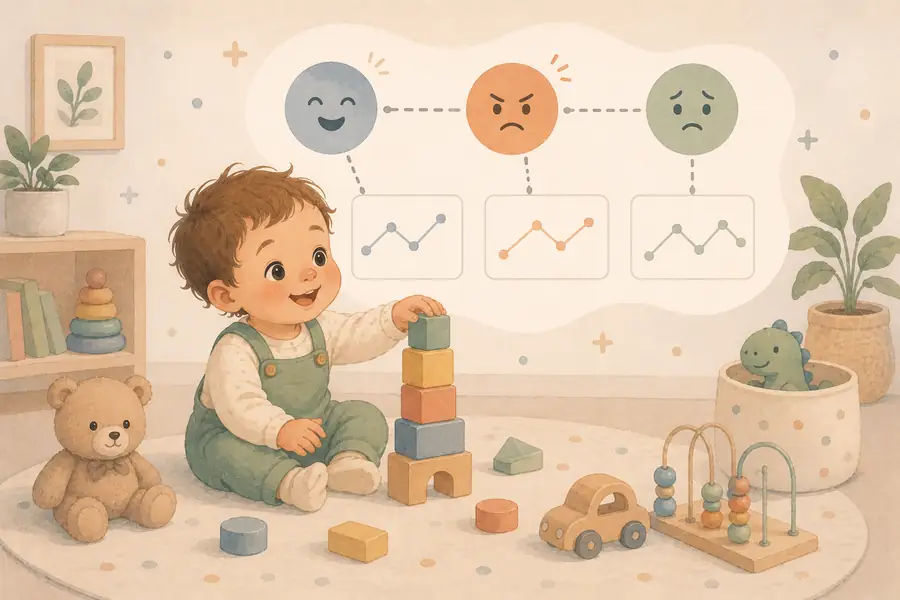
Tantrums and big feelings look chaotic until you separate the headline moment from the repeating story underneath:
- Log three fields consistently: trigger, intensity (1–3), recovery time in minutes
- Recovery time is usually a stronger pattern signal than how loud the moment felt
- Behavior is not only temperament. Sleep, hunger, and sensory load shift the threshold daily.
- Look for patterns across 5–7 days, not one day.
This is the behavior sub-pillar of our pattern-tracking cluster. Start with the parent page: Track your baby's patterns. For a specific situation (tantrums, food refusal), the entry articles at the bottom are faster.
_Educational only. Not medical advice. Last updated: February 2026._
Quick reference
| Field | What to capture | Why it matters |
|---|---|---|
| Trigger / context | What happened in the 5 min before? | Transitions, hunger, fatigue, sibling, screen, noise |
| Intensity 1–3 | Simple scale, perfection is not the goal | Patterns show up in the simple scale, not the precise one |
| Recovery (minutes) | Time until regulation returned | The strongest pattern signal you can capture |
| Time of day | Late afternoon? Morning? | Late-afternoon clusters are usually fatigue + hunger |
| Sleep the night before | Hours, quality | Sleep debt is a multiplier on every threshold |
What "tracking behavior" looks like in practice
You are not running clinical research. You are building a small map of what tends to repeat in your week, so that the meltdowns stop feeling random and start showing you which lever is most worth changing.
A few age realities the American Academy of Pediatrics keeps coming back to (healthychildren.org, 2024):
- Toddler emotional regulation is still developing until roughly age 4–5
- Tantrums in the 1–4 range are a normal developmental signal, not a parenting failure
- Co-regulation (calm adult presence) supports regulation faster than discipline of the emotion itself
A real-life example: a toddler melts down when play ends every evening, not "randomly," but predictably after high stimulation and a late nap. Parents often label it "defiance," while the repeating pattern is transition + fatigue. One week of tracking surfaces it; one rough Tuesday does not.
How to review behavior data without shame
When you review the week, ask three questions, in this order:
- Do hard moments cluster at the same time of day?
- Do they follow missed sleep, illness, or big transitions?
- Does recovery get faster when you change one variable (earlier snack, calmer transition script, quieter evening)?
You are looking for repeatable conditions, not a verdict on your child. Tracking triggers for a week before you adjust anything works better than reacting to each episode with a punishment or a reward.
Co-regulation vs "fixing" the feeling
Naming feelings and staying steady is not the same as giving in. The boundary and the regulation are different jobs. Your log helps you see whether meltdowns shorten when you slow transitions, even when the limits stay the same.
You can hold a boundary and still reduce stimulation: short sentences, slower pace, fewer repeated explanations in the heat of the moment. If your notes show shorter recovery when you use a calmer script at transitions - that is actionable, not proof you were "too strict" before.
Sensory load, hunger, and "end of day" meltdowns
Many families see a reliable late-afternoon spike that is not attitude - it is accumulated stimulation plus falling blood sugar. A tiny snack at 15:45 and a calmer transition can change the whole evening, but you will not believe it from one anecdote. Five days of tracking is what convinces you.
Caregiver mismatch: same kid looks "different"
If daycare reports "great day" and home feels explosive, you are not imagining things. You may be seeing different thresholds after the child held it together elsewhere. Tracking lets you compare apples to apples: time of day, sleep the night before, and recovery time, not labels.
A simple weekly review (10 minutes)
Open your notes and scan only for repeats:
- Top three triggers that showed up more than once
- Time-of-day clusters (late afternoon vs mornings)
- Recovery time trend (shorter vs longer across the week)
Then pick one experiment for the next 5–7 days: calmer transition script, earlier snack, quieter evening, fewer transitions, or clearer limit with warmth. Not all at once.
If you only track one thing, track recovery
Intensity is memorable; recovery is informative. Recovery tells you whether the environment returned to safety for your child's nervous system, and whether your next step helped or added fuel. The NHS parenting resources echo this: recovery time is one of the most useful signals for caregivers trying to read regulation patterns (NHS, 2024).
Frequently asked questions
When do tantrums stop?
For most children, frequency drops noticeably between ages 3.5 and 4.5 as language and regulation skills mature. Intensity often drops earlier; frequency lingers a bit longer.
What if my child's "normal" is different from other kids?
Some children are more sensitive to sensory load, hunger, or transitions than others. Your log compares your child's week to your child's previous week, not to the average. That is the only valid comparison.
Should I record every small frustration?
No, only what you would normally remember (intensity 2 or 3). Recording every small "no" turns tracking into a burden. The pattern shows up just fine with the meaningful events.
My partner and I disagree on what "intensity 2" means. Does it matter?
Less than you think. As long as you each use your own scale consistently, the trend reads accurately. Calibration across caregivers is nice but not necessary.
When does this stop being "behavior" and start being something to evaluate?
Talk to your pediatrician if you see breath-holding, head-banging that causes injury, frequent extreme distress lasting more than 25 minutes, regression in language or social skills, or any concern about safety.
How KidyGrow helps with this
KidyGrow does not stop tantrums. The app remembers what you can't track in real time - triggers, intensity, recovery - so you stop relying on stressed-out memory when you sit down to figure out what changed this week.
- Daily Brief each morning surfaces the most likely lever for your child based on the last 5–7 days. Not "toddlers go through phases", the actual transition or time-of-day pattern your log is showing.
- Tonight plan reflects yesterday's pattern.
- Child Insights ties the week together: which triggers repeated, how recovery times moved, what changed since last week.
Day one, the brief offers something generic: "try a calm-down ritual." After a week of logs it reads: "Your toddler's three biggest meltdowns this month all happened within 90 minutes of a lunch after 13:00. Try moving lunch 30 minutes earlier this week." That is the lever you would not have spotted in real time.
Honest expectation. The app warms up over 3–5 days of consistent logging. By day five the pattern reads off the screen. You will not get useful behavior data from one logged meltdown - that is by design. Some weeks the picture is just illness or daycare disruption, and the app will say so rather than invent a story.
KidyGrow's free tier covers the baseline → one change → compare loop for behavior the same way it does for sleep. After two weeks of normal logging, you stop arguing with yourself about whether last Tuesday was bad. You just look.
Related (behavior cluster)
When to call your pediatrician
If you worry about safety, developmental regression with other red flags, or your child seems in distress beyond typical tantrums, seek professional guidance. The CDC milestone tracker at Learn the Signs, Act Early is a useful first reference.
Sources
- American Academy of Pediatrics. Temper Tantrums. healthychildren.org, 2024. https://www.healthychildren.org/English/family-life/family-dynamics/communication-discipline/Pages/Temper-Tantrums.aspx
- NHS (UK). Baby and toddler behaviour guidance. nhs.uk, 2024. https://www.nhs.uk/conditions/baby/
- Centers for Disease Control and Prevention. Developmental Milestones. Learn the Signs. Act Early. CDC, 2024. https://www.cdc.gov/ncbddd/actearly
_Educational only. Not medical advice._