 Kidy
Kidy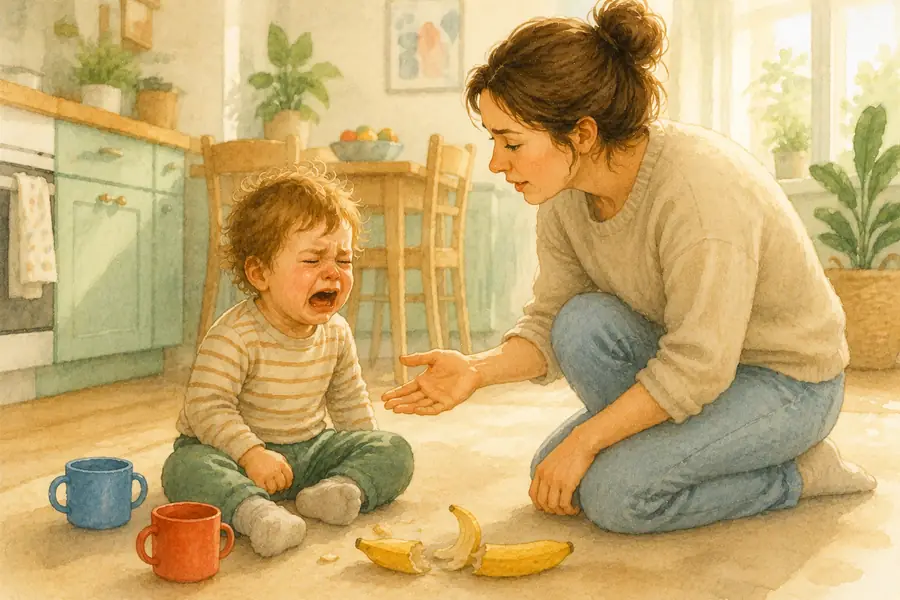
The wrong cup. A banana that snapped in half. The door they wanted to open themselves but you opened first. To you these are nothing. To a two-year-old they can be the end of the world, and the screaming that follows is real distress, not manipulation.
Toddler meltdowns over small things usually come down to:
- An emotional brain that runs years ahead of the brain region that calms it (AAP)
- A still-forming sense of control, so losing it over a "tiny" thing feels enormous
- Hunger, tiredness, or overstimulation lowering the threshold for everything
- Big feelings with almost no words yet to explain them
This is normal toddler development, not bad behavior or bad parenting. Below is why "small" to you is huge to them, how a meltdown differs from a tantrum, and what actually helps in the moment versus what prevents the next one.
Quick reference: meltdowns over small things
| Question | Short answer |
|---|---|
| Is it normal? | Yes, very common between roughly 18 months and 3–4 years |
| Why "small" things? | To the child the loss of control or the broken object is not small |
| Meltdown or tantrum? | Tantrum has a goal; a meltdown is the brain overwhelmed past control |
| What helps most? | Calm presence first, words and fixing second (co-regulation) |
| When to seek help? | If it derails daily life, comes with regression, or worries you |
Why do toddlers have huge meltdowns over tiny things?
Because the part of the brain that feels things is far ahead of the part that manages them. The amygdala, which fires up fear, anger, and frustration, is active from birth. The prefrontal cortex, the brakes that let us pause and self-soothe, keeps developing into the mid-twenties (AAP, HealthyChildren.org).
So a toddler feels a flood of frustration with almost no built-in way to dam it. The banana broke. To them, something they expected and counted on just shattered, and they have no tool yet to think "it tastes the same, no big deal." That thought needs a brain they do not have yet.
Two more things stack on top. First, toddlers are driven to do things themselves. Autonomy is a developmental engine at this age, so when you open the door they wanted to open, you have not annoyed them, you have taken away the one thing they were trying to master. Second, the same upset that they would shrug off rested and fed becomes a screaming heap when they are hungry or overtired. The trigger is the cup. The fuel was the 5:10 missed snack.
What's the difference between a meltdown and a tantrum?
People use the words interchangeably, but the distinction is useful.
A tantrum has a goal. The child wants the candy, the screen, the toy, and the crying is, partly, a strategy. There is often a glance to check whether it is working. A tantrum tends to wind down once the goal is clearly off the table and the child gets calm attention instead of a reaction.
A meltdown is not strategic. It is the nervous system overwhelmed past the point of control (ZERO TO THREE). The child is not choosing it and often cannot stop it on demand, the way you cannot stop a sneeze halfway. Meltdowns can come from sensory overload, exhaustion, or a frustration that tipped over. Trying to bargain or discipline a meltdown rarely works, because there is no one home to negotiate with yet.
In real life the line blurs. A tantrum over the wrong cup can spill into a full meltdown when the child crosses their own limit. That is why your first move is the same for both: get them calmer before you do anything else.
Co-regulation: how children borrow your calm
Toddlers cannot regulate big feelings alone. They borrow it from a calm adult, a process called co-regulation, and it is one of the most studied building blocks of healthy emotional development (CDC).
In plain terms: your nervous system talks to theirs. If you get loud and tense, their alarm climbs. If you stay low and steady, their body slowly reads "safe" and the storm passes faster. You are the brakes their brain has not grown yet.
This does not mean you feel calm. Most days you will not. It means you act calmer than you feel for ninety seconds, which is roughly how long the worst surge lasts. Lower your voice instead of raising it. Get down to their level. Fewer words, slower body. You are not rewarding the screaming. You are lending a brain.
What helps in the moment
Once a meltdown is rolling, logic is offline. Save the teaching for later.
- Get low and close. Crouch to eye level, soften your face. Presence over speech.
- Name the feeling, briefly. "You wanted the blue cup. You are so mad." Naming, sometimes called "name it to tame it," helps the upset start to organize.
- Drop the lecture. Now is not the time to explain why the banana is still good.
- Offer contact, let them refuse it. Some kids want a lap; some need space and a hand nearby. Both are fine.
- Wait it out. The surge crests and falls. Your steadiness is the intervention.
Afterward, when they are calm and reconnected, you can say one short sentence about what happened. Not a debrief. A bridge back.
What prevents the next one
You will never delete meltdowns, but you can lower how often the small stuff tips over.
- Predictability. A roughly steady rhythm of meals, naps, and bedtime means fewer hungry-tired ambushes. The same upset lands softer on a rested child.
- Name feelings on calm days too. Kids who hear feeling-words at neutral moments cope better in hot ones.
- Offer real control in small doses. Red shirt or blue. Stairs or carried. The apple or the pear. Genuine choice feeds the autonomy that otherwise erupts.
- Telegraph transitions. "Two more minutes, then shoes." Surprises are a classic trigger.
- Protect the snack and the nap. Boring, and the single biggest lever most parents have.
For the deeper toolkit on regulation and limits, see our toddler behavior management guide. If the anger feels constant, what to do with a child who is angry all the time, without yelling goes further, and for the philosophy underneath holding limits warmly, read what gentle parenting actually is.
If X, then Y: a quick decision guide
- If the crying has a clear goal and a checking glance, treat it as a tantrum: stay warm, hold the limit, do not negotiate under pressure.
- If the child is past the point of reason and cannot stop, treat it as a meltdown: co-regulate first, talk later.
- If meltdowns spike for a few days with no clear cause, check the basics: teething, illness coming, a skipped nap, a new sibling or daycare week.
- If the explosion is always the same trigger, prevent it: pre-cut the banana, let them open the door, offer the cup choice before the fight.
- If you have stayed calm and nothing lands, sometimes the answer really is teething plus tired plus a bad afternoon. Not every meltdown has a clean cause.
Common mistakes to avoid
- Reasoning mid-meltdown. The thinking brain is offline. Explanations now just add noise.
- Matching their volume. Your raised voice raises their alarm. You become a second storm instead of the anchor.
- Shaming the feeling. "Big boys don't cry over a banana" teaches them to hide feelings, not handle them. Shame does not build regulation.
- Caving to end the noise. If you said no to the candy, switching to yes mid-scream teaches that meltdowns work. Hold the limit warmly; you do not have to be harsh to be firm.
- Expecting adult control from a toddler brain. They are not giving you a hard time. They are having one.
If the worst meltdowns are saved for you specifically, that is its own well-documented pattern: see why your toddler acts worse with you than with anyone else.
When to seek professional help
Most meltdowns over small things fade as language and the prefrontal brakes mature, often easing noticeably by age four. Check in with your pediatrician if you see:
- Meltdowns so frequent or intense they derail everyday life past age 4–5
- Aggression that regularly hurts the child or others
- Loss of skills the child previously had (words, social interest, eye contact)
- Meltdowns paired with very limited speech, no pointing or sharing, or no pretend play
- Your own sense, as the parent, that something is off
Trust that instinct. You are not overreacting by asking. Your pediatrician can reassure you or point you to early help, and earlier is always easier.
Frequently asked questions
At what age do toddler meltdowns over small things peak?
They are most intense between about 18 months and 3 years, when desire and frustration run far ahead of language and self-control. Most children melt down much less by age 4 as speech and the brain's "brakes" mature, though tired or hungry days still bring flare-ups.
Is a meltdown the same as a tantrum?
No. A tantrum has a goal and tends to ease once the goal is off the table and you stay calm. A meltdown is the nervous system overwhelmed past control, not a strategy, and the child usually cannot stop it on demand. Your first response, staying calm and close, works for both.
Should I ignore my toddler during a meltdown?
Ignoring the behavior while staying physically present often helps, but cold withdrawal does not. The child needs to feel you are near and steady even if you say little. Co-regulation, lending your calm, does more than either lecturing or stony silence.
Why does my child melt down over things that don't matter?
Because to them it does matter. Losing control, or a broken object they were counting on, is a real loss to a brain that cannot yet think "this is no big deal." The "small" size of the trigger is your adult judgment, not theirs.
Can I prevent meltdowns completely?
No, and chasing zero will exhaust you. You can lower the frequency with predictable routines, protected naps and snacks, real small choices, and warnings before transitions. Some weeks are just illness and chaos, and that is not a failure.
How KidyGrow helps you
Meltdowns over "nothing" almost always have a pattern, and you cannot see it while you are in it. That is where the app earns its place.
You note the rough moments and the basics around them: when the meltdown hit, the nap, the last snack, the mood. The app remembers what an exhausted parent cannot. By the second week, instead of a generic line like "toddlers have tantrums," your morning brief might say something like: the last three big explosions all landed in the 5 to 6 pm window, on days the afternoon nap ended before 1:30. That is your lever. Move the snack earlier, protect the nap, and watch the evening.
Sometimes the app finds nothing useful, and the honest answer is teething plus a bad week. But when there is a thread, it pulls it. The morning question shifts from "why is everything a disaster lately" to "this is what last week actually was, now I can decide."
For more on reading these patterns, see how to track toddler behavior patterns.
_This is educational content, not medical advice. If you are worried about your child's development or behavior, talk to your pediatrician._
Sources
- American Academy of Pediatrics, HealthyChildren.org — How to Shape and Manage Your Young Child's Behavior. https://www.healthychildren.org/English/family-life/family-dynamics/communication-discipline/Pages/How-to-Shape-Manage-Young-Child-Behavior.aspx
- ZERO TO THREE — Toddlers and Challenging Behavior: Why They Do It and How to Respond. https://www.zerotothree.org/resource/toddlers-and-challenging-behavior-why-they-do-it-and-how-to-respond/
- Centers for Disease Control and Prevention — Positive Parenting Tips for Toddlers (2-3 Years). https://www.cdc.gov/child-development/positive-parenting-tips/toddlers-2-3-years.html
- American Academy of Pediatrics, HealthyChildren.org — Temper Tantrums: A Normal Part of Growing Up. https://www.healthychildren.org/English/family-life/family-dynamics/communication-discipline/Pages/Temper-Tantrums.aspx