 Kidy
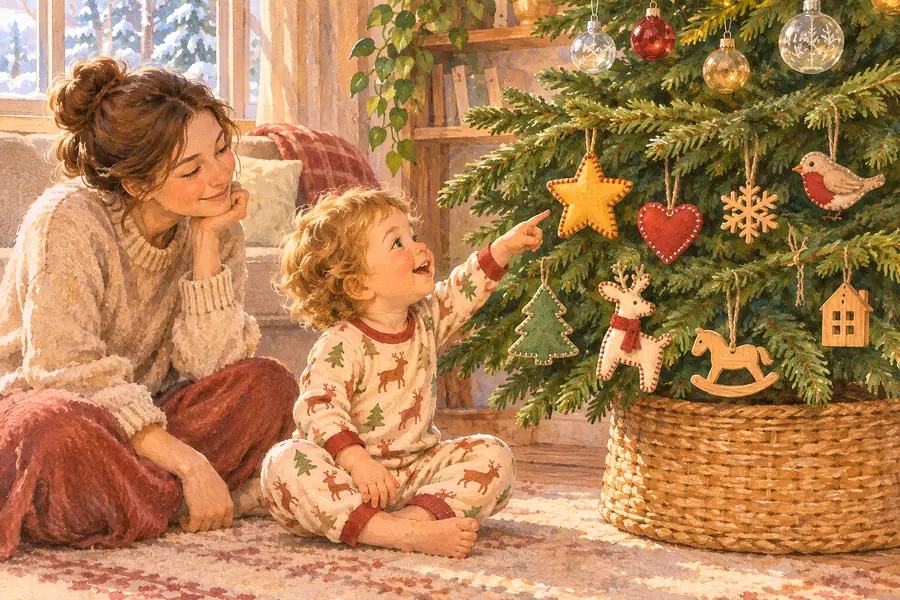
- Swallowed decorations send children to the ER every December. A US study counted about 22,200 emergency visits for swallowed Christmas decorations over 19 years, most often in children aged 2 and under.
- The poinsettia is mostly a myth. In 22,793 poinsettia exposures reported to poison centers, nobody died and 92.4% had no symptoms at all.
- Holly berries are not a myth. They can cause vomiting and cramps, and you rarely know how many were eaten.
- The real December dangers are button batteries in lights and remotes, glass baubles, small hooks and lit candles.
A toddler sees a Christmas tree the way you would see a buffet. Shiny, low, full of things that come off. This guide is about the years between first crawling and roughly age four, when everything on the bottom third of the tree ends up in a hand or a mouth: what is genuinely dangerous, what only looks dangerous, and what to do in the first few minutes if something gets swallowed.
Quick reference: tree hazards by risk
| Hazard | Why it matters | Simple fix |
|---|---|---|
| Button batteries (lights, remotes, musical ornaments) | Can burn through the esophagus within hours | Screw-shut compartments, remotes on a high shelf |
| Glass baubles, small hooks | Cuts, swallowed hooks | Plastic or felt on the lower third, hooks higher up |
| Lit candles, Advent wreath | Burns, fire | Never unattended, never on the tree |
| Holly and mistletoe berries | Vomiting, cramps | Up high or out of the house |
| Poinsettia | Mild tummy upset at most | Fine out of reach; not an emergency |
| A tippy tree | Falls on a climbing child | Stable stand, tie the top to a wall hook |
Where the real risk is (and where it is not)
Most parents worry about the plant on the windowsill. The numbers point elsewhere.
The poinsettia's bad name goes back to a single unconfirmed death of a 2-year-old in Hawaii in 1919. A review of holiday plants in the Western Journal of Emergency Medicine describes a study of 22,793 poinsettia exposures reported to US poison centers. Nearly all were children, 77% were under 2, there were no deaths, 92.4% had no symptoms and 96% were handled at home without a trip to a doctor. Mild tummy upset is the usual worst case. The one real exception is a child with a latex allergy, where a skin reaction is possible; our guide to allergic reaction signs in babies covers what that looks like.
Meanwhile, the boring things do the damage. Researchers who went through US emergency department data from 1997 to 2015 estimated that 22,224 children came in after swallowing Christmas decorations, and children aged 2 and under did it most often. Lights, tree stands, ornaments, the lot.
And the one item that can turn a normal evening into surgery is the smallest. Button batteries sit in battery-powered fairy lights, flameless candles, singing cards and the remote for the LED star. The AAP warns they can cause life-threatening injuries if swallowed and asks parents to secure every battery compartment. If you only do one thing from this article, do that. Our button battery and magnet guide has the full first-hour plan.
How to set up the tree, by age
Crawling babies (about 7–12 months). They pull themselves up on anything, including the lowest branch. A small tree on a sturdy table, or a tree behind a play gate, is easier than defending every ornament. The bottom of the tree is where the cables are, and cables get chewed.
Walkers (1–2 years). This is the peak swallowing age. Put only unbreakable, larger decorations on the bottom third: felt, wood, fabric, big plastic baubles. Glass, small hooks and anything that looks like a sweet go higher. The AAP specifically says to skip trimmings that look like food, because to a toddler, they are food.
Climbers (2–4 years). Now the tree itself is the hazard. A child who tries to reach the chocolate ornament at the top can bring 20 kilos of spruce down on top of them. Use a heavy, wide stand and tie the top to a hook in the wall or ceiling with fishing line. You will not see it from the sofa.
From about age three, a lot of children can learn a rule like "we look with our eyes on this branch, and this branch is for touching." Give them one low branch of their own with unbreakable ornaments they may move around. It works better than "no" repeated 40 times a day.
Lights, cables and candles
Check every light strand before it goes on, even new ones, for frayed wires, broken sockets and loose connections. The AAP also notes that light strands can contain lead in the bulb sockets and the wire coating, so keep them away from small mouths and wash hands after decorating. Keep the tree away from radiators and fireplaces and, with a real tree, keep the stand full of water so it does not dry out.
The water in the stand is its own small problem. A curious toddler will drink it, and some families add preservatives, aspirin or fertilizer to keep the tree fresh. Cover the stand with a tree skirt or a basket, and if your child did get to it, call the poison center and tell them exactly what was in the water.
Candles are where Christmas actually burns children. The AAP rule is short: never leave a burning candle unattended and never put lit candles on a tree. For an Advent wreath on the kitchen table, put it on a fireproof base, keep matches and lighters out of reach, and blow the candles out whenever you leave the room. Even for one minute.
Plants, berries and the rest of the decorations
Three plants deserve different treatment.
- Poinsettia: out of reach is enough. If a leaf gets chewed, wipe the mouth, offer a drink and watch.
- Holly: the berries are the problem, not the leaves. According to the same review, an adult would need to eat 20 to 30 berries to feel unwell, a child only about 5. Nausea, vomiting and cramps are typical. That number is not a safe limit: you rarely know how many were eaten, so call the poison center for any amount.
- Mistletoe: the review says European mistletoe berries cause trouble mainly in large amounts, while the leaves and stems are the more toxic parts. You will not know which part your child ate. Hang it high or skip it.
Then there is the stuff nobody thinks of as a hazard. Angel hair (spun glass) irritates skin and eyes, so wear gloves. Snow spray can irritate the lungs if it is sprayed near a child. Glitter ends up in eyes. And on the 25th, the wrapping paper, ribbons and plastic bags are a choking and suffocation risk, so a bin bag in hand while presents are opened is not fussy, it is sensible. Gifts themselves are a separate topic; our guide to Christmas gifts by age covers small parts and age labels, and the new EU toy rules explain what the 0–3 symbol actually means.
"It went in the mouth": what to do in the first minutes
Stay at the tree for ten seconds and look before you pick anything up. What is missing? A berry, a hook, a bauble with a broken edge, a battery cover hanging open?
- Something is missing and you cannot find it, and it could be a battery or a magnet → emergency department now. Do not wait for symptoms. Take the packaging or a matching battery.
- Coughing, gagging, can't breathe properly → first aid for choking and call your emergency number.
- Plant, berries, tree water, a bit of snow spray → wipe the mouth, give a few sips of water, call the poison center and describe what and how much. Do not make your child vomit.
- A scratch inside the mouth from glass, and nothing is missing → rinse gently, look with a torch and call your pediatrician for advice.
- A piece may have been swallowed (a bauble with a chunk missing, a hook gone) → emergency department now, even if your child seems fine. Rinsing the mouth does nothing for a swallowed piece.
- Licked tinsel, chewed a felt ornament → take it away, move it higher. Done.
The hard part is usually the not knowing. One afternoon the bauble count on the bottom branch is suddenly one short, and you spend twenty minutes on your knees with a torch under the sofa. Most of the time it turns up. Search anyway.
Common mistakes
Watching the poinsettia, ignoring the remote. The remote for the light-up reindeer, with its battery cover held on by a tired clip, is the bigger risk.
Putting the best ornaments at child height "so they can enjoy them". They will enjoy them, mostly with their teeth.
A heavy tree in a light stand. Tie it.
Advent candles on the coffee table while the toddler is still awake. Light them after bedtime, or with an adult sitting right there.
Making a child vomit after they ate a berry. It is not recommended. Call the poison center instead and follow their advice.
When to get help
Go to the emergency department straight away, or call your emergency number, if you suspect a button battery, a magnet or a sharp piece such as glass was swallowed, if your child chokes, has trouble breathing or swallowing, drools and refuses to drink, vomits blood, or becomes unusually sleepy after swallowing something. The same goes for a burn that is larger than your child's palm, blisters on the face, hands or genitals, or any burn from an electrical cable.
For berries, plants, tree water and decorations you are unsure about, call your local poison center first. They answer these calls all day every December, and in most cases they will tell you to watch at home.
Call your pediatrician the same day if vomiting, tummy pain or a rash appear in the hours after your child ate something from the tree. If you are unsure whether any symptom is serious, our guide to a sick child at home and when to call the doctor walks through the warning signs.
Frequently asked questions
Is a poinsettia poisonous to toddlers?
Much less than its reputation suggests. In a study of 22,793 poinsettia exposures, there were no deaths and over 92% of children had no symptoms. A chewed leaf may cause a mild upset tummy. Keep it out of reach, but it is not an emergency.
Should we skip the real tree this year because of the baby?
Not necessarily. Needles can be choked on, and the stand water is something toddlers like to drink, but a stable stand, a covered base and a clear zone around the trunk solve most of it. An artificial tree has its own small parts and should carry a fire-resistant label.
What should I do if my toddler ate a holly berry?
Wipe the mouth, give a little water and call the poison center straight away with the plant in hand, then follow their advice. Don't wait for symptoms and don't try to count berries first. Do not make your child vomit.
At what age can we decorate the tree normally?
There is no fixed age. Most children can follow a "look, don't touch" rule somewhere between 3 and 4, but small parts and button batteries stay a risk until your child no longer puts things in their mouth. Keep glass and battery items high until then.
Are LED fairy lights safer than old bulbs?
They run cooler, which helps with fire risk. But many battery-powered LED strands and flameless candles use button batteries, which are the bigger danger for a toddler. Check that the compartment is screwed shut.
Can my child sleep in the room with the tree lights on?
It is safer to switch decorative lights off when nobody is watching, at night and when you leave the house. Use a timer if you like the glow at bedtime.
How KidyGrow helps you
It is 8 pm, the tree is up, and you are standing in the living room holding a half-chewed leaf, typing with one thumb.
With emergency signs, choking, a possible battery or magnet, trouble breathing, don't wait for an app's answer: get help first. KidyGrow is for afterwards and for next time, and it will not know what is missing from the tree. It does remember what you tell it about your child, such as a latex allergy, so next December you are not explaining it all again.
Sources
- Reeves PT, Krishnamurthy J, Pasman EA, Nylund CM. Pediatric Ingestions of Christmas Past, Present, and Future: A Review of Holiday Trends, 1997 to 2015. Clin Pediatr (Phila). 2019;58(5):571–577. https://pubmed.ncbi.nlm.nih.gov/30735061/
- Evens ZN, Stellpflug SJ. Holiday plants with toxic misconceptions. West J Emerg Med. 2012;13(6):538–542. https://pubmed.ncbi.nlm.nih.gov/23359840/
- American Academy of Pediatrics, HealthyChildren.org. Holiday Decoration Safety: 12 Tips for Families. https://www.healthychildren.org/English/safety-prevention/at-home/Pages/Holiday-Decorations-Safety-Tips.aspx
- NHS. Baby and toddler safety. https://www.nhs.uk/baby/first-aid-and-safety/safety/baby-and-toddler-safety/
- National Capital Poison Center. Button Battery Ingestion Triage and Treatment Guideline. https://www.poison.org/battery/guideline
_This article is for information and does not replace medical advice._