 Kidy
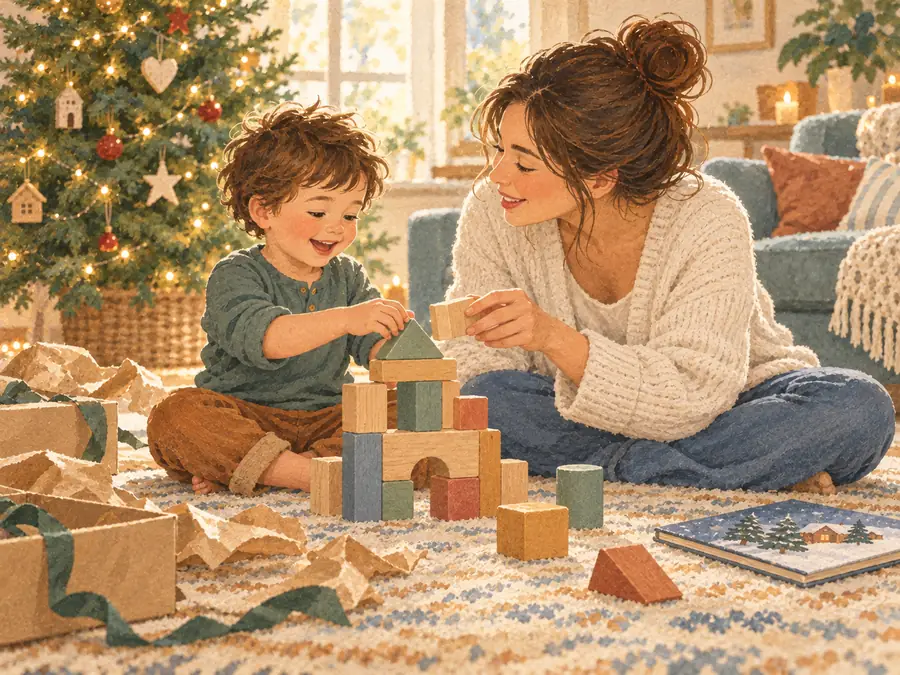
- Fewer gifts often means more time with each. In a study with toddlers, children given 4 toys played longer and in more varied ways than with 16.
- With toys that talk, parents talked less. In a small study of 10 to 16-month-olds, parents said about 40 words a minute with electronic toys, against 56 with plain toys and 67 with books.
- Under 3: nothing smaller than a ping-pong ball, no loose button batteries.
- Balloons stay a choking risk up to age 8 (AAP).
By mid-December the question is rarely "what does my child want". It is "what do we buy that will still get played with in February", and "how do we stop three relatives buying the same thing". This guide is about those two decisions. For concrete gift ideas filtered by age and budget, the tool below does that part.
Quick reference: what fits each age
| Age | What they are into | A gift that fits | Skip |
|---|---|---|---|
| 0–12 months | faces, voices, grabbing, mouthing | board or cloth books, a rattle for a small fist | screens, button batteries |
| 1–2 years | stacking, pushing, filling and emptying | big blocks, a push toy, lift-the-flap books | small parts, balloons |
| 2–3 years | pretend play starts, scribbling | play kitchen bits, chunky crayons, simple puzzles | toys "for 3+" with small parts |
| 3–5 years | role play, building, stories | dress-up box, construction set, picture books | strong magnets, chemistry kits |
| 6–8 years | rules, reading alone, making things | card and board games, first chapter books, a craft kit | connected toys you have not checked |
How many Christmas gifts does a child need?
Fewer than you think. In a University of Toledo experiment, 36 toddlers played once in a room with 4 toys and once with 16. With fewer toys they stayed with each one longer and used it in more different ways (Dauch et al., 2018). Small study, a lab playroom rather than a living room on Christmas morning. The direction still matches what most parents see by December 27th.
Some families use a rule of thumb: something they want, something they need, something to wear, something to read. It is not research, just a fence that stops the pile from growing. Grandparents are a separate pile, and we come back to them below.
Picture a two-year-old with eleven parcels. She opens four, plays with the wrapping paper, and falls asleep on the sofa at 10:40.
Gifts by age
Under 1. A baby does not need anything for Christmas, and that is fine. If you buy, buy books. The AAP's 2024 report on early literacy reviews evidence that reading with children from birth supports language, thinking and social-emotional development (AAP, Pediatrics 2024). Board books with faces, cloth books that can be chewed.
1 to 2. This is the age of putting things in and taking them out again. Big blocks, a push toy, a shape sorter with three shapes rather than twelve, lift-the-flap books. A shop test from Germany's federal public health institute: anything smaller than a ping-pong ball stays away from children under three (BIÖG).
2 to 3. Pretend play shows up: a spoon and a pot become dinner. A few play-kitchen pieces, a doll or soft animal to look after, chunky crayons and a big roll of paper. Read the age label: "3+" on a box usually means small parts, not a harder game.
3 to 5. Dress-up, building and stories. A box of old scarves and hats beats most costumes. A construction set with large pieces, picture books, a simple board game played with an adult.
6 to 8. Rules and making things. Card games, a first chapter book series, a craft kit, a magnifying glass and a notebook. The AAP advises against chemistry sets and hobby kits for any child under 12 (AAP, HealthyChildren).
With toys that talk, parents talked less
This is the finding worth repeating at the toy aisle. In an at-home study, 26 parents played with their 10 to 16-month-olds using electronic toys, traditional toys and books. With the electronic toys, parents said fewer words, there were fewer back-and-forth exchanges, and the babies vocalized less than with books (Sosa, JAMA Pediatrics 2016). One plausible reading: the toy did the talking, so the adults said less. It is one small study of short play sessions, so it shows a pattern in that situation, not a rule for every toy.
The AAP's clinical report on choosing toys lands in the same place: a toy is most valuable when it brings a caregiver into the play, and digital "toys" have not shown the same benefits (AAP, Pediatrics 2019). More on why play matters in play is development, and on screens in screen time guidelines by age.
Connected toys deserve a separate look. The Spanish Paediatric Association notes that many have microphones, cameras or sensors and use the child's personal data, and if they are not secure, a stranger can connect to the toy or the paired phone (AEP). Check what it records before it goes under the tree.
Experiences instead of things
A trip to the aquarium, a zoo pass, swimming lessons, a day out with one parent alone. They do not take up a shelf and nobody fights over them. For a child under 3 an experience works best as a small wrapped clue (a toy fish for the aquarium), because "next Saturday" means very little at two.
Grandparents, aunts and too many gifts
The biggest Christmas problem is usually not your own gift. It is four other adults buying blind. A short list sent in early November solves most of it: one or two ideas per person, sizes for clothes, and what you already have. The gift tool above makes a list you can share as a link, so everyone picks from the same one.
It also helps to say what you would rather not have. "No more noisy toys" said kindly in November is easier than a toy with three volumes in January.
How to decide
- If your child is under 3 → one sturdy gift without small parts or loose batteries, plus a book.
- If the playroom is already full → an experience, a book or something for outside.
- If relatives keep doubling up → a shared list, one person coordinates.
- If the budget is tight → a book and one well-chosen toy is a complete Christmas at this age.
Common mistakes
Buying "for older, she'll grow into it". Age labels on toys reflect safety, including choking hazards, and not only whether the child will understand the game (AAP, HealthyChildren).
Forgetting the battery compartment. Button batteries and high-powered magnets can cause serious injury if swallowed. Pick toys whose battery cover is screwed shut (AAP, HealthyChildren).
Leaving older siblings' gifts on the floor. The AAP notes that many choking incidents happen when an older child gives a younger one small toys or food. Construction sets for a seven-year-old and a toddler in the same room need a rule.
Opening everything at once. Spread it out. Half the parcels on the 25th, a couple on the 26th. Nobody notices except the child, who is happier.
If something is swallowed
If you think your child has swallowed a button battery or a magnet, do not wait for symptoms: go to the emergency department or call your local emergency number right away (911 in the US and Canada, 999 or 112 in the UK, 112 across the EU). The NHS warns that button batteries can cause severe internal burns (NHS). When a gift sparks a fight instead, toddler won't share toys helps, and the wider frame is in what gentle parenting actually is. For books by age, see the toddler speech development guide.
Frequently asked questions
How many presents should a toddler get for Christmas?
There is no right number, but fewer usually works better. Toddlers given 4 toys played longer and more inventively than with 16. Many families settle on one main gift, a book and something small, and let grandparents add one each.
What is a good Christmas gift for a 1-year-old?
Board books, big blocks, a push toy or a ball too big to fit in the mouth. Skip anything with small parts or a loose button battery. A one-year-old will also enjoy the box, and that is not a wasted present.
Are electronic toys bad for babies?
Not harmful in themselves, but they change the play. In a study of 10 to 16-month-olds, parents talked less and babies vocalized less with electronic toys than with books. If you buy one, it works better as one toy among plain ones than as the main gift.
Is a book a boring Christmas present?
Only to adults. The AAP reviews evidence that reading with children from birth supports language and social-emotional development. A book that gets read every night for a month is used more than most toys.
How do I stop grandparents buying too many gifts?
Send a short list early, one or two ideas each, and say what you already have. Ask one person to coordinate. Offering experiences, such as a zoo trip with grandma, often goes down better than a flat "please don't".
What toys are not safe for a 2-year-old?
Anything smaller than a ping-pong ball, toys with removable button batteries, strong magnets, balloons and toys marked for over 3, which usually means small parts. Check the age label and the battery compartment before buying.
How KidyGrow helps you
Every December someone asks what the child needs, and you try to remember what she has been doing lately. In KidyGrow you can invite a grandparent by email as a viewer: they see the logged events, milestones and growth, read-only, and cannot change anything. A grandmother who can see that he started stacking blocks this month buys something that fits this month, not last year. The app remembers what you logged, so you do not have to. It will not pick the gift for them. It just means one fewer phone call where you list everything again from memory.
Sources
- Healey A, Mendelsohn A; AAP Council on Early Childhood. Selecting Appropriate Toys for Young Children in the Digital Era. Pediatrics, 2019.
- Sosa AV. Association of the Type of Toy Used During Play With the Quantity and Quality of Parent-Infant Communication. JAMA Pediatrics, 2016.
- Dauch C et al. The influence of the number of toys in the environment on toddlers' play. Infant Behavior and Development, 2018.
- Klass P et al.; AAP Council on Early Childhood. Literacy Promotion: An Essential Component of Primary Care Pediatric Practice. Pediatrics, 2024.
- AAP, HealthyChildren.org. How to Buy Safe Toys.
- AAP, HealthyChildren.org. Choking Prevention for Babies & Children.
- NHS. Baby and toddler safety.
- BIÖG, kindergesundheit-info.de. Fünf Tipps zum Kauf von sicherem Spielzeug (German).
- Spanish Paediatric Association (AEP). Connected toys: a guide to using them safely (Spanish).