 Kidy
- 24 doors, 24 small rituals. Most take 5 to 15 minutes and cost nothing.
- Under 3: the calendar is mostly for you. One picture card a day is plenty.
- Candles stay an adult job. The adult lights the candle; the child takes part in the ritual around it.
- Flameless candles are not risk-free. The AAP lists them among holiday items with button batteries.
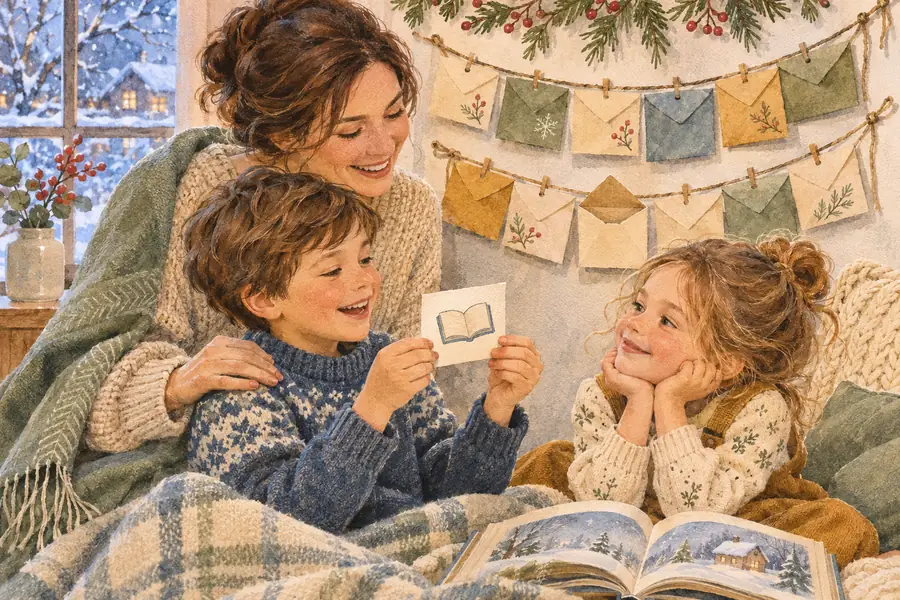
An advent calendar does not have to hold chocolate or a toy behind every door. A slip of paper that says "tonight we read under a blanket with a flashlight" can be the thing a five-year-old runs to at 7am. Below are 24 rituals for December, sorted by week, with notes on what works at which age and what to keep away from small hands.
Quick reference by age
| Age | What goes behind a door | Time a day | Watch out for |
|---|---|---|---|
| 0–2 | a picture card; the ritual is for the parents | 5 min | candles in reach, small decorations |
| 2–3 | one picture, one action ("we hang a star") | 5–10 min | paper clips, tiny chocolates, batteries |
| 4–5 | a short sentence you read out | 10–15 min | matches, hot wax |
| 6–8 | a sentence the child reads, some slips they write | 15–20 min | rituals turning into homework |
Why rituals instead of gifts?
Two reasons, and only one of them is money.
The first is the AAP's own holiday advice for families: don't feel pressure to overspend on gifts, and toys don't need to be expensive or electronic to make great gifts (AAP, HealthyChildren). Twenty-four small toys, on top of St Nicholas and Christmas, is a lot of plastic arriving in one month. If gifts are where your December budget goes, keep them for Christmas gifts by age.
The second is what the research actually says about rituals. A review of 50 years of studies on family routines and rituals separated the two: a routine is something you do, a ritual is something that means something to the family. Both were linked with child adjustment and parenting competence (Fiese et al., 2002). The authors were honest about the limits, mostly small convenience samples, so read this as "rituals are good company for children", not "a December calendar will make your child calmer".
Then there is play. The AAP's clinical report on play describes the shared joy and back-and-forth of playing together as something that helps regulate a child's stress response (Yogman et al., AAP 2018). Most of the rituals below are play with a date on it. More on why that matters in play is development.
The 24 rituals, week by week
In 2026 the first Sunday of Advent falls on 29 November, so a family with a wreath lights the first candle two days before door number one. The calendar itself still runs 1 to 24 December.
Week 1: getting the season out of the box
- Open the decorations box together. The child picks where one thing goes, even if it ends up somewhere strange.
- Draw a wish list. Not to send anywhere. Just to look at and talk about.
- Flashlight reading. One winter picture book, under a blanket, lights off.
- Paper snowflakes. Child-safe scissors from about 3, and a lot of tiny paper on the floor.
- Shoe night. In much of Europe children clean a boot on 5 December and find something in it on the 6th. If that isn't your tradition, make it hot chocolate night instead.
- An evening walk to look at lights. Dark comes early. Use it.
Week 2: giving something away
- Bake one simple thing. Children measure, stir and decorate the baked cookies. Nobody tastes the raw dough: raw flour and raw eggs can carry germs that cause food poisoning (CDC).
- Make a card for a grandparent and post it together.
- Look through the toys and pick one to give away, only if the child agrees.
- Take some of the cookies to a neighbor.
- Video-call someone far away. A screen that connects two people is a different thing from a screen that babysits.
- Hang apple slices or a seed ball for the birds and watch the window.
The AAP's holiday tips also suggest including your child in a volunteer activity and helping them make one or two gifts themselves (AAP, HealthyChildren). Week 2 is that, sized for a preschooler.
Week 3: senses, outside and in
- Candle night. 13 December is St Lucy's day in Scandinavia and Croatia. Lights off, one candle on a stable surface, an adult in charge, one story told in the dark.
- Dry orange slices in a low oven. The flat smells of it for two days.
- A winter walk with a list: three red things, one pinecone, one footprint that isn't human.
- A kitchen dance party, one song chosen by each person.
- Breakfast for dinner, in pajamas.
- Build a blanket fort and read inside it.
That orange smell deserves a line of its own. It doesn't do anything developmental. It sits in the curtains, and in February somebody opens a drawer, finds a forgotten slice and says "December", and that's the whole point.
Week 4: slowing down
- Look at photos from last December. Let the child tell you what they remember, which is usually the wrong thing and always the funny one.
- Wrap a present together for someone else.
- The longest night of the year (the solstice falls on 21 December in 2026). Dinner by lantern or fairy lights.
- "Three good things from this year." The child talks, you write.
- Nothing. Early bath, early bed. By the 23rd everyone is tired, and a door that says "rest" is still a ritual.
- One thing that is the same every year. Your family's, not ours.
How to make the calendar itself
You need 24 containers and some paper. Envelopes on a string, a row of paper bags, a jar with folded slips, a cardboard tree with pockets. For children who can't read yet, draw the ritual: a book, a star, a bird.
Here is the one trick that keeps it working. Fill tomorrow's door tonight, not all 24 on 30 November. Then a sick child, a late shift or an evening that has fallen apart just means you swap the slip. A calendar written in advance holds you to a plan from three weeks ago. A calendar filled the night before bends.
Somewhere around the 17th, it stops being your project. The child reminds you at breakfast, while you are hunting for the second glove.
Adapting it by age
Under 2. The baby will not know it's December. That is fine. Pick the rituals you'd enjoy anyway, the walk, the music, the flashlight book, and keep everything with a flame or a battery high up.
2 to 3. One picture, one action, done in five minutes. Two-year-olds love the opening more than whatever is inside. Repeating last week's ritual is not cheating, they'll ask for it.
4 to 5. Now the calendar starts to mean something. You light the candle, and the child gets a real part in the ritual: choosing tonight's candle, saying the line your family always says, blowing it out with you at the end.
6 to 8. Let them write four or five of the slips themselves. Expect at least one to say "ice cream for dinner". Negotiate.
If December disruption already throws your child off, read why routine changes upset toddlers before planning 24 busy evenings.
Rituals plus a small treat: if/then
- If the child gets a chocolate calendar from grandparents → keep it. Your calendar is the second one, the slips go next to it.
- If siblings are 2 and 7 → one shared ritual, and the older one reads the slip to the younger one.
- If both parents work late → pick rituals that fit after dinner: flashlight book, three good things, the dance.
- If the child is disappointed there's "no present" → say so out loud ("you hoped for a toy"), then open the door together anyway. Disappointment doesn't mean the idea failed.
- If you miss a day → skip it. Two doors on one evening is fine too.
Common mistakes
Planning 24 craft projects. You'll quit by the ninth. Most doors should take less time than making the slip did.
Using the calendar as a threat. "No door tomorrow if you don't tidy up" turns the one thing that was supposed to be connection into leverage. The gentle parenting guide explains why that kind of deal backfires.
Doing it for the photo. If the snowflakes are crooked, they're crooked.
Forgetting the rest of the year. A December ritual works best on top of small everyday ones, like these 5-minute connection rituals or special time with each child.
Making it all screen-based. One video call is warm. A film every night is a different calendar. The screen time guidelines by age still apply in December.
Candles, batteries and small parts
This is the part that matters more than any idea above.
- Real candles: never leave a burning candle unattended, place it where it can't be knocked over, and blow it out before leaving the room (AAP, HealthyChildren). Germany's federal health institute notes most scalds and burns happen before school age, with the highest risk in the first two years (BIÖG).
- LED candles: they remove the open flame, but check that the battery compartment is securely closed. The AAP names flameless candles, string lights and musical ornaments as holiday items with button or coin batteries, which can cause life-threatening injuries if swallowed. Tape or screw the battery compartment shut.
- Small decorations and anything that looks like candy: keep them out of reach of under-3s.
If a child burns a hand on wax, the NHS advice is to hold the burn under cool running water for 20 minutes, and to get medical advice for any burn on a child under 5 (NHS). If you suspect a swallowed button battery, go to the emergency department straight away. Don't wait for symptoms.
Frequently asked questions
What can I put in an advent calendar instead of gifts?
A slip with a short activity: a story under a blanket, baking, a walk to see lights, a card for a grandparent. For children who can't read, draw it. Most families mix in a few small edible treats or stickers, and that's fine.
At what age does an advent calendar make sense?
Around 3 to 4, when a child understands "tomorrow" and can wait a day. Before that the opening itself is the fun, and the calendar is really for the adults. That's a perfectly good reason to do it.
What if my child only wants the chocolate calendar?
Keep both. The chocolate is a treat, the ritual is time with you, and children don't see them as competitors. After a week, many will ask about the paper door first.
How long should each ritual take?
Five to fifteen minutes on a normal weekday. Save the longer ones, baking or a winter walk, for the weekends. If a ritual regularly takes longer than putting the child to bed, it's too big.
Can my child light the advent candles?
Keep the lighting with an adult. The child can pick the candle, say the words and blow it out with you at the end, while the wreath stands on a stable, fireproof base. Matches and lighters go back out of reach straight after.
We don't celebrate Christmas. Does this still work?
Yes. Rename it a winter calendar and keep the walks, the birds, the solstice dinner and the three good things. You can adapt every activity to your own customs.
How KidyGrow helps you
Some December evenings the planned ritual is the last thing anyone needs. The Tonight plan takes the last 24 hours into account, a short nap, a meltdown at pickup, a fever, and adjusts what it suggests after a hard day. You still decide what goes behind the door. Tell the KidyGrow chat once that your child hates loud music or can't have nuts, and it remembers that the next time you ask for an idea. It won't know your family's traditions until you tell it. Swapping the fort for a bath and an early night still counts.
Sources
- Fiese BH, Tomcho TJ, Douglas M et al. A review of 50 years of research on naturally occurring family routines and rituals. Journal of Family Psychology, 2002.
- Yogman M, Garner A, Hutchinson J et al.; AAP. The Power of Play: A Pediatric Role in Enhancing Development in Young Children. Pediatrics, 2018.
- AAP, HealthyChildren.org. 12 Tips to Keep Families Joyful this Season.
- AAP, HealthyChildren.org. Holiday Decoration Safety Tips.
- AAP, HealthyChildren.org. Small Battery Safety at Home: A Winter Holiday Walkthrough.
- NHS. Burns and scalds.
- BIÖG, kindergesundheit-info.de. 10 Tipps für einen sicheren Advent.
- CDC. Raw Flour and Dough.