 Kidy
Kidy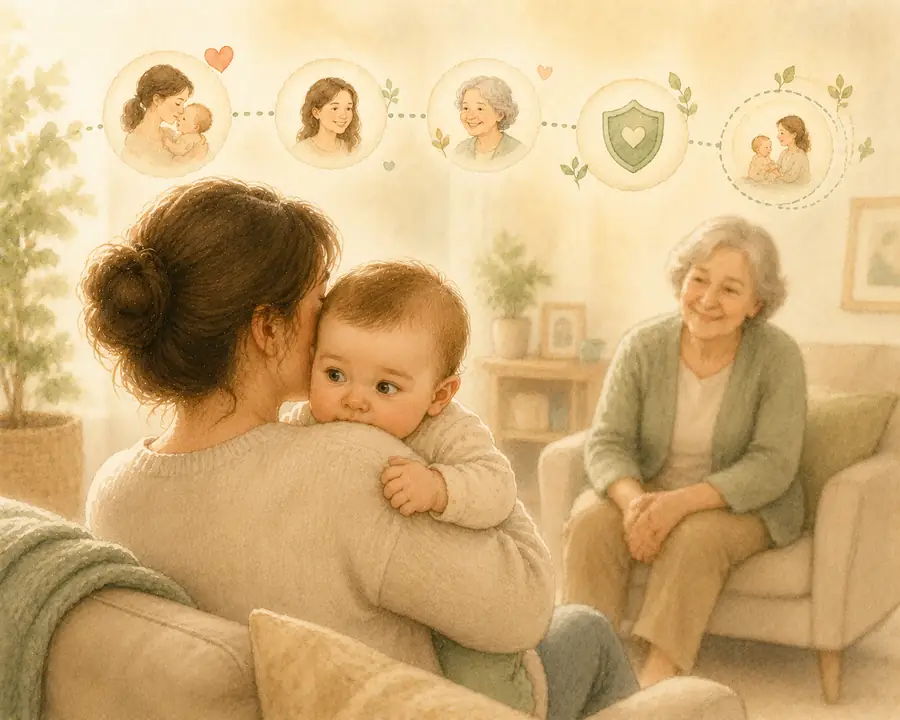
If your once-social baby suddenly buries their face in your shoulder when Grandma reaches for them, you're probably seeing stranger anxiety. The quick orientation:
📋 See where your child is: check the Milestone checklist by age for the skills most children reach around this age.
- It usually shows by around 9 months, often starting from 6, and is most visible between 8 and 12 months.
- It's a sign of healthy development: your baby can now tell familiar faces from new ones.
- It often overlaps with separation anxiety, but the two aren't the same thing.
- It eases on its own: the NHS places fear of strangers between 6 months and 3 years, and most children grow out of it. Forcing contact makes it worse.
Stranger anxiety can feel awkward, especially when a doting relative gets the cold shoulder. But that wary look is a milestone in disguise. Your baby has just figured out the difference between the people they know and everyone else, and they're voting hard for you.
Quick Reference
| Question | Short answer |
|---|---|
| When does it start? | From around 6 months; most babies show it by 9 months |
| When is it strongest? | Often between 8 and 12 months |
| When does it ease? | Gradually; the NHS gives 6 months to 3 years |
| Is it normal? | Yes. It signals healthy cognitive and emotional development |
| What helps most? | Let your baby warm up at their own pace; never force contact |
| When to ask | No warm-up ever, lost skills, or extreme distress that doesn't settle |
What is stranger anxiety, and how is it different from separation anxiety?
Stranger anxiety is wariness or fear of unfamiliar people, even while you're right there holding your baby. Separation anxiety is distress when you leave, regardless of who's around. They're cousins, they often arrive together, and they spring from the same root: a baby who now understands that you are specific, irreplaceable, and currently the safest thing in the room.
The American Academy of Pediatrics describes both as expected parts of social and emotional development in the second half of the first year: anxiety around strangers is usually one of the first emotional milestones, and it is normal (AAP). If your baby is also melting down at drop-off, our guide to separation anxiety in babies covers that side of the same coin.
When does stranger anxiety start and peak?
It can begin around 6 months, as memory and face recognition sharpen. By 9 months being shy, clingy or fearful around strangers is on the CDC checklist, which lists what at least 3 in 4 babies do (CDC). It is often strongest between 8 and 12 months, which is also when many babies hit a sleep regression and ramp up separation anxiety. That clustering isn't a coincidence; it's one big developmental leap wearing several hats. If your nights got harder at the same time, the 8-month sleep regression explains the overlap.
From there it gradually loosens as your toddler builds a wider circle of trust. The NHS places separation anxiety and fear of strangers between 6 months and 3 years, and says it can last longer or come back at stressful times (NHS).
Why it happens (and why it's a good sign)
A few months ago, one friendly face was as good as another. Now your baby holds a mental picture of you and compares every new face against it. That comparison is a cognitive upgrade. The NHS calls it a normal part of development that children usually grow out of (NHS). The AAP adds that babies with a strong, healthy attachment often go through separation anxiety earlier and pass through it more quickly (AAP).
Put plainly: a baby who clings is a baby who has bonded. The clinginess is the receipt.
Not every baby follows the same curve
Most articles, this one included, describe stranger anxiety as a bump: up at 6 to 12 months, down afterwards. A study that followed 1,285 children from 6 to 36 months found it is not one curve. The researchers saw four different paths. For most children the fear stayed modest or eased. The children whose fear stayed high the whole time, or rose sharply as they got older, were the ones who later showed more behavioural inhibition, a trait linked to anxiety (Brooker et al., 2013).
That changes what is worth watching. A baby who is very wary at 9 months tells you little. A 2½-year-old whose fear of new people has kept climbing, and who is not easing even with familiar-ish faces, is worth a relaxed conversation with your pediatrician. Not because something is wrong, but because gentle support is easiest early.
What actually helps
You can't rush a baby out of this, but you can make it gentler.
- Let them set the pace. Hold your baby and let them observe the new person from the safety of your arms. Warming up takes minutes, sometimes a whole visit. That's fine.
- Brief the grown-ups. Ask relatives to approach slowly, get down to the baby's level, and not swoop in for a hug. A new person who plays it cool is far less alarming than one who lunges.
- Stay calm and close. Your baby reads your face. If you're relaxed and friendly with the stranger, that's data your baby uses to decide they're safe.
- Use a comfort object and keep familiar routines during new-people situations.
- Don't apologize for the baby or label them "shy." A phase is not a personality.
At daycare or with a new sitter, a slow, predictable handover beats a quick exit. The first few drop-offs are the hardest. Our daycare transition guide maps the gentler version. And if your baby will only settle for you these weeks, that's the same attachment at work; why a baby only sleeps when held is worth a read.
The patience you're building now carries forward. Once the wary phase eases into toddlerhood, our guide to managing toddler behavior covers the broader toolkit for calm, consistent responses as new challenges show up.
Wait or act? A simple guide
| What you're seeing | Hold steady | Act now |
|---|---|---|
| Baby wary of new people but warms up eventually | ✓ Totally normal | |
| Clings hard at family gatherings | ✓ Let them warm up | |
| Never warms to anyone, ever, including familiar people | ✓ Mention it to your pediatrician | |
| Lost a social skill they used to have | ✓ Get it checked | |
| Extreme, unsettleable distress for hours | ✓ Call your pediatrician |
When in doubt, give it time and watch the trend across weeks. One clingy holiday with too many new faces tells you very little.
Common mistakes to avoid
- Forcing the hand-off. Handing a screaming baby to a relative "so they get used to it" teaches the opposite. It tells your baby the safe person doesn't keep them safe.
- Shaming or teasing. "Don't be silly, it's just Uncle Marko." The feeling is real to your baby, even if the threat isn't.
- Labeling them shy. It's a stage, not a verdict.
- Sneaking away to avoid a scene. Predictable goodbyes build trust; vanishing erodes it.
When to talk to your pediatrician
Stranger anxiety is one of the most reassuring "problems" in babyhood. Reasons to ask, not to panic: your baby never warms to anyone including you, shows no preference for familiar caregivers, has lost social skills they previously had, or the distress is so extreme and constant that nothing settles it. Outside of that, this is a phase to ride out, not a symptom to treat.
Frequently asked questions
What age does stranger anxiety start?
It can start around 6 months, and most babies show it by 9 months. It is often strongest between 8 and 12 months and loosens gradually, often by about age 3.
Is stranger anxiety a sign of a problem?
No, the opposite. It shows your baby can tell familiar people from new ones and has formed a strong, secure attachment to you. It's a developmental milestone.
What's the difference between stranger anxiety and separation anxiety?
Stranger anxiety is fear of unfamiliar people, even with you present. Separation anxiety is distress when you leave. They often appear together because they come from the same leap in understanding.
How do I help my baby with stranger anxiety?
Let them warm up from your arms at their own pace, ask new people to approach slowly, stay calm yourself, and never force contact. Keep familiar routines and a comfort object on hand.
How long does stranger anxiety last?
The NHS places fear of strangers between 6 months and 3 years, and it can last longer or return at stressful times. What matters more than the end date is whether it is slowly easing.
Can you prevent stranger anxiety?
Not really, and you wouldn't want to. It's a normal stage of healthy development. You can make it gentler with patience, but you can't and shouldn't skip it.
How KidyGrow helps
In the middle of a clingy stretch, it's hard to believe it is a stage. It feels like the new normal.
KidyGrow doesn't have a stranger-anxiety tracker, and we won't pretend otherwise. What it remembers is your baby's age, and with it comes the age guide for your baby's month, with what's typical for sleep, play and feeding right now, and an activity library filtered to your baby's age.
That's the whole of it. The phase still has to be lived through, but at least the suggestions fit the age.
Sources
- American Academy of Pediatrics (HealthyChildren) - Emotional and Social Development: 8 to 12 Months (2024). https://www.healthychildren.org/English/ages-stages/baby/Pages/Emotional-and-Social-Development-8-12-Months.aspx
- NHS - Separation anxiety (2024). https://www.nhs.uk/conditions/baby/babys-development/behaviour/separation-anxiety/
- Centers for Disease Control and Prevention - Developmental Milestones, 9 Months (2024). https://www.cdc.gov/act-early/milestones/9-months.html
- Brooker RJ, Buss KA, Lemery-Chalfant K, et al. (2013). The development of stranger fear in infancy and toddlerhood: normative development, individual differences, antecedents, and outcomes. Developmental Science, 16(6), 864-878. https://pmc.ncbi.nlm.nih.gov/articles/PMC4129944/