 Kidy
Kidy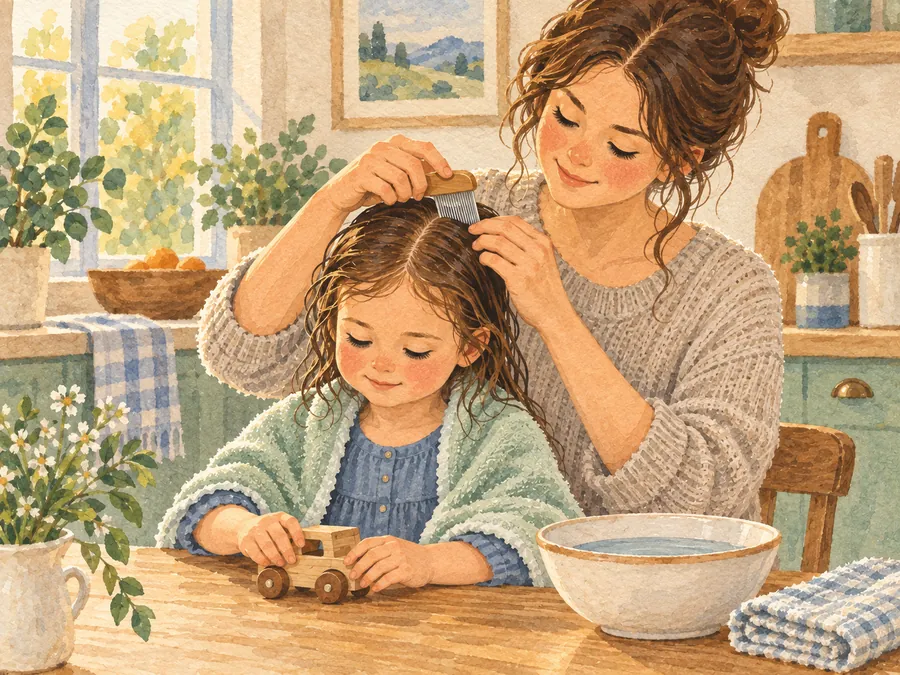
A message from school, and suddenly you are parting your child's hair under a phone torch. Three things first: lice have nothing to do with cleanliness, they cannot jump or fly, and this is solvable, just not in one go.
- Lice spread mostly through direct hair-to-hair contact, they crawl and cannot hop or fly
- Nits are glued to the hair shaft and will not flick off, dandruff will
- Looking is unreliable, wet combing with conditioner is what actually finds them
- One treatment is never the whole job, the repeat is what breaks the cycle
Quick Reference
| Question | Short answer |
|---|---|
| Can lice jump? | No. They crawl. Hair has to touch hair |
| Are nits the same as dandruff? | No. A nit is cemented to the hair, dandruff falls away |
| Does this mean dirty hair? | No. Clean hair is just as welcoming |
| Who else do I check? | Everyone in the household, the same day |
| Do I need a hot wash? | The NHS says no. Treat heads first |
| Time off school? | The NHS says no need to keep your child off |
| Is one treatment enough? | No. Plan the repeat from day one |
What lice and nits actually look like
An adult louse is about three millimetres, grey, sometimes reddish after feeding, and wingless. It moves fast and runs from light, which is exactly why scanning dry hair misses so many.
Nits are the eggs. They are tiny, pale, and cemented to the hair shaft close to the scalp. That gives you the most useful home test there is: dandruff and product residue flick away, a nit stays put and has to be slid down the hair with a fingernail.
Look where the scalp is warmest: behind the ears, at the nape, and along the fringe. Those are the spots where the egg gets the temperature it needs.
How they actually spread
This is where the folklore lives. Lice crawl; they cannot hop or fly (CDC). For a louse to reach your child, two heads have to touch. That is the whole mechanism, and it explains why children get lice far more often than adults: they put their heads together when they play, and adults mostly do not.
Objects can carry a louse, but rarely. A shared hat, a comb, a pillow. Possible, not the main route, and not worth reorganising your house over.
And the part parents most need to hear: lice are not a hygiene problem. Freshly washed hair is no defence. Long, short, thick, fine, clean, unwashed, it is all the same to a louse.
What to do tonight
Order matters. Heads first, house second.
1. Detect by wet combing. Wash the hair, apply plenty of ordinary conditioner, and comb section by section with a fine-toothed detection comb, from the roots to the ends. The conditioner both eases the comb through and slows the lice down so they cannot scuttle away. Wipe the comb on kitchen paper after each pass and look at what came off. The NHS puts this at roughly 10 to 30 minutes depending on hair type (NHS).
2. Treat if you find live lice. Medicated lotions and sprays from the pharmacy kill lice, usually within a day, and typically need repeating about a week later. Follow the instructions exactly. The usual failures are washing it out too early, using too little to coat all the hair, and applying to hair so wet it dilutes the product.
3. Keep combing on a schedule. The NHS schedule is wet combing on days 1, 5, 9 and 13, then a check on day 17 to confirm it is clear. This is the part that catches lice hatching from eggs the treatment missed, and it is the part almost everyone abandons around day 5.
4. Do not expect one round to finish it. No product reliably kills every egg. That is not a failed treatment, it is how the life cycle works.
Who else to check
Everyone you live with, on the same day, and treat everyone who has them on the same day too. Treating one head while another goes untreated is how a household stays in a loop for a month.
Not everyone itches. Itching comes from a reaction to louse saliva and some children barely react, so "she isn't scratching" is not a clearance. Check the head, not the symptom.
If you are wondering why nursery seems to pass everything around, why kids get sick so often at daycare covers the same group dynamics.
Bedding, hats and the cleaning question
Guidance genuinely differs by country here, so use the one your school is working from. The NHS position is blunt: you do not need to wash your laundry on a hot wash.
What is worth doing is small: change and wash the pillowcase and towel of the person who has lice, clean combs and brushes, and give everyone their own hairbrush for a while. Items that are hard to wash can simply be set aside for a few days, since a louse away from a scalp has no food and does not last.
What is not worth doing: disinfecting sofas, spraying carpets with insecticide, bagging up the entire toy collection. That is a lost weekend with no effect on the outcome.
Going back to school
There is no need to keep your child off school. Once appropriate treatment has started, they can be in class.
The other half of that, which schools sometimes get wrong, is the "no-nit" rule. The American Academy of Pediatrics and the National Association of School Nurses both argue for dropping policies that require a child to be completely nit-free before returning (AAP, Pediatrics, 2022). Nits more than about a quarter of an inch from the scalp are mostly hatched shells or eggs that will not hatch, they do not transfer to other children, and the missed school days cost the family more than the lice do.
If your child is just starting nursery and you are collecting this sort of thing in advance, starting daycare: what to expect and the adjustment timeline cover the rest of it.
Common mistakes
- Treating once and stopping. The repeat is not optional, it is the treatment.
- Only treating the child who itches. Itch is a poor test of who is carrying them.
- Not telling the school. The group reinfects and it comes back to you.
- Home remedies. The NHS specifically lists tea tree and eucalyptus oils, herbal remedies, electric combs and repellents as unlikely to work.
- Cutting your child's hair. It does not solve it, and for many children it is worse than the combing.
- Deep-cleaning the house. A day spent on carpets is a day not spent on heads.
- Assuming every scalp complaint is lice. Once you have combed and found nothing twice, look elsewhere. Fever and a cough belong in when to monitor and when to call the doctor, and an itchy rash that spreads off the scalp is a different question, closer to chickenpox.
Lice rarely need a doctor, but if treatment fails twice or the scalp looks infected, go in with the dates of each treatment and the product used. How to prepare for a pediatric visit using your child's data covers how to hand that over in two minutes.
Frequently asked questions
Can head lice jump from one head to another?
No. Lice have no wings and cannot jump; they crawl, so hair has to touch hair. That is why they spread during play and only rarely through objects.
How do I tell a nit from dandruff?
Try to flick it. Dandruff and product residue come away easily, a nit is cemented to the hair shaft and has to be slid down with a fingernail. Nits also cluster behind the ears and at the nape, while dandruff is scattered.
Does having lice mean my child's hair is dirty?
No. Lice move onto freshly washed hair just as readily. It is a question of head-to-head contact, not hygiene, and it happens in every school.
Do I have to wash everything in the house?
No. The NHS says a hot wash is not needed. Change the pillowcase and towel of the person affected, clean combs and brushes, and leave hard-to-wash items aside for a few days. Skip the carpets and furniture entirely.
Why did the lice come back after treatment?
Usually because the repeat was skipped. No product reliably kills every egg, so lice hatching a few days later restart the cycle. The other common reason is someone else in the household or class was never checked.
Do home remedies like vinegar or mayonnaise work?
There is no good evidence for them. The NHS lists plant oils and herbal remedies among the things unlikely to be effective, and some of them irritate the scalp. Stick to a pharmacy product plus combing.
How KidyGrow helps you
You do not need an app for this. You need a comb and three free evenings.
What does get lost is when the first treatment was, and that single date is what every other date hangs off. You log the first treatment in a few seconds and the app remembers it, then your Daily Brief tells you when the repeat and the next comb are due, instead of you carrying that around with everything else.
Day one that is only a reminder. Over a week or so KidyGrow learns your child's pattern and picks up what you would miss in the middle of all this, for instance that the itching lands in the evening, or that the two rough nights both followed a combing day. If the itch outlasts the lice, or sores appear, that record goes to the appointment with you, so you are not rebuilding the week from memory.
Some weeks it has nothing useful to say, and it says that instead of inventing something.
There is a second thing it quietly does. Lice tend to arrive in the same week as everything else, and by Friday nobody remembers whether the bad night on Tuesday was the itching or the cold that was already going around. Having both in one place is what makes that answerable later.
It will not comb your child's hair. It will tell you it is day nine, which is the thing that actually gets dropped somewhere between work, pickup and three evenings with a comb.
Sources
- NHS: Head lice and nits (accessed 2026).
- CDC: About lice (accessed 2026).
- American Academy of Pediatrics: Head Lice, clinical report, Pediatrics 150(4), 2022.
- BIÖG, kindergesundheit-info.de: Wie man Kopfläuse bekommt (accessed 2026).
_Educational content. Not a substitute for medical advice._