Kidy
Kidy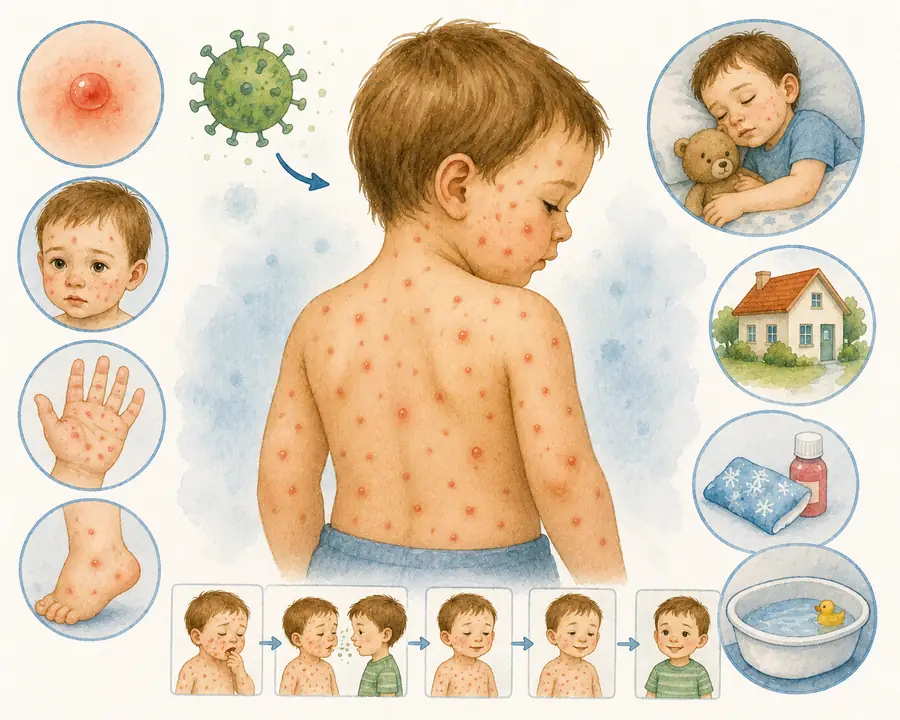
Tiny blisters spreading everywhere, an itch that won't quit, and a child who can't go to daycare until everything crusts over. Chickenpox is one of those childhood rites that arrives for almost every family, and then passes.
The short version:
- It's caused by the varicella-zoster virus (VZV), it spreads easily, and it most often shows up before age five.
- The course: mild fever and tiredness, then a rash that moves through stages - red spots, blisters, broken blisters, scabs.
- Core care: no scratching, short nails, lukewarm baths, an anti-itch lotion; give acetaminophen, and not ibuprofen or aspirin.
- A child is contagious from 1-2 days before the rash until every blister has crusted - roughly 5 days after the first blister appears.
- A chickenpox vaccine exists; in some countries it's part of the routine immunization schedule.
According to the NHS, chickenpox in otherwise healthy children is almost always a mild illness that clears on its own in about a week. Your job is to ease the itch, stop the scratching, and recognize the rare signs of trouble.
Quick reference: chickenpox
| What to expect | |
|---|---|
| Cause | Varicella-zoster virus (VZV) |
| Most common age | Preschool and school age; possible at any age |
| Incubation | 10-21 days |
| Contagious from | 1-2 days before the rash |
| Contagious until | All lesions have crusted (~5 days after the first blister) |
| Illness length | 5-10 days total |
| Rash | Red spots, blisters, broken, scabs; all stages at once |
| Fever | Low to moderate, 99.5-101.3 °F; not always present |
| Fever reducer | Acetaminophen; NOT ibuprofen, NOT aspirin |
| Daycare | When all lesions have crusted and the child feels well |
What chickenpox is and who gets it
Chickenpox is caused by the varicella-zoster virus, one of the herpesvirus family. It is extraordinarily contagious. Up to 90% of non-immune household contacts catch it after exposure to a sick family member, per NCBI StatPearls (Varicella-Zoster Virus).
Most children get chickenpox between ages one and ten. In young kids the illness is usually milder than in teenagers and adults, which is part of why pediatricians want children to gain immunity early, whether through the illness itself or vaccination. The CDC notes the disease is far less common now in countries with routine vaccination.
The virus then stays in the nervous system and can reactivate decades later as shingles (herpes zoster) - a painful rash along one nerve, triggered when immunity dips (illness, stress, older age). This has nothing to do with childhood chickenpox. Children don't get shingles from having chickenpox.
The timeline: what happens, day by day
Incubation (10-21 days). Your child is infected but has no symptoms. The virus multiplies quietly. They don't know they're carrying it, yet they're already mildly contagious in the 1-2 days before any rash shows.
Prodrome (1-2 days). Mild tiredness, less appetite, maybe a low fever and a headache. In small children this stage sometimes passes without anyone noticing.
Rash, days 1-2. The first red spots appear, usually on the trunk first, then the face and scalp. Each spot turns quickly, within hours, into a blister filled with clear fluid. Like a dewdrop sitting on the skin.
Blisters, days 2-5. New blisters keep arriving in waves, so the skin looks like it has lesions in every stage at once: fresh spots, full blisters, broken ones. The itch peaks here. Spots cover the whole body, the trunk, face, scalp, inside the mouth, eyelids, the diaper area. The total count ranges from a dozen to several hundred.
Crusting, days 5-7. Blisters break and dry, leaving yellow-brown scabs. A child stops being contagious once every lesion has crusted - no fresh blisters left anywhere. That usually happens around day five after the first blister, but it can take longer.
Recovery. Scabs fall off on their own over 1-2 weeks, leaving no lasting mark, unless lesions got infected or heavily scratched. Kids who scratched can be left with faint scars.
Home care
The itch is priority number one. It's the most miserable part for the child and the hardest thing to leave alone. A few strategies:
- Short nails: trim them down, or put cotton mittens on at night so they can't scratch in their sleep.
- Lukewarm baths: a short lukewarm bath (skip hot water) can take the edge off the itch. Add a little baking soda or colloidal oatmeal to the water.
- Anti-itch lotion: calamine lotion (no prescription needed) goes straight onto the lesions and cools the skin for a while.
- Antihistamines: older children can take an oral antihistamine that also causes drowsiness, which can help at night. Ask your pediatrician about the right age and dose.
- Loose clothing: soft cotton reduces friction against the spots.
Fever. If your child is uncomfortable from fever, give acetaminophen by weight.
Ibuprofen: no. Ibuprofen is best avoided with chickenpox. Studies have linked it to a higher risk of serious bacterial skin infections in children with the disease, specifically invasive strep soft-tissue infections. This is the key difference from most other feverish illnesses, where ibuprofen is normally fine.
Aspirin: never. As with any viral illness in children, aspirin is off the table because of the risk of Reye's syndrome, per CDC chickenpox treatment guidance.
Hydration. Push fluids, especially if there's a fever. Mouth blisters can make eating hard, so offer softer foods and cool drinks.
Mouth sores. Salt stings. Skip salty, acidic, and spicy foods while mouth lesions last.
For more on managing temperatures in kids, read when to monitor a fever and when to call the doctor.
Contagiousness and going back to daycare
Chickenpox is one of the most contagious childhood illnesses. It spreads:
- through droplets from an infected person's nose and throat,
- through direct contact with the fluid from blisters.
Your child is contagious from 1-2 days before the rash until 5-7 days after the first blister appears, that is, until every lesion has crusted. Not a single fresh blister can remain.
When they can return to daycare: once all lesions have crusted and the child feels well. If some spots are in hard-to-check places (scalp, back) and you can't tell, your pediatrician can examine the child and clear them.
A note for daycare: tell them the moment you spot the first symptoms. They may need to warn other parents - some children have weakened immunity, and some pregnant staff may not be immune.
A pediatrician visit is always easier if you've written down the course of the illness, what appeared and when. There's more on that in a guide to common feeding problems and the broader question of whether your child is eating enough during illness. If you want a simple way to organize that kind of detail before you go in, see how to prepare for a pediatric visit with your child's data.
The chickenpox vaccine
The varicella vaccine is a live attenuated vaccine that offers strong protection - around 85% against any disease, and over 95% against severe disease. According to the NHS, two doses in countries that use it have sharply cut hospitalizations.
Whether chickenpox vaccination is routine depends on where you live. In some countries it's on the mandatory schedule; in others it's recommended and self-paid. Your pediatrician can advise whether and when it's right for your child.
Children who've had chickenpox have lifelong immunity (with a small risk of reactivation as shingles in old age). Children vaccinated with one dose can still get a milder form if exposed.
What NOT to do
- Don't give ibuprofen. It's best avoided with chickenpox because of the bacterial skin-complication risk.
- Don't give aspirin. Risk of Reye's syndrome, a severe brain and liver injury.
- Don't let them scratch. The itch is fierce, but scratching pushes bacteria into open sores and can lead to secondary infection, even permanent scars.
- Don't put them out in strong sun. The skin is healing, and fresh lesions and scabs are sensitive. For healthy habits in those first days at home, read the first night home with a newborn.
- Don't send a child to daycare while still contagious. Fresh blisters mean contagious.
- Don't diagnose chickenpox on your own. A rash that looks similar could be scarlet fever, roseola, an allergic reaction, or rarely something more serious.
When to call the doctor
Chickenpox in healthy children usually needs no visit, but some situations do call for medical attention.
Go to the ER right away if:
- Your child is breathing hard or fast.
- The rash spreads fast and turns hard, red, and hot around one lesion - signs of a bacterial skin infection (cellulitis).
- Your child is limp, confused, has a severe headache or a stiff neck (possible meningitis).
- Lesions appear in an eye, or the child can't open an eye.
Call your pediatrician the same day if:
- A newborn or baby under 4 weeks has chickenpox - always assessed.
- A pregnant household member who isn't immune is exposed - antiviral prophylaxis may be needed.
- Your child has a chronic illness or weakened immunity (chemotherapy, long-term corticosteroids) - an antiviral (acyclovir) may be needed.
- Blisters look bacterially infected - a spreading red rim, warmth, pus, painful to touch.
- Fever lasts more than 4 days or returns after it had already gone.
- Your child has more than 250-300 lesions and is doing very badly.
Frequently asked questions
Can a child get chickenpox twice?
Rarely, but it can happen. One bout usually gives strong immunity. Sometimes the virus reactivates as shingles later in life in someone who had chickenpox, but that's not the same illness.
How do I know the chickenpox is over and my child isn't contagious?
A child stops being contagious once EVERY lesion has crusted - none can still be fresh or fluid-filled. That's usually 5-7 days from the first blisters, but check everywhere on the body, including the scalp and back.
Can my child still take a bath?
Yes. Short lukewarm baths can ease the itch. Avoid long soaks and rubbing. Pat the skin dry gently rather than rubbing. Bathing doesn't prolong the illness.
My child isn't vaccinated. Can the vaccine still help after exposure?
Post-exposure vaccination can work if given within 3-5 days of contact. Call your pediatrician right away if you know your unvaccinated, never-infected child was exposed to someone with chickenpox.
What does skin care look like after chickenpox?
Scabs fall off on their own in 1-2 weeks. Faint marks can linger for several more weeks, then fade. Scratched lesions can leave permanent scars. There's no special preventive treatment beyond sun protection. For the bigger picture on what to do when a child eats and sleeps poorly while sick, see why a toddler wakes up crying at night.
Can an adult catch chickenpox from a child?
Yes, if they've never had it or the vaccine. Chickenpox in adults is usually more severe than in children, with more lesions, higher fevers, and a greater risk of complications (pneumonia, encephalitis). Non-immune adults exposed to a sick child should see a doctor.
How KidyGrow helps you
Chickenpox runs about a week, and tracking how many new spots appeared each day, when the fever broke, and when the last blisters crusted over is a lot to hold in your head. KidyGrow remembers the course of the illness the way you enter it, with no special form.
Once you've noted that the first spots showed Thursday morning, fifteen blisters by Friday, and everything dry by Sunday, you have an answer ready for the pediatrician's "when did it start and where are you in the course." The app also tracks shifts in your child's sleep and mood; when three rough nights line up with the itch, that shows in the pattern, and the evening suggestions adjust to where things actually are. Sometimes the app won't find anything useful - some weeks chickenpox just runs its course and clears. But when you're wondering whether a fever alongside the spots is normal, the comparison to the past few days comes from the app, not from an exhausted memory. The morning question stops being "what did this week even look like" and becomes "this is what it was."