Kidy
Kidy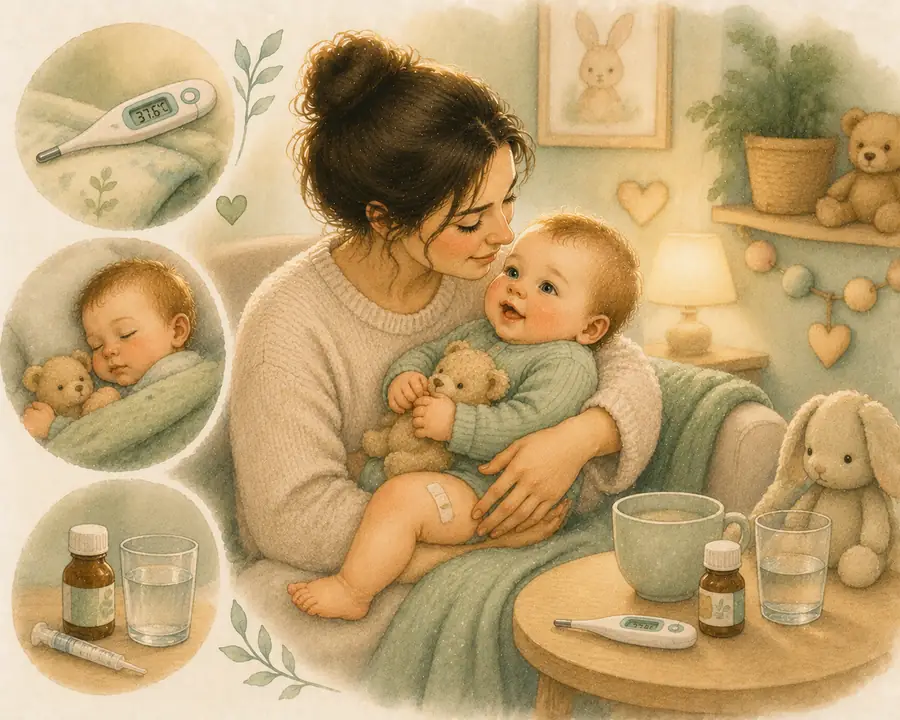
A warm, slightly miserable baby a few hours after their shots is one of the most common worries parents carry home from the clinic. The short version first:
- A mild fever (under 38.5°C / 101.3°F) in the first 24 to 48 hours is common and expected after most childhood vaccines.
- After the MMR vaccine, fever often arrives later, around 5 to 12 days after the shot, which catches a lot of families off guard.
- Medicine is for comfort, not for a number on the thermometer.
- Most post-vaccine fevers settle within a day or two. One that drags on usually points to something else.
Fever after vaccination is your baby's immune system doing exactly what the vaccine asked it to: rehearsing a response so the real illness, if it ever comes, meets a body that already knows the drill. It feels alarming at 2am. In almost every case, it is a good sign.
Quick reference: post-vaccine fever at a glance
| What you are seeing | What it usually means | What to do |
|---|---|---|
| Low fever, first 1-2 days | Normal immune response | Comfort, fluids, watch |
| Fever 5-12 days after MMR | Delayed live-vaccine response | Same comfort care; expected |
| Red, warm, swollen leg or arm | Local reaction at the site | Cool cloth; eases in 1-2 days |
| Any fever 38°C+ in a baby under 3 months | Always needs a check | Call the doctor, even post-shot |
| Fever past 48 hours, or 39°C+ not easing | Possibly a separate illness | Call the pediatrician |
Why do babies get a fever after vaccines?
A vaccine shows the immune system a harmless piece or blueprint of a germ. The body answers by releasing chemical messengers that, among other things, can nudge body temperature up. That low-grade warmth is a side effect of the rehearsal, not an infection. The NHS lists mild fever among the expected reactions to the 6-in-1, pneumococcal and MenB vaccines given in the first year.
Most reactions are small: a warm forehead, a clingier evening, less appetite, a sore spot on the thigh. One 4-month-old ran 38.1°C the evening of his shots, drank half his usual bottle, and was back to chewing the dog's ear by morning. That arc is the rule, not the exception.
Is a fever after vaccination normal, and how high?
Yes. A temperature up to around 38.5°C in the first day or two sits within the expected range for most inactivated vaccines. Higher spikes happen too, especially after the MenB vaccine, which is more likely to cause fever than the others.
What matters more than the exact number is how your baby looks and behaves. A baby at 38.4°C who is feeding, settling and making eye contact is in a very different place from a floppy, grey, hard-to-rouse baby at the same temperature. For the general "watch versus call" thresholds that apply to any fever, our guide on when to monitor a fever and when to call the doctor breaks the numbers down by age.
Why does the fever come days later after the MMR?
This one confuses almost everyone. The MMR (measles, mumps, rubella) is a live, weakened vaccine. The viruses have to replicate gently before the immune system reacts, so the fever, and sometimes a faint measles-like rash, tends to show up about 5 to 12 days after the appointment rather than the same night. By then the shot feels like ancient history, and parents go hunting for a cold or a new tooth instead. If a mild fever and rash appear a week or so after an MMR, the vaccine is the likeliest explanation.
Paracetamol or ibuprofen, and should I give it before the shot?
Treat the baby, not the thermometer. If your little one is genuinely uncomfortable, hot, miserable, not sleeping, the right weight-based dose of infant paracetamol usually helps. Ibuprofen is an option from 3 months and over 5 kg, but not for younger babies and not if your baby is dehydrated. Dose by weight, not age, and check with your pharmacist or pediatrician if you are unsure.
Now the part most parents have never heard. Giving paracetamol routinely before a vaccination, purely to head off a fever, is generally not recommended. A study published in The Lancet (Prymula et al., 2009) found that prophylactic paracetamol lowered fever but also blunted the antibody response to several vaccines. The WHO and AAP therefore advise treating discomfort if it happens, rather than pre-medicating.
There is one well-known exception. The NHS specifically recommends paracetamol around the MenB vaccine at 8 and 16 weeks, because that one causes fever often enough that the benefit outweighs the small dip in response. So the honest answer is: do not pre-medicate by default, but follow the specific advice for the MenB shot. If you are not sure which rule applies to your baby's schedule, ask the nurse giving the vaccine.
Fever, or is it teething?
Both land in the same months, so the mix-up is constant. Here is the line worth keeping: teething can make a baby drooly, gummy and irritable, and may nudge the temperature up by a few tenths of a degree, but it does not cause a true fever. A reading of 38°C or higher is not "just teeth," and blaming a real fever on teething can delay noticing an actual infection. Our piece on teething signs and what actually helps walks through what teething does and does not do. A fussy evening can also simply be an overtired baby, and the signs a baby is overtired are easy to confuse with feeling unwell.
When to act, when to wait
- Baby is warm but feeding, settling and consolable: comfort measures, watch, no medicine needed.
- Baby is clearly distressed by the fever: weight-based paracetamol, fluids, lighter clothing.
- Fever in a baby under 3 months reaching 38°C: call the doctor the same day, even right after a vaccine.
- Fever still climbing or lasting beyond 48 hours: call the pediatrician and think beyond the vaccine.
- Trouble breathing, a seizure, swelling of the face or lips, or a floppy, unrousable baby: emergency services now.
Extra fluids help: more breast or formula feeds, and a little water if your baby is over 6 months. Dress them lightly, keep the room comfortable rather than hot, and skip the cold baths and sponging, which can backfire by making a baby shiver.
Common mistakes to avoid
- Overdressing a hot baby "to sweat it out." It traps heat.
- Pre-dosing with paracetamol before every appointment "just in case." (See the antibody point above.)
- Alternating paracetamol and ibuprofen on a stopwatch with no advice. Pick one, dose it correctly, and only switch if your doctor tells you to.
- Pinning a 39°C fever on teething.
- Assuming a fever a week after the MMR has to be a new bug.
When to seek professional help
Call your pediatrician, or urgent care, if:
- Your baby is under 3 months and has a temperature of 38°C or higher.
- The fever is above 39°C, lasts more than 48 hours, or keeps climbing.
- Your baby is very drowsy, floppy, refusing all feeds, or making far fewer wet nappies.
- The crying is high-pitched and inconsolable for hours.
- The injection site spreads into a large hot red area after 48 hours, or there is any blistering.
Seek emergency care immediately for difficulty breathing, swelling of the face or mouth, or a seizure. Severe allergic reactions are very rare and almost always happen within minutes at the clinic, which is exactly why you wait a short while after the shot before going home.
Trust the look, not just the number. A baby who worries you at 38°C beats a chart every time.
Frequently asked questions
How long does a fever last after vaccination?
Usually 24 to 48 hours for most vaccines. After the MMR it may appear 5 to 12 days later and then pass within a day or two. A fever lasting beyond 48 hours deserves a call, because it may be a coincidental infection rather than the vaccine.
What temperature is too high after a baby's vaccines?
Up to about 38.5°C is expected. For a baby under 3 months, any reading of 38°C or more should be checked the same day. For older babies, 39°C and up, or a fever that will not ease, is worth a call.
Can I give paracetamol before the vaccine to prevent fever?
Not as a routine. Pre-medicating can lower the immune response (Prymula et al., 2009), so it is better to treat discomfort if it actually appears. The one common exception is the MenB vaccine, where the NHS advises paracetamol around the appointment.
Why did the fever start a week after the shot?
That points to the MMR or another live vaccine. The weakened virus replicates slowly, so the reaction is delayed by 5 to 12 days. A mild fever and a faint rash in that window are expected.
Is it teething or the vaccine?
Teething does not cause a true fever. If your baby is 38°C or higher, treat it as a fever, often the vaccine in the days after a shot, not as teeth.
Should I skip the next vaccine if my baby had a fever?
A normal post-vaccine fever is not a reason to skip future doses. Mention any strong reaction to your pediatrician, who will advise you, but fever on its own is expected and protective.
How KidyGrow helps you
The hardest part of a post-vaccine night is not the fever. It is remembering, three days later and on no sleep, when the temperature actually started, what dose you gave and at what time, and whether this is day one or day two.
KidyGrow holds that thread for you. You note the vaccine and the readings as they happen, and the app keeps the timeline straight: when the fever began, when the last paracetamol was due, and whether you are still inside the expected 48-hour window. After your baby's first couple of appointments, the Daily Brief starts to recognize the shape of your child's reactions rather than an average baby's. Instead of "babies sometimes get a fever," it might say something closer to "the last two times, the fever was mild and gone by morning, and so far this matches that pattern."
It will not diagnose, and some reactions simply do not fit a tidy pattern. But when you call the nurse, or sit in front of the pediatrician, you are reading from a clear record instead of guessing. If you have a check-up coming, our note on preparing for a pediatric visit with your child's data shows how that record turns a foggy "I think it was Tuesday?" into something you can actually use.
The morning question shifts from "how bad was last night, really?" to "this is exactly what last night was. Now I can decide."
Sources
- NHS - Vaccinations and their side effects, including fever and the MenB paracetamol advice. https://www.nhs.uk/vaccinations/
- WHO - Vaccines and immunization, safety and reactions. https://www.who.int/health-topics/vaccines-and-immunization
- Prymula R, et al. Effect of prophylactic paracetamol on antibody response. The Lancet, 2009. https://pubmed.ncbi.nlm.nih.gov/19837254/
- CDC - Vaccine safety and possible side effects. https://www.cdc.gov/vaccine-safety/about/index.html