 Kidy
A new food lands on the plate and your toddler pushes it to the rim, or the whole plate goes back to you. If your child won't try new foods, here is what the research actually says:
- 10 or more tastes can be needed before a toddler accepts a new food (AAP)
- A tiny daily taste for about two weeks raised liking for a disliked vegetable in 2–6-year-olds (Wardle, 2003)
- Pressure lowers intake: preschoolers ate more when nobody asked them to finish (Galloway, 2006)
- Genes play a big part: in a large study of twins aged 8–11, about 78% of the differences in food neophobia were linked to genetic differences (Cooke, 2007)
This article is about one narrow moment: getting a specific new food from "no" to a first real taste. For the wider picture of fussy eating, the division of responsibility and meal structure, see picky eating without pressure.
Quick reference: what you see and what it usually means
| What you see | What it usually means | What to try |
|---|---|---|
| Won't touch anything unfamiliar | Normal wariness of new foods | A very small, age-safe amount beside a safe food, no comment |
| Eats pasta plain, refuses it with sauce | "New" includes new versions of known foods | Change one thing at a time |
| Licks it, then spits it out | Progress, not failure | Count it as a taste, offer again tomorrow |
| Refused a food 3 or 4 times | Far too early to call it | Keep going, AAP says 10+ tastes |
| Gags or vomits on many textures | Possibly more than pickiness | Talk to your pediatrician |
Why won't my toddler try new foods?
Wariness of new food has a name, food neophobia, and researchers treat it as a separate thing from general picky eating (Dovey et al., 2008). A neophobic child may happily eat the same six meals and still refuse anything that looks, smells or feels unfamiliar.
It is not a verdict on your cooking. A large UK study of 5,390 pairs of twins estimated the heritability of food neophobia at 0.78 (Cooke et al., 2007). That was measured in 8–11-year-olds, so it doesn't predict any one toddler, but it does say something useful: a wary child is often simply built that way. Two siblings at the same table can end up miles apart.
Adults do this too, by the way. Think of the first time someone put an oyster, or a durian, or grandma's tripe stew in front of you. You probably looked at it for a long time. Maybe you smelled it. Maybe you let someone else go first and watched their face. Nobody calls that picky. A toddler has that experience with a red pepper.
How many times do you have to offer a new food?
More than feels reasonable. The American Academy of Pediatrics notes that it can take as many as 10 or more tastes before a toddler accepts a food. The NHS says the same thing more gently: it may take lots of attempts.
The detail most parents miss is what counts as an attempt. In the study that best matches home life, parents of 2–6-year-olds gave their child a small taste of one disliked vegetable every day for 14 days. Liking and intake went up more than in the families who got only nutrition advice (Wardle et al., 2003). A taste. Not a portion, not a clean plate.
The tasting ladder: from "no" to a first bite
This is our practical framing, not a clinical protocol. It turns "offer it again" into steps a child can actually climb, and it lets you count progress that would otherwise look like refusal.
Everything that goes into your child's mouth has to be prepared in a shape and texture that suit their age and how well they chew. Whole grapes, nuts, raw carrot sticks, hard apple pieces and hot dogs are on the AAP's list of choking hazards for young children.
- Tolerates it on the table. The food sits in a bowl nearby. Nobody mentions it.
- Tolerates it on the plate. A very small amount, prepared in a shape and texture that is safe for your child's age, parked at the edge, not touching anything.
- Touches it. Picks it up, squashes it, moves it. That counts.
- Smells it or brings it to the lips. A kiss on a soft cooked carrot is a real step.
- Licks it or bites and spits. Keep a napkin within reach and say nothing about spitting.
- Chews and swallows a bite.
A 2-year-old might sit on step 2 for a week and then skip straight to 5. That is fine. What matters is that you are no longer asking "did she eat it?" but "which step was she on today?"
Three rules we suggest for the ladder: one new food per meal, next to at least one food your child reliably eats, and the new amount stays very small. A big heap of something unfamiliar is a wall. A single green bean is a question.
What helps a new food feel familiar
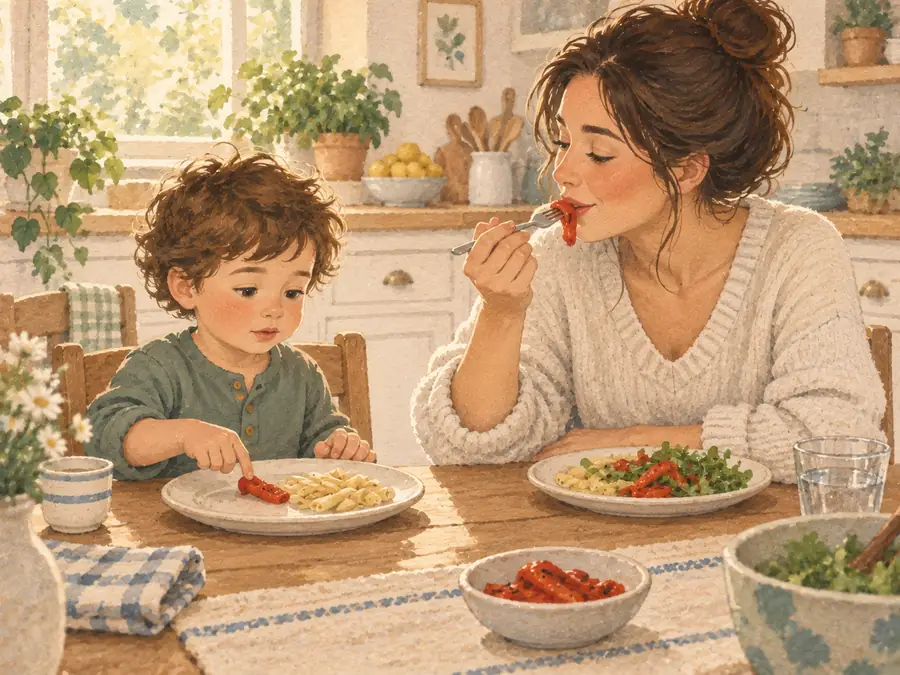
Eat it yourself, where they can see. The NHS puts it plainly: the best way for a child to learn to eat new foods is to copy you. No commentary needed. Just eat the pepper.
Show it before you serve it. This one surprised us. Toddlers aged 19–26 months whose parents read a picture book about an unfamiliar vegetable every day for two weeks later ate more of that vegetable than of a matched one they hadn't seen in the book (Heath et al., 2014). Looking is exposure too. So is washing carrots at the sink or dropping peas into a pot.
Bridge from a food they already accept. Plain pasta, then pasta with a drop of butter, then with a few flecks of cheese. Change one thing at a time: color, shape, texture or taste, never all four. This is a practical rule rather than a tested protocol, but it follows the same logic as the exposure studies. Familiar things get accepted.
A sticker for tasting, if you want one. In a trial with 173 families of 3–4-year-olds, parents offered 12 daily tastes of a disliked vegetable. Children who got a small sticker for tasting increased both intake and liking more than controls, and the effect held three months later. Praise alone did not reach a significant difference from the control group (Remington et al., 2012). Notice what was rewarded: tasting, not finishing, and never with food. If you try it, keep it a game for your child, never a condition or a bargain.
Common mistakes that make new foods harder
- "Just one more bite." In an experiment with preschoolers, children ate more when they were not pressured and made far fewer negative comments about the food (Galloway et al., 2006). The AAP adds that pressure can make children actively dislike foods they might otherwise have liked.
- Dessert as the prize. The NHS advises against using food as a reward, because children may start to see sweets as nice and vegetables as nasty.
- Giving up after three tries. Three refusals is barely the start of the range. Keep offering.
- Hiding it and hoping. Blending spinach into a smoothie adds nutrients, fine. It may not help your child accept spinach they can actually see, because they never met it.
- Introducing a new food when your child is starving or wrecked. A hungry, tired toddler reaches for the safe food. That is also why the timing of snacks matters, covered in toddler eats only snacks, not meals and in fixing the timing, not the food.
Some weeks nothing moves. A cold, a molar, a new room at daycare, and the ladder slides back two steps. Start again from wherever your child is. And if several weeks of calm offers have moved nothing at all, keep the food on the table without pressure, try it prepared another way or a close cousin of it, and mention it at the next check-up. There is no date by which it has to work.
When to talk to your pediatrician
Wariness of new foods on its own, in a child who grows well and eats a range of familiar foods, is usually not a medical issue. If your child truly cannot breathe or cough because of food, that is an emergency: call emergency services. If coughing or choking episodes during meals keep coming back, ask for a feeding and swallowing assessment. A short list of foods and a normal weight do not on their own rule out missing nutrients or a feeding difficulty. If the list keeps narrowing, meals hurt or cause a lot of stress, or your child often coughs while eating, ask for an assessment even when weight looks fine.
Talk to your pediatrician if:
- your child is losing weight or dropping across growth lines
- gagging or vomiting on textures happens regularly
- the list of accepted foods keeps getting shorter, or entire food groups are missing
- meals bring real panic or distress, not just a firm no
- eating seems painful, or there are ongoing tummy or bowel problems
Some children with very narrow diets have feeding difficulties that benefit from specialist help, and it is worth asking rather than waiting it out. If your toddler refuses meals in general, not only new foods, start with toddler refuses food: calm steps that actually work. For what intake is normal from 0 to 3, the baby and toddler feeding guide has the whole arc.
Frequently asked questions
How long does it take for a toddler to accept a new food?
There is no fixed timeline. The AAP says it can take 10 or more tastes, and the home studies used daily tastes over roughly two weeks. Some foods click in days, others take months, and a few never become favorites. That is allowed.
Does licking and spitting out count as trying?
Yes. On the tasting ladder, licking or biting and spitting is one step below swallowing. Don't scold the spit. The goal is to keep tasting free of pressure, so you can calmly offer the same step another day.
Should I make my toddler take one bite?
It is better not to. In Galloway's experiment, pressure lowered what children ate and made them more negative about the food. Put it on the plate, eat it yourself, and let your child decide.
Is it okay to hide vegetables in other foods?
For nutrition, yes. For learning to accept the food in a form they recognize, it probably helps little, because the child never sees what they ate. Many families do both: a hidden version for nutrients and a visible piece on the plate for exposure.
My toddler used to eat everything and now refuses new foods. Why?
It happens a lot. A baby who ate spinach purée at nine months can be a two-year-old who won't look at anything green, and that change is not a sign you did something wrong. Go back to tiny tastes of the old foods alongside the safe ones.
When does neophobia become a feeding problem?
When it comes with weight loss, regular gagging or vomiting, a shrinking list of foods, or real distress at meals. Then it is a question for your pediatrician, not for a new trick at dinner.
How KidyGrow helps you
Week two of a tasting ladder is exactly when memory fails. Was it Tuesday he licked the pepper, or last Tuesday? In KidyGrow a meal entry takes a few taps: pick the food, switch on New food, choose a reaction from Loved to Refused. Every entry keeps the food and the reaction, so on a discouraging evening you can look back and see, say, that the pepper went from Refused to Neutral over nine days. Tell Grow in chat which foods are safe, and the app remembers them for later suggestions.
It will not tell you which taste is the one that sticks. Nobody can. It just keeps the count you would have lost by Thursday.
Sources
- American Academy of Pediatrics, HealthyChildren.org: 10 Tips for Parents of Picky Eaters. https://www.healthychildren.org/English/ages-stages/toddler/nutrition/Pages/Picky-Eaters.aspx
- NHS: Fussy eaters. https://www.nhs.uk/conditions/baby/weaning-and-feeding/fussy-eaters/
- Wardle J, et al. Increasing children's acceptance of vegetables; a randomized trial of parent-led exposure. Appetite, 2003. https://pubmed.ncbi.nlm.nih.gov/12781165/
- Galloway AT, et al. "Finish your soup": counterproductive effects of pressuring children to eat on intake and affect. Appetite, 2006. https://pubmed.ncbi.nlm.nih.gov/16626838/
- Remington A, et al. Increasing food acceptance in the home setting: a randomized controlled trial of parent-administered taste exposure with incentives. Am J Clin Nutr, 2012. https://pubmed.ncbi.nlm.nih.gov/22158728/
- Heath P, Houston-Price C, Kennedy OB. Let's look at leeks! Picture books increase toddlers' willingness to look at, taste and consume unfamiliar vegetables. Front Psychol, 2014. https://pubmed.ncbi.nlm.nih.gov/24653709/
- Cooke LJ, Haworth CM, Wardle J. Genetic and environmental influences on children's food neophobia. Am J Clin Nutr, 2007. https://pubmed.ncbi.nlm.nih.gov/17684215/
- Dovey TM, et al. Food neophobia and "picky/fussy" eating in children: a review. Appetite, 2008. https://pubmed.ncbi.nlm.nih.gov/17997196/
- American Academy of Pediatrics, HealthyChildren.org: Choking Prevention for Babies & Children. https://www.healthychildren.org/English/health-issues/injuries-emergencies/Pages/Choking-Prevention.aspx
_This article is for general information and does not replace medical advice. Talk to your pediatrician if your child is losing weight, gags or vomits regularly, or eats fewer and fewer foods._