 Kidy
Kidy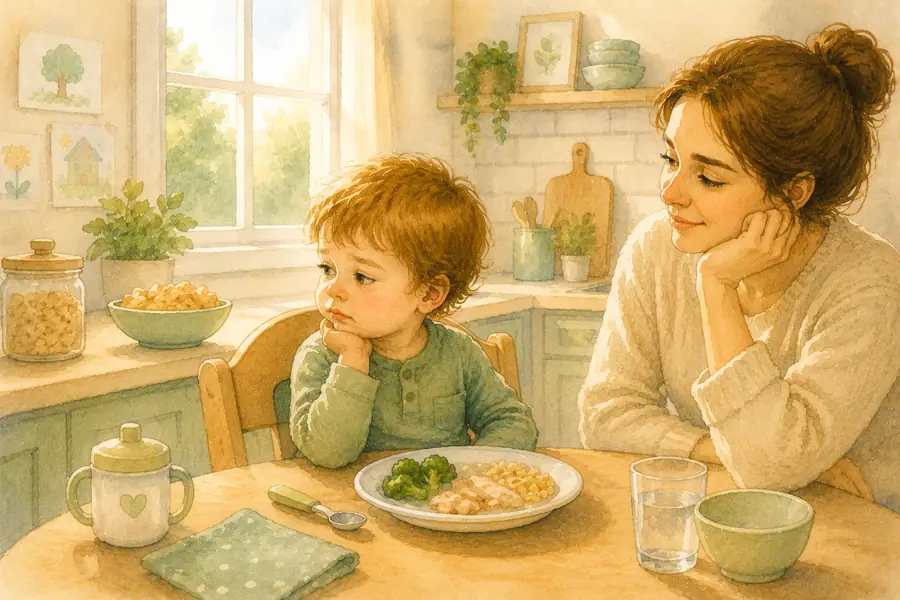
If your toddler grazes all day but turns away from the plate at dinner, you are not doing anything wrong, and your child is not broken. Constant snacking quietly removes the hunger that makes meals work. The fix is rhythm, not pressure.
Start here:
- Grazing kills appetite. A handful of crackers at 4 pm means little real hunger at a 5:30 pm dinner.
- Offer food at set times, not on demand: three meals and two snacks, then the kitchen closes between.
- Let water fill the gaps. Milk and juice sipped all afternoon fill the tank the same way snacks do.
- Make snacks small meals, with some protein or produce, not only crackers and puffs.
- Stay calm at the table. Pressure makes children eat less, not more.
Quick reference: snack-grazer vs. structured rhythm
| Situation | What it looks like | What helps |
|---|---|---|
| Constant grazing | Eats every 30 to 60 minutes, never very hungry | Three meals and two snacks at set times |
| Snacks are only crackers and puffs | Pouches and dry cereal on demand | Pair with fruit, veg, yogurt or cheese, on a plate |
| Drinks fill the tank | Milk or juice sipped all day | Water between meals; milk and any juice with meals |
| Battles at the table | Begging, bribing, "three more bites" | Serve, sit, stay neutral, end calmly |
When kids only want snacks, not meals, it is almost always a timing problem rather than a taste problem. When food arrives every time they ask, their body never builds enough appetite for a full meal. The good news: appetite follows rhythm, and rhythm is something you can rebuild.
Why grazing happens (and why it sticks)
Snacking starts for kind reasons. A toddler whines, you offer a cracker, the whining stops. It works once, so it becomes the default. A few weeks later the pantry has become a way to calm things down, and a child who eats a little all the time is never hungry enough for chicken and broccoli.
The official guidance points the same way. The AAP describes a one-year-old's day as three meals and two snacks (AAP, feeding your one-year-old). The NHS says two healthy snacks a day is plenty, and warns against too many snacks between meals (NHS, fussy eaters). And the AAP puts the split of roles in one line: it is the parent's job to provide food and the child's decision to eat it. It adds that scheduled meals and limited snacks help make sure your child is hungry at the table (AAP, picky eaters). Grazing flips that split: the child ends up controlling the timing, and timing is what drives appetite.
If you have already ruled out genuine undereating, this is usually a rhythm issue rather than a worry. (If your child is truly eating very little overall or losing weight, read baby not eating much: when to worry first.)
The 7-day reset: rebuild the meal-and-snack rhythm
You do not need a dramatic overhaul. You need a predictable clock.
1. Set a visible eating schedule. Three meals and two snacks, spaced roughly 2.5 to 3 hours apart. For example: breakfast 7:30, snack 10:00, lunch 12:30, snack 15:00, dinner 17:30. The spacing is our working rule, not a clinical norm. Between those windows, the kitchen is closed.
2. Close the kitchen between windows. This is the hardest and most important change. When your toddler asks for food off-schedule, acknowledge it warmly: "I hear you're hungry. Snack is at three, and it's coming." No punishment, no lecture, just the clock.
3. Make snacks small meals. A snack of only crackers fills a small tummy without doing much. Pair it with protein or produce: apple slices with cheese, yogurt with berries, half a banana with a thin spread of smooth nut butter. The NHS suggests giving dried fruit like raisins with meals rather than between them, because of the sugar (NHS, what to feed young children).
4. Move drinks to mealtimes. A toddler sipping milk or juice all afternoon arrives at dinner with a full tank. Offer water between meals and serve milk with food. The AAP recommends about 16 ounces (480 ml) of milk a day at age two, an amount that covers calcium without spoiling appetite (AAP, feeding your two-year-old). For juice, the AAP says no more than 4 to 6 ounces (120 to 180 ml) a day for ages 1 to 6, ideally with a meal, and whole fruit is better (AAP, fruit juice).
5. Serve the meal, then step back. Put a small amount of the family food on the plate, sit together and stay neutral. The AAP advises one meal for the whole family and no second meal if your child refuses. If they eat two bites and stop, that is information, not failure. The next eating window is only a few hours away.
6. Expect a dip, then a turn. For the first days your toddler may eat less overall and protest the closed kitchen. This is normal. Look at the week, not the day: the NHS suggests thinking about what a child eats over a week rather than in a single day.
For the calm-table mechanics, how to respond to refusal without turning dinner into a standoff, picky eating: help without pressure and toddler refuses food: patterns go deeper.
What not to do
- Don't graze "just to get something in." A few bites every hour guarantees little appetite at meals. Less snacking often leads to more eating at the table.
- Don't make a separate "kid meal" after they reject dinner. The AAP warns this only encourages picky eating. A reliable backup of crackers teaches them to hold out for it.
- Don't pressure or bribe bites. In a lab study, preschoolers ate significantly more soup when nobody asked them to finish it, and made far fewer negative comments (Galloway et al., Appetite, 2006). The AAP adds that pressure can make children actively dislike foods they might otherwise like.
- Don't confuse boredom or tiredness with hunger. Off-schedule "I'm hungry" is often "I'm bored." Offer water and something to do. And don't leave meals so late that your child is too tired to eat, which the NHS also warns about.
If mealtimes have become a daily battle, portion expectations help too: how much should a toddler eat.
When it is more than grazing
Most snack-only patterns ease with rhythm. Talk to your pediatrician if your toddler also:
- is losing weight or not gaining
- gags, coughs or chokes on textures other children manage
- eats a very short list of foods that keeps shrinking
- shows real distress, not just dislike, around whole food groups
These can point to feeding difficulties beyond grazing and deserve a professional look.
How KidyGrow helps you
You log meals, snacks and drinks in a few taps, and KidyGrow remembers them. Insights show counts over a week, so you can see how many snacks actually happened and when, instead of guessing from a tired memory. The Daily Brief takes the last 24 hours into account and adapts today's suggestion, and the app keeps what you tell it, such as which snack worked.
What it does not do: it does not link a 3 pm snack to a refused dinner for you, and it does not compute a schedule. After a week or two your entries sit side by side, and you can see for yourself whether the refused dinners followed the late snacks.
Frequently asked questions
My toddler only eats snacks. Should I just let them, since at least they're eating?
It feels safer, but constant snacking is usually what causes the meal refusal. The small, frequent intake keeps them mildly full and never truly hungry, so meals never get a fair chance. Three meals and two snacks at set times, with the kitchen closed between, lets real appetite come back.
How long does it take to fix snack grazing?
Often about a week, though some children take longer. Expect a dip in the first days while the old pattern fades and your child protests the closed kitchen. Judge by the week, not the day. Consistency matters more than perfection, and one off day won't undo it.
What's a good snack that won't ruin dinner?
A small meal that pairs a carbohydrate with protein or produce: yogurt and berries, cheese and apple, half a banana with a thin spread of smooth nut butter. Keep it at the planned time, and give water rather than milk or juice alongside it.
Could refusing meals mean something is medically wrong?
Usually not, it's a timing pattern. But see your pediatrician if your toddler is losing weight, eats a very short and shrinking list of foods, gags or chokes on age-appropriate textures, or shows real distress around food. Those can signal a feeding difficulty that needs a professional assessment.
Related: For the wider feeding picture beyond this one battle, see the Baby and Toddler Feeding Guide.
Sources
- AAP HealthyChildren. Picky Eaters (accessed September 2026).
- AAP HealthyChildren. Feeding and Nutrition: Your One-Year-Old (accessed September 2026).
- AAP HealthyChildren. Feeding and Nutrition: Your Two-Year-Old (accessed September 2026).
- AAP HealthyChildren. Where We Stand: Fruit Juice (accessed September 2026).
- NHS. Fussy eaters (accessed September 2026).
- NHS. What to feed young children (accessed September 2026).
- Galloway AT, et al. 'Finish your soup': counterproductive effects of pressuring children to eat on intake and affect. Appetite. 2006;46(3):318-23.