 Kidy
Kidy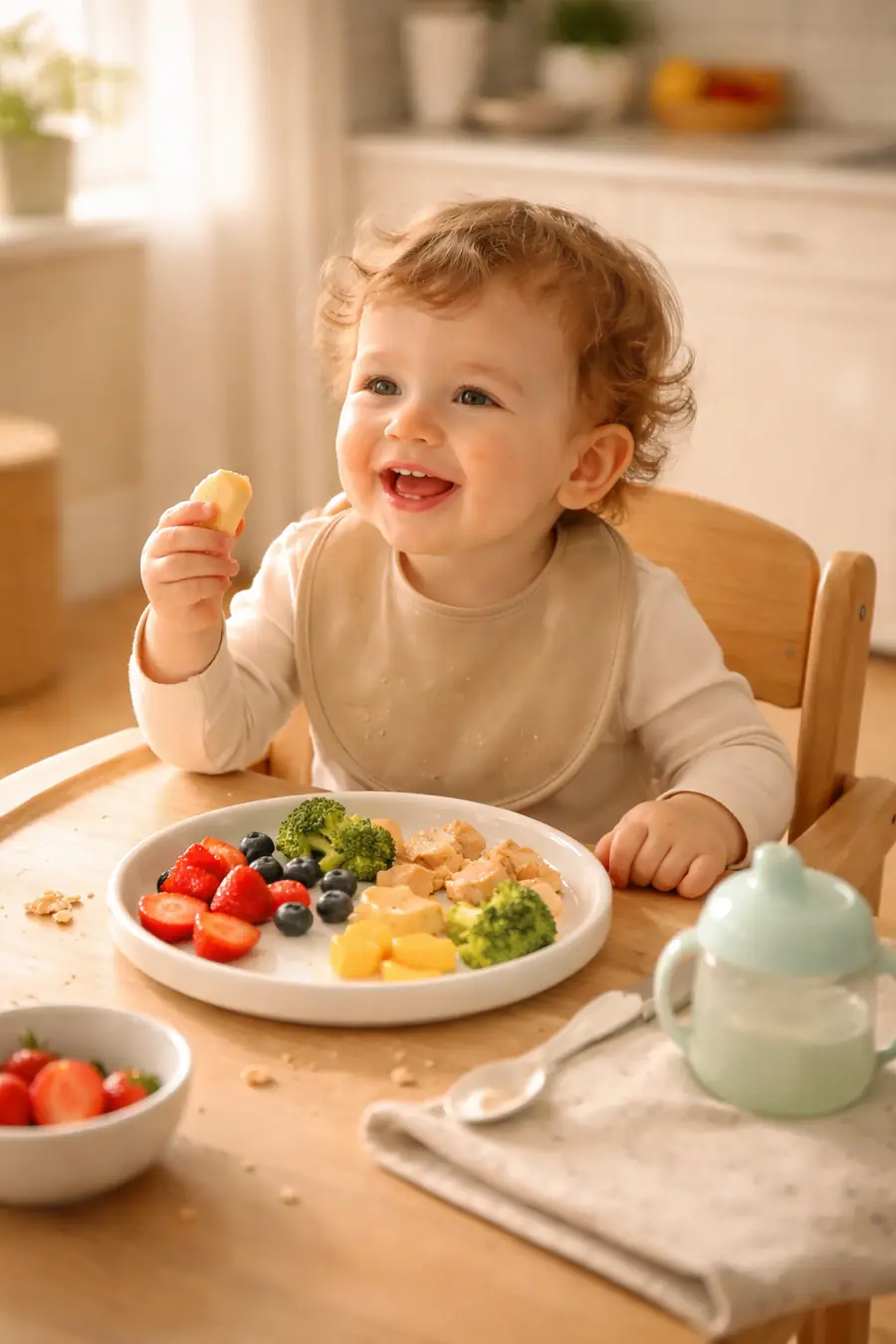
Most toddlers (12–36 months) eat less than their parents expect, and far less evenly. The short version:
- Single meals swing wildly. Whole days don't. In a classic study, meal intake varied by about a third while daily intake varied by about a tenth (Birch et al., 1991)
- Judge by the week, not the plate. If your toddler is active, gaining weight and well, they're getting enough (NHS)
- 3 meals and about 2 snacks. The NHS calls 2 healthy snacks a day "plenty"
- Watch the milk. The AAP suggests about 16 oz (roughly 470 ml) a day at 12–24 months (AAP)
- Pressure backfires. Preschoolers ate more when nobody asked them to finish (Galloway et al., 2006)
If your toddler eats well one day and barely picks the next meal, you're watching the most ordinary pattern in this age group.
Quick reference: toddler eating, 1–3 years
| Question | Short answer |
|---|---|
| Meals and snacks | 3 meals plus 2 healthy snacks a day is plenty (NHS) |
| Cow's milk, 12–24 months | About 16 oz (470 ml) a day, whole milk (AAP) |
| Cow's milk, 2–5 years | 16–24 oz (470–710 ml) a day, lower-fat (AAP) |
| Minimum dairy (NHS) | At least 350 ml of milk, or 2 servings of dairy foods, a day (NHS) |
| Protein (NHS) | 1 portion from animal sources or 2 from plants a day (NHS) |
| How to judge "enough" | Over a week: active, gaining weight, well (NHS) |
These are guides, not targets. The point of the table is the milk rows. Too much milk is the most common reason a healthy toddler "won't eat".
How much does a toddler actually need?
Less than you'd think, and less than a few months ago. Growth slows a lot after the first year, and appetite follows it. A one-year-old who drank big bottles of formula doesn't need that volume any more.
That's why so many parents read normal toddler eating as a problem: they're still expecting baby-sized intake from a child whose growth curve has flattened. The NHS puts it simply. Don't worry about what your child eats in a day. Think about what they eat over a week. If they're active, gaining weight and seem well, they're getting enough (NHS, Fussy eaters).
What does a toddler portion look like?
Small. Much smaller than the plate you'd serve an older child. The NHS advice is to give small portions and praise any eating, even a little (NHS).
A practical test: serve half of what you think they'll eat and let them ask for more. If most of the plate comes back every time, the portion was a grown-up guess, not a toddler serving.
Across the day, the NHS suggests at least 350 ml of milk or two servings of dairy foods, and one portion of protein from meat, fish or eggs, or two from beans, lentils or tofu (NHS, What to feed young children). Fruit and vegetables at every meal, as many different kinds as they'll take.
Why does my toddler eat so little at some meals?
Because that's how toddlers eat. Real reasons include:
- growth that has slowed since the first year
- teething, colds and ear infections
- tiredness after a missed nap
- a big developmental leap, when walking or talking beats sitting still
The finding worth repeating
In 1991 researchers measured every bite 15 children aged two to five ate, over six days. Intake at individual meals was all over the place: the average variation was 33.6%. But each child's total for the day barely moved, varying by only 10.4%. A big meal was usually followed by a small one, and the other way round (Birch et al., 1991).
So the refused dinner is usually paid back at breakfast, or was paid for at lunch. Children balance it themselves, if nobody interferes. And pressure is exactly what interferes. When preschoolers in a later experiment were asked to finish their soup, they ate less of it and said more negative things about it than when nobody pushed (Galloway et al., 2006).
For when refusal is more than a bad meal, see toddler refuses food: what to do.
Quick decision check
- Eats something across the week, growing, energetic → normal variation, nothing to do
- Drinks a lot more than 16–24 oz of milk → cut milk first, watch appetite for 5 days
- Weight loss or a drop across percentile lines → call your pediatrician this week
Is my toddler drinking too much milk?
Often, yes, and it's the most common quiet reason for a poor appetite. The AAP suggests about 16 oz (2 cups) of whole milk a day at 12–24 months, and 16–24 oz from age two to five (AAP, Recommended drinks for young children). A toddler drinking a litre a day has had a meal's worth of calories before sitting down.
If your toddler eats poorly and drinks a lot of milk, try this for a week: bring milk back to about 16 oz, offer water between meals, and watch what happens to appetite.
Common mistakes
- "Two more bites." Pressure makes children eat less, not more (Galloway et al., 2006)
- Replacing a refused meal with a favourite snack half an hour later. It teaches that skipping pays
- Constant grazing. Small amounts every hour stop real hunger from building. Two snacks a day is plenty
- Watching the meal, not the week. A toddler who eats well across the week is fine after two skipped dinners
- Eating separately. The NHS says the best way for children to learn new foods is to copy you, so eat with them as often as you can (NHS)
- Using food as a reward. Sweets become "nice" and vegetables "nasty"
For pressure-free ideas see picky eating: how to help without pressure or battles.
When to talk to your pediatrician
Most uneven eating is normal. Talk to your pediatrician if you see:
- weight loss across two growth checks
- a drop across percentile lines on the WHO growth charts, for example from around the 50th to around the 10th
- refusal of whole food groups, not just favourites
- choking, gagging or vomiting at most meals
- noticeably fewer wet diapers than usual
- persistent tiredness or low energy
A very narrow and shrinking list of accepted foods, with meals that end in distress most days, is worth raising too. Sometimes that's a feeding disorder called ARFID rather than ordinary picky eating, and it's treatable.
If your worry is "she barely eats but is growing and busy", that's almost always normal variation. If it's "he is losing weight and tired", book an appointment within the week.
For the broader picture see the baby and toddler feeding guide, and for younger babies my baby is not eating much: when to worry.
Frequently asked questions
How many calories does a toddler need?
It varies with age, size and activity, and calorie counting is rarely useful at this age. The NHS test is simpler and more reliable: over a week, is your child active, gaining weight and well? If yes, they're getting enough.
Should I worry if my toddler eats less than the portions I serve?
Not at a single meal. In the Birch study, children's intake varied by about a third between meals and by about a tenth across whole days. Worry if growth slows, energy drops, or your child stops accepting whole food groups.
Is it okay if my toddler eats the same few foods every day?
For a while, yes. Keep offering other foods alongside the favourites. The NHS notes it can take lots of attempts before a child accepts a food, and tastes change: hated one month, loved the next (NHS). Raise it with your pediatrician if the list keeps shrinking or whole textures disappear.
When does a picky-eating phase pass?
For most children it eases gradually through the preschool years. Repeated, calm offers work better than coaxing: the pressure experiment above is the reason why.
Should my toddler take vitamins?
In the UK the NHS recommends a daily supplement with vitamins A, C and D for all children from 6 months to 5 years (NHS, Vitamins for children). Other countries have their own advice, so ask your pediatrician what applies where you live before starting anything else.
How KidyGrow helps
A refused dinner feels like a crisis at 6 p.m. By breakfast you've forgotten that lunch went fine.
KidyGrow remembers the week for you. You can log meals and snacks with what was on the plate and how it went, from loved to refused. That's it: the app doesn't count calories or portions, and it won't tell you your toddler ate "enough". What the log gives you is the week, so one refused dinner sits next to four ordinary days.
For growth itself, the Growth charts plot your child's weight and height against WHO percentiles. That line answers "is she eating enough" better than any single plate.
Sources
- Birch LL, et al. The variability of young children's energy intake. N Engl J Med. 1991;324(4):232-5.
- Galloway AT, et al. 'Finish your soup': counterproductive effects of pressuring children to eat on intake and affect. Appetite. 2006;46(3):318-23.
- American Academy of Pediatrics. Recommended drinks for young children ages 0–5.
- NHS. Fussy eaters.
- NHS. What to feed young children.
- NHS. Vitamins for children.
- World Health Organization. Child growth standards.
- American Academy of Pediatrics. Picky eaters.
_Educational content only. Not medical advice. Talk to your pediatrician about your child's specific needs._