 Kidy
Kidy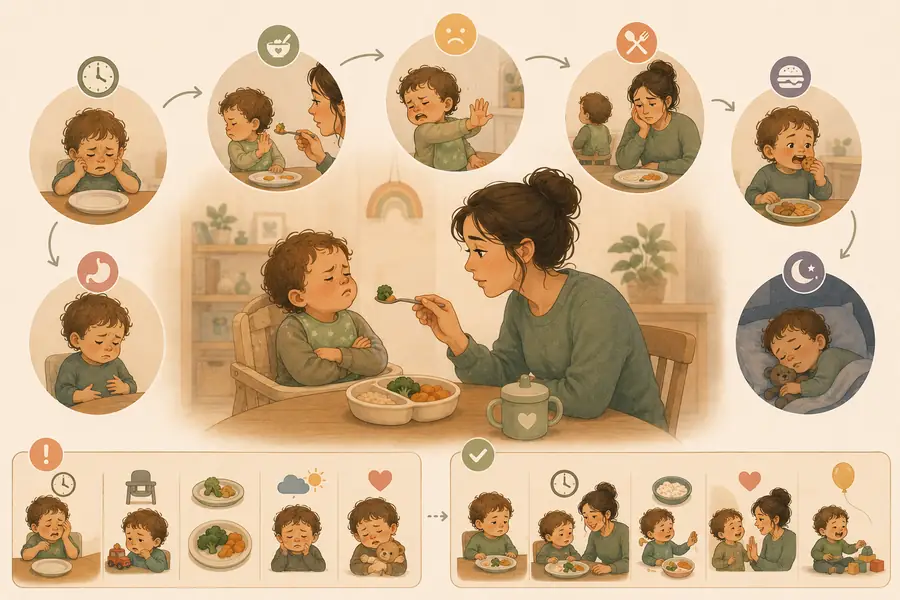
If your toddler says "no" to dinner but snacks beautifully all afternoon, the story is usually fullness and timing, not a permanent label like "picky":
🍽️ Set a loose rhythm: the Feeding schedule by age lays out meals and snacks that fit your child's age.
- About 60–80% of toddler refusals track to snack–meal timing or pressure-at-the-table, not to a stable food preference
- Picky eating peaks between ages 2 and 4 in roughly half of children, and most resolve without intervention
- Daily appetite varies by 30–50% in healthy toddlers; one refused meal is biology, not a verdict
- Five "no thanks" dinners in a row is signal. Three across two weeks is noise.
Look for patterns across 5–7 days, not one day. For the full method, start at Track your baby's patterns and the feeding sub-pillar How to track feeding patterns (baby & toddler).
_Educational only. Not medical advice. Last updated: February 2026._
Quick reference
| Check | Look for | Why it matters |
|---|---|---|
| Last snack timing | Big snack within 90 min of meal? | Fullness lingers and flattens appetite |
| Liquid calories | Milk/juice volume same day | Milk and juice compete with solid intake |
| Pressure at the table | "Just two more bites" frequency | Pressure raises refusal more than it raises intake |
| Illness or teething | Symptoms in last 7 days | Appetite drops with both, returns slowly |
| New texture / new food | Introduced this week? | Toddlers often need 8–15 exposures before accepting |
What "refusal" actually means at this age
Toddler refusal is rarely a permanent verdict. The American Academy of Pediatrics and World Health Organization both emphasize that toddler appetite is rhythmic and varies considerably day to day in healthy children (healthychildren.org, 2024; WHO infant and young child feeding, 2023).
Three things change appetite thresholds fast:
- Recent intake. A 4pm snack changes the 6pm meal more than any other variable.
- Pressure. Even gentle pressure ("two more bites") raises refusal in the next meal, not lowers it. The pressure trains the child to expect a fight.
- Context. Illness, teething, a new texture, an unfamiliar environment, sibling drama - all shift the threshold for the meal.
The "picky eater" label, applied early, tends to outlast its usefulness. The Division of Responsibility framework (Ellyn Satter), referenced by the AAP, separates jobs cleanly: parents decide what, when, where; children decide whether and how much. Tracking helps you see whether your refusal pattern is fullness, pressure, or developmental - three different fixes. For the wider picture of feeding schedules and expectations across the toddler years, see our baby and toddler feeding guide.
Three common refusal patterns
Pattern 1: snack–meal compression
The most common one. A 4pm snack at 4:00 makes a 5:30 dinner hard. Track snack times and dinner appetite for a week; the correlation usually pops out within 4 days.
Pattern 2: pressure spiral
You worry. You coax. The child resists. You coax more. Appetite drops further. Pressure-reduction (neutral offering, no coaxing, no rewards for eating) is what holds up over 4–8 weeks. Pressure tends to backfire.
Pattern 3: post-illness appetite dip
Appetite often returns slowly after a virus, sometimes 2–3 weeks. Logging when the illness ended vs current appetite usually surfaces this clearly. Treating it as picky eating during the recovery window misreads the pattern.
Decision logic: what to try first
| Pattern in your week | Try this | Give it |
|---|---|---|
| Big snacks under 2 hours before meals | Move snacks earlier or shrink them | 5–7 days |
| Pressure-coaching every meal | One week of neutral offering, no "two more bites" | 7–10 days |
| Recent illness | Hold expectations; offer; do not push | 14–21 days |
| Refuses one specific food repeatedly | Keep offering without comment; mix with accepted foods | 8–15 exposures |
| Refusals + weight or growth concern | Talk to pediatrician, this is not a track-and-wait situation | Immediately |
Common mistakes when "fixing" picky eating
Bribing with dessert or screens. Short-term gain, long-term raise of resistance. The child learns that the main dish is something to get past, not something to enjoy.
Making a separate "kid meal" every night. Reduces exposure to the foods you want them to accept. Most pediatric dietitians suggest one family meal with at least one accepted food as a safety net.
Pulling new foods after one refusal. Acceptance often takes 8–15 calm exposures over weeks. One "no" is the start, not the verdict.
Reading too much into one bad week. Toddler appetite varies wildly. Two weeks of pattern data is more honest than one bad Tuesday.
When to call your pediatrician
Refusal becomes a clinical conversation, not a track-and-wait one, in any of these cases:
- Weight loss or plateau outside expected growth curve
- Swallowing concerns or coughing/choking during meals
- ARFID-level food selectivity (fewer than ~20 accepted foods, distress around eating)
- Allergic reactions or suspected allergy
- Persistent vomiting
The CDC checklist at Learn the Signs, Act Early is a useful first reference for development-related feeding concerns.
Frequently asked questions
How many exposures before a toddler tries a new food?
Often 8–15 calm offerings, sometimes more. The trick is offering without commentary or pressure. The child watches, smells, and eventually tastes. Stopping at "she didn't eat it the first three times" is the most common mistake.
Should I make my child sit at the table until they eat?
No. The NHS guidance is explicit that prolonged sitting raises resistance, lowers intake, and damages mealtime relationships over time (NHS, 2024). Short, neutral meals beat long, tense ones.
Is it okay that my toddler eats almost nothing some days?
For healthy toddlers, yes, within a normal range. Appetite varies. The relevant question is whether the week of intake is roughly age-typical, not whether Tuesday was.
What about milk?
Milk volume affects solid intake more than parents expect. The AAP suggests roughly 16 oz / 480 ml per day after age 1, more than that often crowds out meals.
My toddler "eats great at daycare." Why not at home?
Common, and not a failure. Peer modeling, structured timing, fewer distractions, and lower stakes (no parent watching) all matter. Tracking helps you see whether home refusals cluster on days with more parental coaching at the table.
How KidyGrow helps with this specifically
KidyGrow is not a picky-eating cure. It remembers what sleep-deprived parents can't — your child's appetite rhythm — so you stop guessing meal by meal.
- Daily Brief highlights the most likely lever this week. For a refusal week, that is usually snack timing or pressure pattern based on the last 5–7 days, not generic "offer variety" advice.
- Tonight plan reflects yesterday's meal pattern. Big snack at 4pm, refused dinner? Tonight's plan suggests an earlier snack or no afternoon snack.
- Child Insights shows you whether refusals cluster after specific snack windows, on specific weekdays, or post-illness - three completely different fixes.
Honest expectation. The app warms up over 3–5 days of consistent logging. By day five the pattern reads off the screen. Useful refusal pattern data does not come from one logged meal.
KidyGrow's free tier covers the baseline → one change → compare loop for feeding the same way it does for sleep.
Related (feeding cluster)
- Toddler tantrums: spotting the pattern
- How to track feeding patterns (baby & toddler)
- How to track toddler behavior patterns
- Track your baby's patterns
Sources
- American Academy of Pediatrics. Toddler Nutrition and Feeding. healthychildren.org, 2024. https://www.healthychildren.org/English/ages-stages/toddler/nutrition
- World Health Organization. Infant and Young Child Feeding. WHO, 2023. https://www.who.int/health-topics/infant-nutrition
- NHS (UK). Toddler feeding guidance. nhs.uk, 2024. https://www.nhs.uk/conditions/baby/
_Educational only. Not medical advice._