 Kidy
Kidy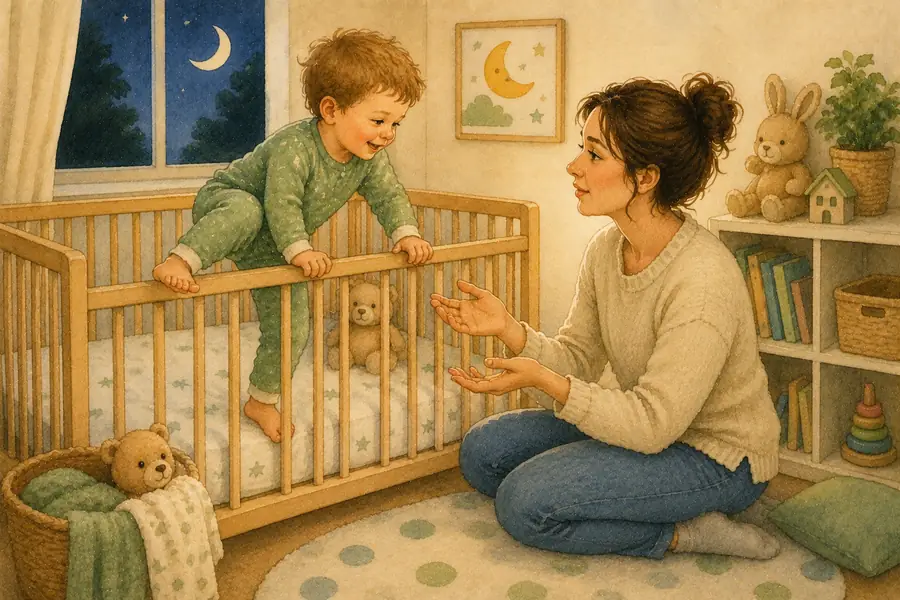
The first time you see a leg swing over the rail, your stomach drops. Here is what matters most:
- Climbing out is mainly a fall risk, and most falls happen from a crib set too high
- Lower the mattress to its lowest setting first, and many toddlers stay safely in the crib until 2.5 to 3.5 years
- Switch to a bed when the rail sits below your child's chest, they are about 35 inches / 89 cm tall, or they escape repeatedly despite every precaution
- A few rough nights after the switch are normal and usually settle within 1 to 2 weeks
A toddler climbing out of the crib is one of those milestones nobody warns you about. One night they are sleeping soundly, the next they are standing in your doorway at 5:40 AM, proud of themselves. The instinct is to rush out and buy a bed. Sometimes that is right. Often it is not, at least not yet. Safe sleep still matters at this age, and a crib, made harder to climb, is usually safer than a bed a not-quite-ready toddler can wander from all night.
Quick Reference
| Situation | What to do |
|---|---|
| First climb, crib still high | Lower mattress to lowest setting today |
| Climbs but rail is above chest | Keep the crib, remove climb aids |
| Rail below chest / ~89 cm tall | Start planning the switch to a bed |
| Escapes nightly despite precautions | Switch, and toddler-proof the room |
| Fell and got hurt | Move out of the crib now, do not wait |
Is climbing out of the crib dangerous?
Yes, but the danger is specific: it is the fall, not the climbing itself. A child going over a crib rail can land on their head or neck from a meaningful height. That is why safe-sleep guidance keeps the sleep space low and clear of anything a child can stand on (AAP, A Parent's Guide to Safe Sleep).
Most crib escapes are not superhuman feats. They happen because the mattress is still set high from the newborn days, so the rail only reaches the toddler's thigh. Drop the mattress and you often buy months. If your child has already fallen, treat that as the line: get them out of the crib before it happens again.
How do I stop my toddler climbing out?
You cannot un-teach a skill, but you can make the crib far less climbable. Work through these in order:
- Lower the mattress to the lowest setting. This is the single most effective change. The rail should reach at least mid-chest when your toddler stands.
- Strip the crib. Remove bumpers, pillows, stuffed animals, and any large toy. Anything they can pile up and stand on becomes a step stool. A bare crib is also what safe-sleep guidance recommends anyway (AAP, Baby Sleep).
- Try a sleep sack. A wearable blanket keeps legs together and makes swinging one over the rail genuinely awkward. For a lot of families this alone ends the escaping.
- Turn the crib. If one side is lower (a drop-side style or a design with a lower back), face the higher side out.
- Keep the room boring after lights-out. Do not turn the climb into a game. Calm, dull, back to bed. No big reaction.
Protect the floor too. Put a soft rug or a folded duvet on the landing side, just in case the next attempt beats your precautions.
When should I switch to a bed?
There is no magic age. Readiness is physical and behavioral, not a birthday. Switch when any of these is clearly true:
- The top rail sits below your toddler's chest when they stand inside. That is the height where going over stops being hard.
- Your child is around 35 inches / 89 cm tall. Many manufacturers name this as the point a crib is outgrown.
- They climb out repeatedly despite the lowered mattress, the sleep sack, and a stripped crib.
- Someone got hurt, or a near miss scared you. Do not wait for the second fall.
If none of these is true, keep the crib. A crib you have made harder to climb is calmer and safer than a bed for a toddler who is not developmentally ready to stay put. Plenty of children stay happily in a crib past their third birthday, and there is no prize for switching early. Regular, protected sleep is what supports everything else at this age (NHS, Helping your baby to sleep).
How to make the switch
When it is genuinely time, the room matters more than the bed. A toddler in a bed can now reach everything, so the whole room has to be safe enough to sleep in unsupervised.
- Pick the bed. A toddler bed (low, often reusing the crib mattress) feels familiar. A floor mattress is even lower and removes the fall entirely. Both are fine. A twin with a guard rail works for taller toddlers.
- Anchor the furniture. Bolt every dresser, shelf, and bookcase to the wall. This is the non-negotiable one. Toddlers climb.
- Cover outlets, cord up the blinds, gate the doorway. Assume they will be up and roaming at some point. A gate at the door keeps the world small and safe without a locked door.
- Keep the rest identical. Same sleep sack, same books, same songs, same order. Change the bed, nothing else. The bedtime routine is your anchor here, the same way it was during earlier bedtime battles with your toddler.
Expect the first nights to be busy. A newly free toddler will test the border. Walk them back calmly, few words, every time. Boring consistency wins. If you are already deep in nightly standoffs, the patterns in when your toddler refuses bedtime every night apply directly to the bed transition too.
Should I lower the mattress or switch to a bed?
Use this quick decision path:
- If the crib rail is still at or above chest height then lower the mattress, add a sleep sack, strip the crib, and stay put.
- If they escape once or twice but the rail is high then treat it as an alarm, not a verdict. Boring re-do, reinforce precautions, watch for a week.
- If they escape nightly, or the rail is below the chest, or ~89 cm tall then switch to a bed and toddler-proof the room first.
- If there has been a fall with any injury then switch now. Safety outranks routine.
A rough patch after switching is expected. Night wakings and a wandering toddler often look like a sudden increase in night waking, but here the cause is simply new freedom, and it fades as the novelty does.
Common mistakes
- Switching at the first climb. One escape from a high crib usually means "lower the mattress," not "buy a bed."
- Leaving the mattress high. The most common reason a toddler can climb at all. Check it before anything else.
- Leaving climb aids inside. Bumpers and big plush toys are a staircase. Take them out.
- Making it exciting. A gasp, a laugh, a chase, and now escaping is the best game in the house.
- Switching to a bed without securing the room. An unanchored dresser near a newly mobile sleeper is the real hazard, more than the sleep itself.
- Expecting instant success. If the first two nights are chaos, that is the transition, not a failure. Overtired days can follow, much like any stretch of fighting sleep.
When to seek help
Most crib-climbing is a safety-and-logistics problem you can solve at home. Reach out to your pediatrician if a fall caused a head knock with vomiting, drowsiness, or a loss of consciousness, if climbing is paired with extreme, unsafe agitation at every sleep, or if weeks pass and your child cannot settle in any sleep space at all. Those are the moments to get eyes on the situation rather than keep improvising.
The crib-to-bed move is the last big sleep transition of the 0 to 2 stretch. What comes before it, and why timing it after a regression rather than during one matters, is in the baby sleep guide 0–2 years.
Frequently asked questions
Is it safe to keep my toddler in the crib after they have climbed out once?
Usually yes, if you lower the mattress to its lowest setting and remove anything they can stand on. One climb from a high crib is a signal to adjust, not an automatic reason to switch. Watch for a week after the changes.
At what age do toddlers usually stop needing a crib?
There is a wide range. Many children stay in a crib safely until 2.5 to 3.5 years. Height and behavior matter more than age, so a small 3-year-old who stays put may keep the crib longer than a tall, determined 20-month-old.
Does a sleep sack really stop climbing?
For many toddlers, yes. A sleep sack keeps the legs together and makes lifting one over the rail awkward and slow. It is one of the cheapest, fastest things to try before considering a bed.
Should I use a crib tent or netting to keep them in?
Safety agencies do not recommend crib tents, because they carry their own entrapment and strangulation risks. Lower the mattress, strip the crib, and use a sleep sack instead, and switch to a bed when it is truly time.
How long does the rough patch last after switching to a bed?
Usually one to two weeks. The first few nights involve testing the new freedom. Calm, repetitive walk-backs and an unchanged routine shorten it. If wakings persist well beyond two weeks, look at the wider schedule, not just the bed.
Is a floor bed better than a toddler bed?
Both work. A floor mattress removes the fall risk entirely and suits very young or very mobile toddlers. A toddler bed feels more contained. Choose by your child's temperament and your room, not by trend.
How KidyGrow helps you
The hardest part of this transition is not the bed, it is the memory. Which precaution actually helped? Was last night worse because of the new bed, or the skipped nap, or the late dinner? A tired parent cannot hold two weeks of scattered nights in their head. KidyGrow remembers what tired parents can't.
Log the switch date and each night's bumps, and after a few days the Daily Brief stops offering generic tips. Instead of "toddlers need consistent routines," it might say something like: your last three rough nights all followed a nap that ended after 3 PM, and the calm nights did not. That is the kind of pattern nobody spots at 2 AM. The app needs about three to five days of data before it says anything that specific, so it is not magic on night one.
Sometimes there is no clean pattern, and the honest answer is teething plus a new bed plus bad luck. The app will tell you that too, instead of inventing a cause. Mostly, though, the morning question shifts. It stops being "what on earth happened this week" and becomes "here is what this week actually was, now I can decide."
Sources
- American Academy of Pediatrics, HealthyChildren.org — A Parent's Guide to Safe Sleep. https://www.healthychildren.org/English/ages-stages/baby/sleep/Pages/A-Parents-Guide-to-Safe-Sleep.aspx
- American Academy of Pediatrics, HealthyChildren.org — Baby Sleep. https://www.healthychildren.org/English/ages-stages/baby/sleep/Pages/default.aspx
- NHS — Helping your baby to sleep. https://www.nhs.uk/baby/caring-for-a-newborn/helping-your-baby-to-sleep/