 Kidy
Kidy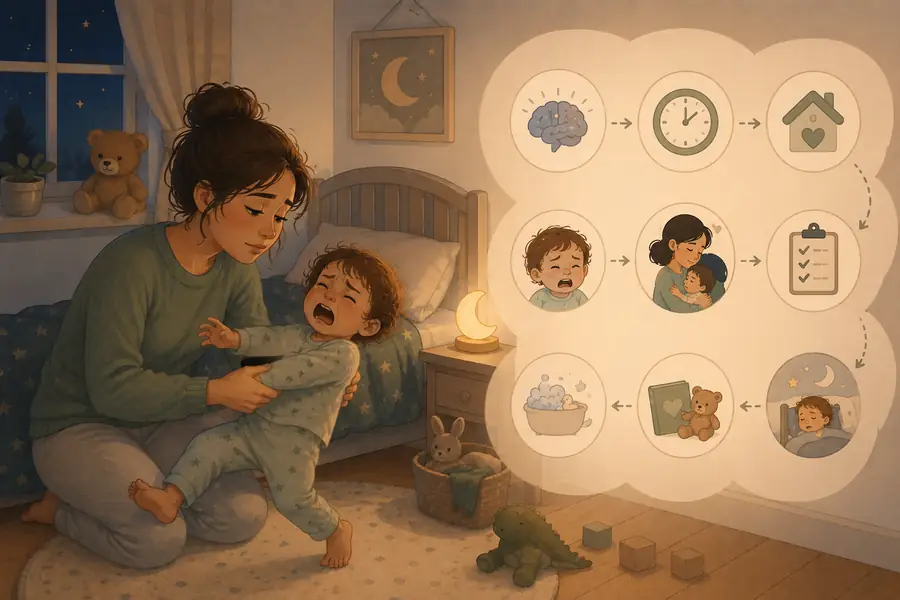
If bedtime is a fight most nights, it is rarely solved by adding more rules. Usually you are looking at fatigue, transitions, and sensory load stacking together:
🌙 Map out the day: enter your baby's age in the sleep schedule calculator for naps and a bedtime that fit their rhythm.
- About 60–70% of recurring bedtime battles track to late afternoon naps or evening stimulation, not to "limit-testing"
- A bedtime routine over 45 minutes is more likely to ramp arousal than wind it down, especially for kids over 2
- Toddlers do not battle "bedtime"; they battle the transition into it. The fight you see at 19:45 is usually about what happened between 17:00 and 19:00.
- One bad night is noise. Five hard nights out of seven is signal.
Look for patterns across 5–7 days, not one day. For the full method, start at Track your baby's patterns and the sleep sub-pillar How to track baby sleep patterns.
_Educational only. Not medical advice. Last updated: February 2026._
Quick reference
| Check | What you are looking for | Why it matters |
|---|---|---|
| Last nap end time | End of nap > 6 hours before bedtime? | Late naps drift the entire evening's sleep pressure |
| Evening stimulation | Screens, rough play, big sibling games in last 60 min | Stacks arousal right when you need wind-down |
| Routine length | Total time from "okay, getting ready" to lights-out | Over 45 min is often counterproductive for older toddlers |
| Hunger or transition | Dinner finished < 30 min before bedtime? Long pickup-to-bed gap? | Both stretch the threshold |
| Recent change | New sibling, daycare start, parent travel | Behavior shifts after change can take 2–3 weeks |
What "battle" usually means at this age
Bedtime resistance from a 2–4 year old is almost always one of three stories:
- Stack: several small disruptions piled into one evening (late nap + big screen + tired parent + slightly later dinner). No single piece is "wrong," but the stack is.
- Routine drift: the routine has grown over weeks. Three books became seven. The "five more minutes" became three. The window between dinner and lights-out is now 90 minutes of slow wind-up instead of 30 of wind-down.
- Genuine schedule misalignment: age changed, the schedule did not. A 3.5-year-old on a 2-year-old's schedule with a 2pm nap will fight bedtime almost every night.
The American Academy of Pediatrics emphasizes that consistent routine and consistent timing matter more than which specific rules you choose (healthychildren.org, 2024). In practice, shortening an over-long routine tends to help faster than adding more steps to it.
If bedtime battles are just one piece of a bigger sleep puzzle for your family (naps, night waking, schedule changes), our complete 0–2 years sleep guide covers how those pieces usually connect.
Decision logic: what to try first
| What your week looks like | Try this | Give it |
|---|---|---|
| Nap ended after 16:00 most days | Cap nap or move start earlier; or drop the nap | 7–10 days |
| Routine has crept over 45 min | Cut to 25 min: bath, two books, song, bed | 5–7 days |
| Pickup → dinner → bed feels rushed | Add 15 min buffer between dinner and routine start | 5–7 days |
| Battles started after sibling/move/daycare change | Hold consistency; allow 2–3 weeks for adaptation | 14–21 days |
| Battles only on parent-A nights | Compare scripts; align on one transition phrase | 7 days |
If you change two of these the same week, you will not learn anything from the next week. Pick one. Run it. Compare.
Common mistakes when fixing bedtime battles
Adding more steps to the routine. Counter-intuitive but reliable: an over-long routine often makes battles worse. Cut, do not add.
Bargaining inside the battle. Bargaining at 19:45 trains the next 50 evenings to expect bargaining at 19:45. Decide the rules at 18:00 when you are calm, then hold them with warmth.
Moving bedtime later "to make them tired." Overtired toddlers fight harder, not less. The fix is usually earlier, not later, especially when battles started after a schedule slip.
Reading too much into Tuesday. One battle in an otherwise smooth week is noise. Three battles in seven nights is signal.
When to call your pediatrician
Schedule conversations stay schedule conversations unless the battles come with reflux symptoms, anxiety symptoms outside bedtime, regression in developmental skills, or genuine fear-based distress that does not resolve with a calm caregiver presence. The CDC red-flag list at Learn the Signs, Act Early is a useful first reference.
Frequently asked questions
My toddler is "just stalling", is that really a pattern?
Stalling is the symptom. The pattern is usually underneath: too much arousal in the last hour, a routine that takes too long, or a schedule that no longer fits the age. Three nights of stalling tells you which.
How long should the routine be?
For most toddlers, 20–30 minutes is enough. Past 45 minutes you tend to ramp, not wind down. The shape (bath → quiet → book → bed) matters more than the length.
Should we drop the afternoon nap?
If naps end after 15:30 and bedtime is hard most nights, that is the most testable lever. Drop the nap for 7 days (with an earlier bedtime to compensate) and read the week. The NHS notes that nap transitions are usually clearer in trends than in single days (NHS, 2024).
My toddler asks "one more book", should I always say no?
Not necessarily, but decide before the routine starts how many books you are reading tonight. The negotiation is what trains stalling, not the books themselves.
We have two parents on different scripts. Does it matter?
Yes, more than people realize. Pick the lines that work for your child and use the same five sentences on both nights. The log will surface whether one script consistently leads to shorter battles.
How KidyGrow helps with this specifically
KidyGrow is not a bedtime-fixer. It remembers what sleep-deprived parents can't — your child's specific evening rhythm — and tells you when the stack is building.
- Daily Brief flags the most likely lever right now. For a bedtime-battle week, that is usually nap timing or routine length based on the last 5–7 nights, not a generic "toddlers need a consistent routine" reminder.
- Tonight plan reflects last night's pattern. Long battle yesterday after a late nap? Tonight's plan suggests an earlier wind-down with a tighter routine.
- Child Insights shows you whether battles cluster after late naps, screen evenings, or parent-handoff nights - three different stories with three different fixes.
Honest expectation. The app warms up over 3–5 days of consistent logging. By day five it is reflecting your child's actual rhythm. By two weeks it is noticeably more specific than any generic schedule chart.
KidyGrow's free tier covers the baseline → one change → compare loop.
Related (sleep cluster)
- Why your baby wakes up too early
- Baby only naps 30 minutes
- Nothing seems to work with baby sleep
- How to track baby sleep patterns
Sources
- American Academy of Pediatrics. Getting Your Baby to Sleep. healthychildren.org, 2024. https://www.healthychildren.org/English/ages-stages/baby/sleep
- NHS (UK). Baby and toddler sleep guidance. nhs.uk, 2024. https://www.nhs.uk/conditions/baby/
- Centers for Disease Control and Prevention. Developmental Milestones. Learn the Signs. Act Early. CDC, 2024. https://www.cdc.gov/ncbddd/actearly
_Educational only. Not medical advice._