 Kidy
Kidy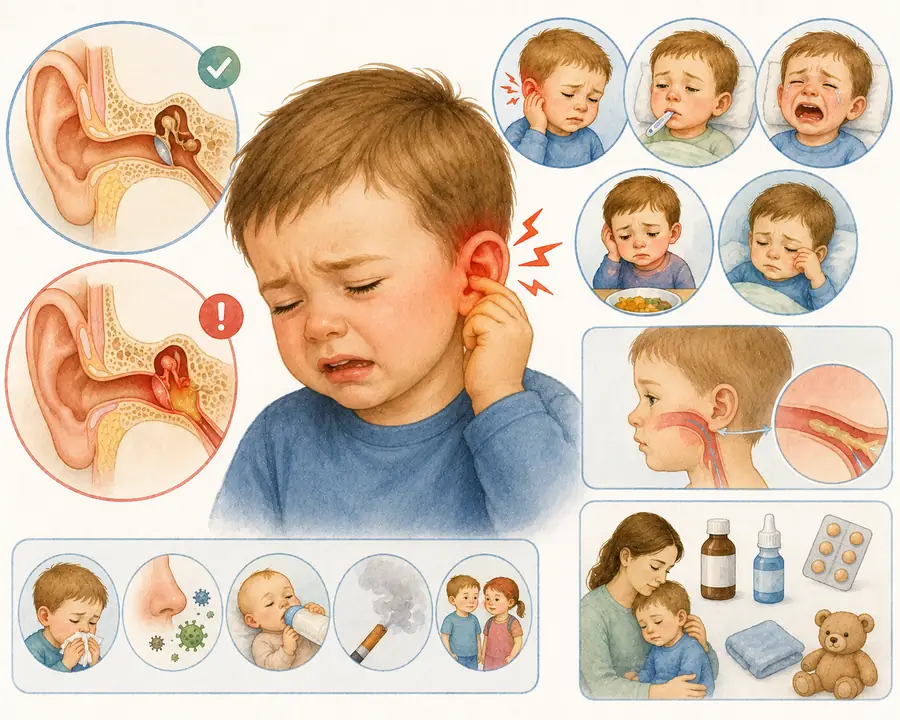
A baby up all night, tugging one ear by morning, fever that won't quit. Most parents of small children meet an ear infection at least once.
The short version of an ear infection in babies:
- The most common signs are ear pain, pulling or rubbing the ear, waking at night, irritability, and fever (NHS, Ear infections).
- Children under 3 are especially prone because the eustachian tube is shorter and more horizontal than an adult's.
- For children over 2 without severe symptoms, doctors recommend a "watch and wait" 48–72 hours before prescribing antibiotics (AAP, HealthyChildren.org).
- Pain eases with acetaminophen or ibuprofen dosed for the child's weight. That is the single most useful thing you can do right away at home.
- Repeat infections (3 or more in 6 months) are a reason to talk to an ENT specialist.
A middle ear infection (acute otitis media) is one of the most common bacterial infections of childhood, and here is the part nobody mentions at 2 AM: most of them clear on their own, often without antibiotics at all. This guide is here so you know what each symptom means, when watching is enough, and when a pediatrician visit is non-negotiable. No panic required.
Quick reference
| Question | Answer |
|---|---|
| How long does the pain last? | Worst the first 1–3 days; better within 3–5 days |
| Antibiotics right away? | For kids over 2 without severe signs, usually not |
| What eases pain at night? | Acetaminophen or ibuprofen, dosed for weight |
| Can it clear on its own? | Yes - about 80% in kids over 2 resolve without antibiotics |
| When is an ENT needed? | 3+ infections in 6 months, hearing loss, fluid over 3 months |
| Is it contagious? | The infection itself no, but the cold that causes it yes |
Why are small children so prone to ear infections
The eustachian tube is the small channel connecting the middle ear to the back of the nose and throat. In adults it runs longer and tilts downward, so fluid drains easily. In young children, especially under three, that tube sits shorter, wider, and almost flat. Bacteria from the nose and throat reach the middle ear more easily, and fluid pools instead of draining.
On top of that, little ones catch more colds and upper-respiratory viruses, daycare multiplies the exposure, and feeding a bottle flat on the back can help fluid sit behind the eardrum. Put it all together and you see why pediatricians half-joke that ear infections are a rite of passage.
Signs to watch for in a baby who can't tell you
Here is the hard part. A pre-verbal baby can't point to an ear and say it hurts. The signs they can't put into words are exactly the ones you have to read off their body.
Babies and children under 2:
- Pulling, rubbing, or batting at one or both ears
- An unusually intense or off-sounding cry, especially at night
- Trouble sleeping; waking more than usual
- Fever (sometimes high, sometimes mild)
- Loss of appetite. Sucking and swallowing raise pressure in the ear and can hurt
- Irritability, listlessness, a child who just seems "off"
- Sometimes: yellowish or clear fluid draining from the ear. That means the eardrum has burst under pressure. The pain often drops suddenly, and that is actually a good sign because the pressure released
Older children (2 and up):
- A clear complaint of ear pain, pressure, or "fullness"
- Reduced hearing or saying they can't hear well
- Fever and a generally lousy feeling
- Sometimes dizziness
One detail trips parents up constantly: ear-infection signs and teething discomfort can look almost identical. Listlessness, face-and-ear tugging, fever, and crying at night show up in both. A pediatrician tells them apart with an otoscope. If you're unsure, don't guess.
The link with a recent cold
Almost every ear infection starts as a viral upper-respiratory infection, a plain cold. The virus swells the lining of the eustachian tube, it closes, fluid collects behind the eardrum, and that warm pool becomes ideal ground for bacteria. The usual culprits are Streptococcus pneumoniae and Haemophilus influenzae (Kaur i sur., 2017).
That is why an ear infection so often lands 3 to 5 days after the cold started. Parents describe it the same way every time: "we thought she was getting better, then the ear hit." Worse lying down, fever after a cold, a sudden bad night. That is the classic arc.
Care at home
The most important thing you can do right away is pain relief:
- Acetaminophen or ibuprofen, dosed to the child's weight, work on both pain and fever. A night can be slept through without antibiotics if you keep the pain controlled.
- A warm (not hot) compress on the ear can ease pain in older children.
- Over-the-counter analgesic ear drops exist, but do not use them if you suspect a burst eardrum (fluid draining from the ear).
Keep your child drinking fluids. Hydration helps with both fever and the swollen lining. There's no need to seal them off from daily life if they feel up to it, though ear plus cold wind is not a friendly combination the first few days.
For everything around the fever and cough that travel with a cold and ear infection, the piece on fever and cough: when to monitor and when to call the doctor walks through it in detail.
Antibiotics or "watch and wait"
This is the question that confuses parents most, and fairly. You're standing in the office with a sobbing kid and every instinct says: give us something.
Research has shown consistently that about 80% of ear infections in children over 2 clear without antibiotics within 3 to 7 days (Rovers i sur., 2006). Antibiotics shorten symptoms by roughly one day, but they carry the risk of resistance and disrupt the gut microbiome. So the AAP and NHS both back a "watch and wait" approach.
Antibiotics right away are prescribed for:
- Babies under 6 months
- Children under 2 with infection in both ears or severe symptoms
- Fluid draining from the ear (a burst eardrum with infection)
- A fever over 39°C / 102°F with strong pain that painkillers don't control
The wait-48-to-72-hours approach is reasonable when:
- The child is 2 or older with mild to moderate symptoms and a fever under 39°C
- Pain is controlled by a painkiller
- You can watch your child and reach a pediatrician quickly if things worsen
A pediatrician sometimes writes a "safety net" prescription, with instructions to start it only if there's no improvement in 48 hours. That is a legitimate practice, not carelessness.
Antibiotics and the gut, what to know
If antibiotics do turn out to be needed, remember they kill helpful gut bacteria too, not just the one in the ear. Your child may have looser stools or a smaller appetite the first few days. For what to do about the gut after a course, see do babies need probiotics after antibiotics.
Finish the full course, even if your child turns cheerful and symptoms vanish in 2 to 3 days. Stopping halfway is one reason infections come back.
What NOT to do
- Don't push cotton or anything into the ear. It won't stop the infection and can injure the ear canal.
- Don't use ear drops if you suspect a burst eardrum (fluid draining out).
- Don't stop antibiotics early even when your child looks better.
- Don't give aspirin to children under 16. There is a risk of Reye's syndrome.
- Don't wait more than 2 days without a pediatrician visit if your child has a fever over 39°C, cries hard, or doesn't respond to painkillers.
- Don't assume every symptom is teething. Fever plus ear-tugging earns an otoscope look.
When to call the doctor
Same-day or next-day pediatrician visit:
- A baby under 6 months with any suspicion of ear pain.
- Symptoms not improving after 48 hours despite painkillers.
- Fluid draining from the ear (yellowish, clear, or blood-tinged).
- A fever over 39°C that won't come down.
- A child who is very listless and refusing to eat or drink.
Emergency care:
- A child who is very weak, hard to wake, or not responding to you.
- Redness, swelling, or pain behind the ear (mastoiditis, a rare complication).
- A stiff neck with fever.
Whichever visit you end up needing, walking in with your child's ear history already organized helps the pediatrician make a faster call. This guide on how to prepare for a pediatric visit with your child's data covers what to bring and how to lay it out so nothing gets lost at the front desk.
Frequently asked questions
Is it normal for the ear to leak a little?
Yes. Clear or yellowish fluid draining from the ear means the eardrum burst under pressure. The pain usually drops sharply because the pressure released. The eardrum almost always heals on its own within a few weeks. Tell your pediatrician to confirm, but don't panic.
Can my child swim with an ear infection?
With a burst eardrum, no. Otherwise, with an intact eardrum and mild symptoms, a short bath is usually fine, but water in the ear can worsen the pain. If you're unsure, ask your pediatrician.
Why do ear infections and nighttime go together?
Lying down raises pressure in the eustachian tube and middle ear, so pain is stronger flat on the back. A child who copes fairly well by day cries at midnight because the pain has climbed. For an older child, an extra pillow sometimes helps. A baby under one should not be propped up, not with a pillow and not with anything under the mattress: back to sleep, flat surface, because the AAP considers any sleep surface inclined more than 10 degrees unsafe (AAP). While your baby is awake, hold them a little more upright.
Should I watch my child's hearing after an ear infection?
A mild temporary dip in hearing for 2 to 4 weeks afterward is normal and clears as the fluid drains. If hearing isn't back to normal after 4 to 6 weeks, or your child stops responding to sounds the way they used to, see your pediatrician.
Can ear infections cause speech delay?
Repeat infections with chronic fluid that lowers hearing can affect speech development, especially in the critical window between ages 1 and 3. If your child has frequent ear infections, your pediatrician will keep an eye on speech too. More on that in when to seek help for speech delay.
Can my child go to daycare with an ear infection?
The ear infection itself isn't contagious, but the illness that caused it (cold, virus) is. While there's a fever, no daycare. Once the fever is gone and they feel well, they can go back even while still on antibiotics, if the pediatrician agrees. If appetite is the worry too, baby not eating much covers it.
How KidyGrow helps you
Ear infections tend to repeat. And when one comes back, the questions that matter are specific: how many times already this year, which antibiotic last time, how the child reacted to it.
KidyGrow keeps your child's health history and remembers every episode. When the pediatrician asks "is this the third or fourth one this season?", you're not doing frantic math in your head. The app holds the thread you can't: dates, symptoms, medications, all in one place. Before an ENT or pediatrician visit, that turns a 20-minute recap into a 5-minute one.
One real moment: it's 11 PM and your child starts tugging an ear. You open the app and see the last time started on the same weekday and passed on its own by morning. That doesn't mean you ignore tonight. It means you decide with information instead of just dread. Sometimes the app won't find a useful pattern, and the answer really is "cold plus bad luck." But often enough, the thread is there.
KidyGrow won't diagnose the ear infection. A pediatrician with an otoscope still does that. The difference between "something feels off" and "this is the fifth time in six months" is the difference between reacting and walking in informed. That difference makes the night a little less exhausting.
Sources
- NHS - Ear infections
- NHS - Glue ear
- American Academy of Pediatrics - Ear Infection Information
- Rovers MM i sur., 2006. Antibiotics for acute otitis media: a meta-analysis with individual patient data. Lancet
- Kaur R, Morris M, Pichichero ME, 2017. Epidemiology of Acute Otitis Media in the Postpneumococcal Conjugate Vaccine Era. Pediatrics
- CDC - Ear Infection
_This is educational content, not a substitute for professional medical advice. Consult your pediatrician for health concerns._