Kidy
Kidy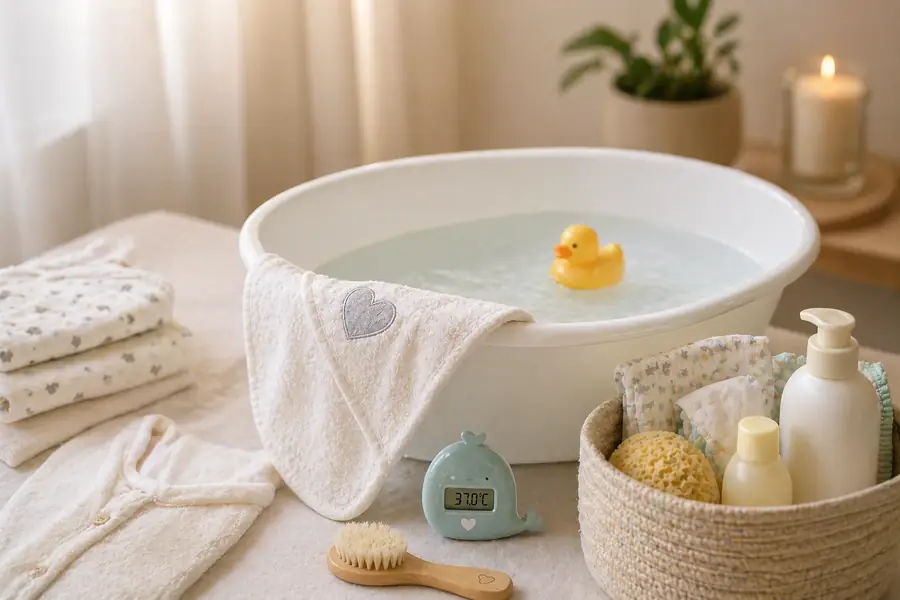
I remember it like it was yesterday. Thermometer in one hand, phone in the other, ten browser tabs open, and the feeling every brand-new mom knows: "Am I going to mess this up?"
If you are getting ready for your baby's first bath at home today, here is what you actually need to know, short version first, no panic, no fluff:
- water at 36–37 °C / 97–99 °F (check with a thermometer or your elbow)
- no tub immersion before the umbilical stump falls off, sponge bath only
- lay everything out before undressing the baby
- 5–10 minutes in the water is plenty
- head always above water, baby never alone (not for one second)
Everything else is built on top of that.
Quick reference: first bath at a glance
| What | When / how long | Quick tip |
|---|---|---|
| Sponge bath | Before stump falls (1–3 weeks) | Lukewarm water, soft cloth, keep cord dry |
| First "real" bath | After stump heals | 5–10 cm of water in baby tub |
| Water temperature | Every time | 36–37 °C / 97–99 °F, thermometer or elbow |
| Room temperature | Every time | 24–26 °C / 75–79 °F, no drafts |
| Frequency | 0–6 months | 2–3 times a week (AAP) |
| Duration | Per bath | 5–10 minutes max |
When can you start bathing baby at home?
Before the stump falls off: sponge bath. That means a gentle wipe-down with a damp soft cloth, face, neck, hands, diaper area, without putting baby in water. The American Academy of Pediatrics recommends sponge bathing until the umbilical cord stump falls off and the area heals, usually 1 to 3 weeks (AAP, 2024).
After the stump falls off: the first "real" bath in a baby tub. New phase, new wave of panic, completely normal.
💡 Pediatricians typically recommend 2–3 baths a week for newborns. More isn't better: baby skin is thin and dries out fast.
Between baths, daily spot-cleaning is enough:
- face
- neck (where milk collects)
- hands
- diaper area
For a wider rhythm of the day, including how bath fits into "winding down", see how to build a baby routine that actually works.
Water temperature: the number everyone googles
36–37 °C (97–99 °F). That is it. Not warmer, not cooler.
The reason is simple: it is closest to body temperature, so baby doesn't get a shock from cold or heat. NHS and AAP agree on this range as safe for newborns (NHS, 2024).
How to check:
- ✔️ Bath thermometer: most accurate
- ✔️ Inside of your elbow or wrist: the skin there is more sensitive than your palm
What not to do:
- ❌ Don't test with your hand, palm is too tough
- ❌ Don't test with your foot
- ❌ Don't add hot water with baby still in the tub
The most important part everyone skips: prep
Lay everything out before you undress the baby.
Because once she's wet, there's no "hold on, let me grab the towel." Wet, naked newborns lose body heat fast.
Mini checklist:
- Towel (hooded if possible)
- Diaper + clean clothes already laid out
- Cream or oil (optional)
- Mild baby wash (optional, newborn skin barely needs it)
- Warm room (24–26 °C, no drafts)
- Soft washcloth
💡 This is the difference between "I'm freaking out" and "I've got this." Two minutes of prep saves ten minutes of panic.
What the first bath looks like, step by step
- Fill the tub: 5–10 cm of water at 36–37 °C
- Undress baby and go straight into the water (don't leave a naked newborn on the changing table)
- Support head and neck: one hand under the neck, the other free
- Wash in order: face → body → hair → diaper area last
- 5–10 minutes max: longer doesn't help, just chills
- Out → warm towel → gentle pat-dry (don't rub, skin is delicate)
- Dress warm fast before crying starts from cooling
🔑 Key: slow tempo, calm hands. Baby reads your panic before she reads the water.
Bathing an overtired baby almost guarantees crying. Try a calm window, not the meltdown hour. More on reading her tank in signs your baby is overtired.
The cord stump: biggest panic source
The umbilical stump is reason #1 new parents google at 3 a.m.
Before it falls off:
- keep it dry
- if it gets wet by accident → pat dry gently with cotton or a soft cloth
- fold the diaper down below the stump
- no alcohol, no powder, no cream, just air
After it falls off:
- tub bathing is fine
- mild redness at first is normal
- small dry skin remnants may flake off, that's fine
❗ Call the pediatrician if you see:
- pus or yellowish discharge
- bad smell
- intense, spreading redness around the cord
- fever
These are signs of possible omphalitis and need a real visit. Don't wait until tomorrow (AAP, 2024).
"She cries the whole bath: am I doing it wrong?"
No.
Seriously, no. Crying during the first few baths is normal. Baby:
- doesn't know what water is
- doesn't understand why she's naked in the air
- has new sensations all over her body
What actually helps:
- ✔️ your calm voice (not a panicky "shhh," just regular talking)
- ✔️ slow tempo, one hand always touching her
- ✔️ a warm wet washcloth draped across her chest in the water (keeps heat, gives a "covered" feeling)
- ✔️ closeness, sit right by the tub if you're alone
💡 Sometimes it's not how you bathe but when. Try a different time of day. Some babies love evening baths, others mornings.
If the crying always lands right before bedtime, the bath may just be lifting the lid on already-stacked tiredness, see baby crying before sleep.
What's normal: what's not
Normal:
- mild redness after the bath
- crying the first few times
- a bit of dry skin (especially in winter)
- slight shivering (sign she's cold, straight into the towel)
Call the pediatrician if:
- the cord area looks infected (pus, smell, deep redness)
- a rash doesn't go away after a few days
- skin reacts strongly (peels, burns, blisters)
- baby panics in the water every single time for weeks
When something on this list sends you in, a little prep makes the visit count: jot down when it started, snap a photo, note the temperature. Here is how to prepare for a pediatric visit with your child's data.
The rules you never skip
- ❗ Never leave baby alone: not for a second, not even "just to grab a diaper"
- ❗ Don't add hot water with baby in the tub
- ❗ Check the temperature every single time (routine, not gut feeling)
- ❗ Head always above water
- ❗ Phone away: not even "just to peek at the thermometer app"
These sound like a lot. But once they become routine, they become second nature, and that's when you can finally relax. Bath often becomes the anchor of the evening rhythm; for the wider picture, the baby sleep guide 0–2 years is a good next read.
How KidyGrow helps (when your brain just goes blank)
After the first bath comes another thousand questions. What did the pediatrician say? What worked last time? Why is today different?
KidyGrow learns your baby, remembers her sensitivities, what calms her, which time of day works best for bathing, and adapts the next suggestion to that. The longer you use it, the better it understands your specific baby, not some "average" one.
Concretely, in the first month KidyGrow helps with:
- noting the bath routine (when, how long, how it went)
- saving what the pediatrician said about the cord or skin
- adaptive reminders that don't reset to zero every day
It needs 3–5 days of use to start "warming up", it isn't instant, because personalization needs a little data. After that: less googling, more confidence, less "am I doing this right?" Curious how the under-the-hood learning works? See behind KidyGrow: how the AI learns your baby.
🌱 Small steps today, big changes tomorrow.
Frequently asked questions
How often should I bathe a newborn?
2–3 times a week, per AAP guidance. More isn't better, baby skin is thin and dries fast. In between, daily spot-cleaning of face, neck, hands, and diaper area is enough.
What temperature should the bath water be?
36–37 °C (97–99 °F). Use a bath thermometer if you have one. If not, inside of your elbow or wrist. Never your palm or foot.
Can I bathe baby before the umbilical cord falls off?
Not in a tub. Sponge bathing (gentle wipe with a damp cloth) is the method until the cord stump falls off and the area heals, usually 1–3 weeks.
What if baby cries the entire bath?
First few times, normal. A calm voice, a warm wet washcloth on her chest, and a slower tempo all help. If panic continues every single time for weeks, call the pediatrician.
Do I need baby wash?
Not really. Plain water is enough for a newborn. If you do use wash, pick a mild fragrance-free one made for newborn skin.
How long should the bath be?
5–10 minutes max. Longer doesn't help, and baby gets cold. Shorter is better for skin, too.
One last thing
To the parent reading this:
I see you. I know the shaking hands. I know the panic of having to do everything perfectly.
But here is what I learned only after my third child:
There is no such thing as a perfect bath. There is only your voice, your hands, and the sense of safety you give. That is all your baby actually needs.
If you feel even a little less lost than you did this morning, this article did its job. You are not alone in this.
— KidyGrow Marija
Related reading
Sources
- American Academy of Pediatrics. Bathing Your Newborn. HealthyChildren.org, 2024. healthychildren.org
- American Academy of Pediatrics. Umbilical Cord Care. HealthyChildren.org, 2024. healthychildren.org
- NHS. Washing and bathing your baby. National Health Service UK, 2024. nhs.uk
_Educational content. Not medical advice. For any concerns, contact your pediatrician._