Kidy
Kidy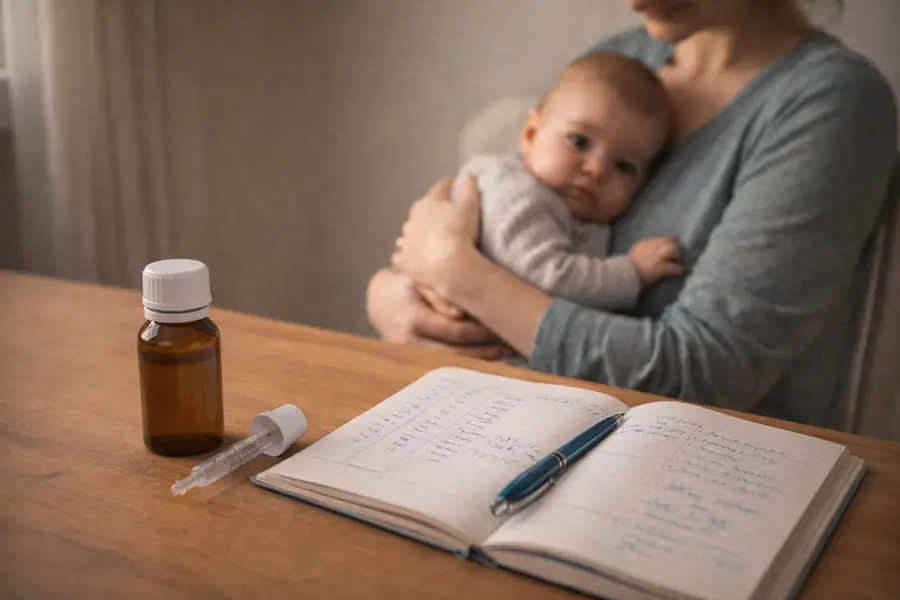
Your baby just finished a course of antibiotics, the stool has changed, and someone has recommended a probiotic. Should you start one?
The honest, short answer:
- Probiotics are not automatically required for every baby after antibiotics
- Selected strains may reduce antibiotic-associated diarrhea in some children, but the evidence is uneven and product-specific
- What matters more day-to-day: hydration, feeding, monitoring symptoms, and your pediatrician's input
- Never start any supplement in a baby without pediatric guidance: strain, dose, and product matter
- Some signs need urgent care, not a probiotic, dehydration, blood in stool, high fever, lethargy
Quick reference: probiotics after antibiotics (babies)
| Question | Answer |
|---|---|
| Are probiotics always needed? | No. Many babies recover with just fluids and time |
| First priorities | Fluids, feeding, stool notes, pediatric guidance |
| Best evidence supports | Specific strains (mostly L. rhamnosus GG, S. boulardii) for antibiotic-associated diarrhea |
| Who chooses the product? | Your pediatrician, especially under 12 months |
| When is it urgent? | Dehydration, blood in stool, persistent vomiting, high fever, unusual lethargy |
| Spacing from antibiotics? | Often advised 2+ hours apart; follow pediatrician's instruction |
Why probiotics keep coming up
Antibiotics save lives, but they don't tell the difference between the bacteria causing illness and the friendly bacteria already living in the gut. The temporary disruption can show up as:
- looser stools or mild diarrhea
- tummy discomfort
- changes in appetite
- a few rough days of feeding
Most babies recover without anything extra, the gut microbiome rebounds on its own within weeks. But the parent watching a third loose diaper in an hour reasonably wants to do something. Probiotics are the most-marketed "something" for this situation.
What does the evidence actually show?
The most-cited research is from Cochrane systematic reviews, which sit at the top of the evidence pyramid.
For antibiotic-associated diarrhea in children, the evidence is solid. A Cochrane review found probiotics cut the incidence from 19% to 8%, a number needed to treat of 9, on moderate-certainty evidence. The strains that carried that result were Lactobacillus rhamnosus and Saccharomyces boulardii, at 5 to 40 billion CFU a day (Cochrane, Probiotics for the prevention of antibiotic-associated diarrhea in children, 2019).
For acute infectious diarrhea, the answer changed. Older versions of the Cochrane review found that probiotics shortened a bout by roughly a day, and that number is still quoted widely. The 2020 update, built on large trials at low risk of bias, no longer supports it: probiotics probably make little or no difference to whether diarrhea lasts 48 hours or longer, and the effect on total duration is uncertain (Cochrane, Probiotics for treating acute infectious diarrhoea, 2020).
For routine "gut support" without a clinical reason, the evidence is much weaker. There is no strong case for daily probiotics in healthy babies.
The NHS summarizes the practical reality: probiotic effects are strain-specific, products are not interchangeable, and most off-the-shelf products in pharmacies have not been studied in babies (NHS, Probiotics).
A practical, safe approach
- Ask your pediatrician before starting any supplement. This is especially important for babies under 12 months, premature infants, immunocompromised children, or babies with central lines or recent surgery.
- If a probiotic is recommended, use a product labeled for infants with clear strain information on the package, not a random adult capsule emptied into a bottle.
- Time the dose if your pediatrician advises spacing: often 2+ hours apart from the antibiotic dose, but follow their specific instruction.
- Track for several days, not a single diaper. Look at trends in stool frequency, comfort, feeds, wet diapers. One loose diaper isn't a verdict.
- Continue normal feeding if your baby tolerates it, breast milk, formula, or solids per their usual pattern. Breast milk in particular helps the microbiome recover.
- Hydrate. Hydration is the single most important thing in the days after antibiotics. Watch wet diaper output.
If feeding has felt chaotic since the illness started, see baby not eating much: when to worry, what to do for the broader appetite question. Recovery is often slow on sleep too, see signs your baby is overtired if naps and nights have unraveled. A predictable routine helps recovery; how to build a baby routine that works covers the rebuild.
Common mistakes (well-meaning but unhelpful)
- Starting several new things at once. A new formula, a probiotic, a new vitamin, and a teether all at once, when something changes, you won't know which one helped or hurt.
- Treating probiotics as a substitute for medical follow-up. If your pediatrician recommended a follow-up visit, keep it.
- Buying expensive multi-strain products with no infant-specific data. Cost doesn't equal evidence; the most-studied strains are usually single-strain products.
- Adding fiber supplements or unfamiliar foods at the same time. Babies' guts respond best to "less change" while recovering.
- Ignoring red flags while waiting for the probiotic to work. A probiotic is not the answer to dehydration or severe symptoms.
For the cluster of symptoms during the illness itself (cough, fever, when to call), see fever and cough: when to monitor and when to call the doctor.
When to call the pediatrician urgently
Skip the supplement aisle and call, or seek emergency care, for any of these:
- signs of dehydration: very few wet diapers, sunken soft spot in young infants, dry mouth, unusual sleepiness, no tears when crying
- blood in stool (red streaks, dark tarry stool, or jelly-like stool)
- persistent vomiting that prevents fluid intake
- high fever ≥ 38 °C / 100.4 °F in a baby under 3 months, or ≥ 39 °C / 102 °F in older babies that doesn't respond
- baby is hard to wake or markedly lethargic
- not feeding for more than several hours in young infants
- symptoms worsening rather than improving after antibiotics finish
Your pediatrician can also help rule out C. difficile infection or secondary illness in stubborn diarrhea (AAP HealthyChildren, Diarrhea).
Antibiotics themselves: a reminder
Use antibiotics only as prescribed, full course, correct dose, correct timing. Stopping early or sharing leftover doses contributes to antibiotic resistance and can also worsen the original problem (AAP HealthyChildren, Antibiotic Prescriptions for Children).
If your baby has had several antibiotic courses in a short time, mention it at the next well-child visit. Pediatricians can review the pattern and advise on prevention or referral if needed. Walking in with the dates, symptoms, and stool changes already written down makes that review faster: here is how to prepare for a pediatric visit with your child's data.
Frequently asked questions
Are probiotics safe for newborns?
Safety depends on health status and product. Specific strains have been studied in healthy term babies; preterm and immunocompromised infants need clinical guidance. This is a pediatric decision, ask your clinician.
Can probiotics interact with antibiotics?
Some clinicians advise spacing the doses (often 2+ hours apart) so the antibiotic doesn't kill the probiotic bacteria immediately. Follow your pediatrician's specific instruction.
What if stools are just a little loose for a day or two?
Many babies have short stool changes after antibiotics. Track for trends and watch hydration; call if symptoms worsen or red flags appear.
Should I change formula on my own after antibiotics?
Don't make big feeding changes without guidance, especially if weight gain is a concern. A specialty formula switch should come from your pediatrician.
How long does the gut microbiome take to recover?
For most healthy babies, weeks rather than days. Continuing normal feeding (especially breast milk if breastfeeding) helps. There is no shortcut to "fully reset" the gut.
Is yogurt a probiotic for babies?
Plain unsweetened yogurt is a fine food for babies over 6 months, but it doesn't deliver the studied strains in studied doses. Don't rely on it as a clinical probiotic.
How KidyGrow can help
KidyGrow learns your baby as you log feeds, diapers, mood, temperature, and medications, and the days after antibiotics are exactly when that pattern view matters. The hardest part isn't deciding about the probiotic; it's holding the thread on stool frequency, hydration, and how feeds are recovering across several days while you're tired and worried.
The Daily Brief surfaces those patterns in a few days, because the app remembers the small notes you'd otherwise forget (Tuesday's three loose diapers, Wednesday's first full feed, Thursday's calmer night) and connects them. The view is personalized to what's actually happening this week with this baby, not a generic recovery chart. When you walk into your pediatrician's office, you can show a real timeline instead of trying to reconstruct it from memory. Calibration takes 3–5 days of regular logging; the longer you use it, the sharper the picture.
_This content is educational and does not replace professional medical advice. For dosing, drug interactions, or any concern about your baby's health, contact your pediatrician._
Sources
- Cochrane, Probiotics for the prevention of antibiotic-associated diarrhea in children (2019) (accessed 2026).
- Cochrane, Probiotics for treating acute infectious diarrhoea (2020) (accessed 2026).
- NHS, Probiotics (accessed 2026).
- AAP HealthyChildren, Diarrhea (accessed 2026).
- AAP HealthyChildren, Antibiotic Prescriptions for Children (accessed 2026).