 Kidy
Kidy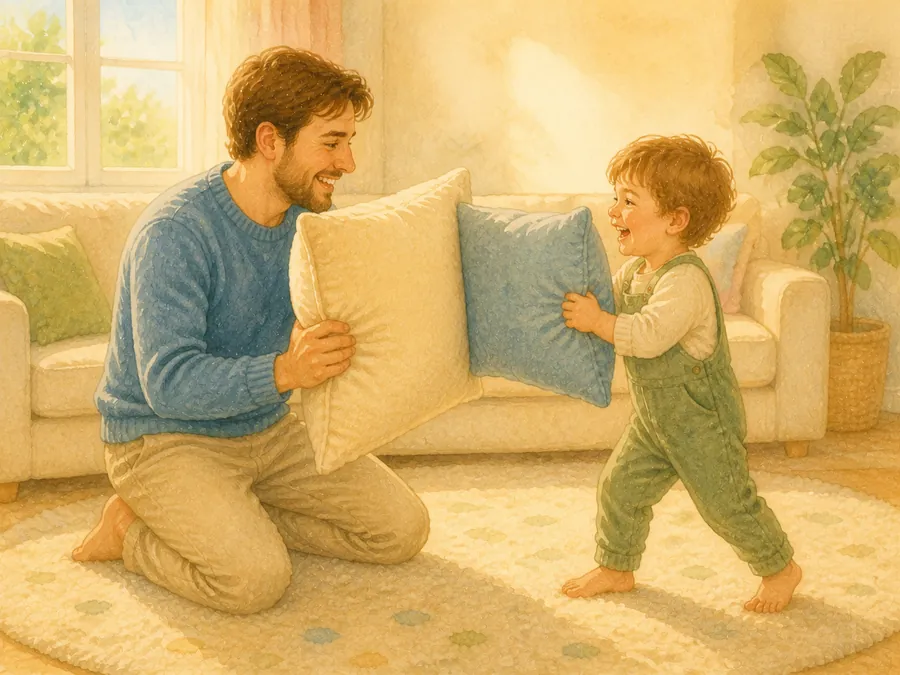
Rough-and-tumble play is the wrestling, chasing, tickling kind of play that often ramps up the moment the second parent walks in. It looks like winding the child up. It is doing something else:
- Repeated practice at getting very excited and then coming back down
- A live lesson in limits: how hard is too hard, and when the other person has had enough
- Fast face-reading, because the game collapses the second nobody is watching anyone
Physical play is not a lesser version of quiet play. The American Academy of Pediatrics describes play as a key part of healthy early development, and rough-and-tumble is one of its oldest forms.
Quick Reference
| Question | Short answer |
|---|---|
| Is rough play bad for children? | No, as long as the adult stays in charge of the intensity. That condition is the part the research is actually about |
| Which ages? | Most research covers 2 to 6 years. Babies get much gentler versions, never tossing or shaking |
| Does it teach aggression? | Not on its own. More aggression showed up only when the father was the less dominant player (Flanders et al., 2009) |
| How long per round? | Short. 10 to 15 minutes with a real wind-down beats 40 minutes that ends in tears |
| Can moms play this way? | Yes. The pattern is a tendency across groups, not a rule about any one person |
Why does the second parent's play look so different?
In a lot of households the split is noticeable. One parent tends toward books, naming things, sitting-down games. The other tends toward lifting, chasing, upside-down. Researchers have been describing rough-and-tumble play as a common form of father-child play for decades, and it shows up across very different cultures (Flanders et al., 2009).
That is a tendency, not a law. Plenty of mothers roughhouse, plenty of fathers do the quiet stuff, and in single-parent and same-sex-parent families both registers come from the same people or from an aunt, a grandfather, an older cousin. Nothing is missing. What matters developmentally is that a child gets both kinds of input somewhere, not which adult body it arrives in.
The more useful question is not who plays rough. It is what that play is actually training.
What rough-and-tumble play actually teaches
Start with arousal. In a wrestle, a child goes from calm to nearly-over-the-edge and back down again, sometimes four or five times in ten minutes. That loop is the raw material of emotional regulation, and it is much harder to practice sitting still. The AAP's clinical report on play describes exactly this: shared, attuned play with a caregiver regulates the body's stress response and builds the executive-function skills that let a child hold a goal and ignore a distraction (Yogman et al., Pediatrics, 2018).
Then calibration. Rough play is one of the few situations where a small child gets fast, honest feedback about force. Too hard, and the game stops. Not hard enough, and it gets boring. A four-year-old learns more about "gentle" in one pillow fight than in fifty reminders to be gentle.
Then the signals. Stop means stop. A flat face means the fun ended. Rough play runs on reading the other person quickly and adjusting, which is the same machinery a child later uses with kids in the sandbox. Related reading: why play is development, not a break from it.
There is even some evidence on the thinking side. A small Australian study of 30 father-child pairs linked both the frequency and the quality of rough play to better working memory (Freeman and Robinson, 2022). Thirty pairs is a small sample. Treat it as a hint, not a headline.
Does roughhousing make children more aggressive?
This is the worry most parents actually hold, usually the parent who is not the one doing the wrestling. The honest answer has a condition attached to it.
Flanders and colleagues videotaped 85 children aged 2 to 6 playing with their fathers at home. Frequent rough play was linked to more physical aggression in one specific group: children whose fathers were the less dominant partner in the game. Where the adult stayed clearly in charge of the intensity, that link did not appear. This is observational work, so it does not prove that the adult's control causes better regulation. What it supports is narrower: rough play seems to work best when an adult holds clear limits and can stop an escalation.
In practice, "in charge" is not the same as "wins". It means the grown-up decides when it speeds up, when it slows down, and when it ends. A child who can escalate the game past the adult's limit is learning that escalation works. That is the lesson nobody wants.
If your child is already hitting and you are trying to work out whether the play is feeding it, the answer usually lives in a different pattern than you expect. Toddlers who hit one parent and not the other are almost always saying something about safety rather than about the wrestling.
What ages it suits, and how to keep it safe
Under 12 months, there is no wrestling. Physical play at this age means slow lifts, tummy raspberries, rolling, gentle bicycle legs. Never toss a baby in the air, never shake, never jolt the head. Infant necks cannot support it and the injury risk is not theoretical (AAP, abusive head trauma).
From roughly 18 months the pillow-and-cushion version starts to work, and by 3 to 6 years most children want a proper wrestle. The floor rules that make it safe are boring and short:
- One stop word. Anyone can call it. It works instantly, including when the adult says it.
- Head and neck are off limits. So are joints being twisted and anyone being sat on.
- No hard floors, no coffee-table corners, no glasses left on faces.
- The adult loses on purpose sometimes, but only on purpose.
That last one carries more weight than it looks. Letting a child win is how they learn what winning feels like. Losing control of the game is how they learn that pushing harder gets results.
The wind-down deserves its own minute. Going straight from a shrieking wrestle to "brush your teeth" is how a good session gets blamed for a bad bedtime. Something slow in between, a lie-down on the rug, a book, water, a boring conversation, closes the loop properly. This is the same co-regulation skill parents use after a meltdown, just running in the other direction.
Decision logic: keep going, or wind it down?
If your child is laughing and re-initiating → keep going, and stay at the same intensity rather than climbing.
If the laugh turns shrill, or the child stops making eye contact → slow down, or pause briefly and check whether your child wants to keep going. A short check-in usually rescues it.
If your child freezes, goes quiet, or hits for real → stop entirely, sit on the floor, and let it end calmly rather than with a lecture.
If it is inside an hour of bedtime and last three attempts ended badly → move it earlier tomorrow instead of trying to do it better tonight.
You usually do not notice the pattern the first time. You notice it the third night in a row that the wrestle falls apart at exactly the same point: right when the child is winning and the adult lets go too suddenly.
Common mistakes to avoid
Treating it as babysitting. "Dad plays with them so mom gets a break" reduces a developmental activity to childcare cover. It is worth doing on its own terms.
Escalating to keep the child laughing. The natural instinct when the giggles fade is to go bigger. That is usually the moment to go smaller.
Ignoring the stop word once. Once is enough to break it. A stop word that is honored 90% of the time is not a stop word, it is a suggestion.
Putting it right before bed because that is when dad gets home. Sometimes it really is the only slot, and then the fix is a longer wind-down, not a shorter game.
Reading a child's preference as rejection. A child who wants one parent for wrestling and the other for comfort is sorting the world, not ranking it. There is a similar dynamic behind why children often behave worse with mom.
Also, the noise. Nobody writes about the noise. A decent wrestle in a small apartment sounds like furniture being destroyed, and the downstairs neighbor has opinions. Outdoors solves most of that, and outdoor play works from the first year.
When to talk to your pediatrician
Bring it up if your child cannot come down from high arousal in any context, if aggression is spreading to daycare and other children, or if physical play keeps ending in fear rather than laughter. Mention it too if a child who loved wrestling now avoids that parent. None of those patterns mean rough play is wrong in itself.
Roughhousing with a stop signal is a small, physical version of the whole approach: warmth first, a limit that holds, and a child who learns both at once. For the rest of that frame, see what gentle parenting actually is (and what it isn't).
Frequently asked questions
Is rough play only for dads?
No. It is more common in father-child pairs across the research, but that is a group tendency, not a rule. Mothers roughhouse, and in single-parent families one adult covers both registers with nothing lost.
At what age can I start wrestling with my child?
Real wrestling suits roughly 18 months and up, and hits its natural peak between 3 and 6 years. Before 12 months, keep physical play slow: lifts, rolling, tummy time games. No tossing, no shaking, ever.
My child gets hyper and cannot sleep after playing with dad. Should we stop?
Usually not. Move it earlier in the evening and add a real wind-down segment of five to ten quiet minutes. If bedtime is still wrecked after two weeks of that, then shift the play to mornings or weekends.
Does rough play teach children that hitting is okay?
Not by itself. That study did not show that rough play improves regulation; it showed that the relationship between how often families played and how much physical aggression appeared depended on the dynamic of the play itself, specifically on whether the father was the dominant partner.
What if my child hurts me during play and laughs?
Stop the game, keep your face and voice flat, say what happened in three words, and wait. A pause is more informative than a lecture. Restart at a lower intensity a minute later if your child re-initiates.
We are a two-mom family. Is our child missing something?
No. What matters is that a child gets both physical and quiet play somewhere in the week, from whoever is drawn to it. The registers matter. The gender of the adult does not.
How KidyGrow helps you
Nobody can hold three weeks of evenings in their head. That is the actual problem, and it is the part KidyGrow takes over.
Day one, the Daily Brief says something plain: a 4-year-old usually needs a slow ten minutes between high-energy play and bed. Useful, and the kind of thing any book would tell you.
Day eight is a different sentence. After a week of ordinary notes about how the evenings went, it gets specific. It might say that the two hardest bedtimes both followed play that ran past 7:30pm, and that every evening which went fine had something quiet in between. The Tonight plan then moves the wrestle half an hour earlier instead of telling you to cut it. That is the whole difference. The first version knows about four-year-olds. The second one knows about yours.
It also catches what nobody writes down. A parent notices a bad Tuesday. The app notices this is the third Tuesday in a row, and that Tuesday is the late-shift day.
Some weeks it finds nothing at all. Two colds, a birthday party and a heat wave produce noise, not a pattern, and the app says so rather than inventing a reason. It also needs three to five days before it has anything worth saying, which is worth knowing before you decide it is broken.
The app remembers what a tired parent stops being able to see by the end of the week. That is most of the job.
What changes is the morning question. Instead of "was last night worse than usual, or does it just feel that way", you already know.
Sources
- Yogman M, Garner A, Hutchinson J, Hirsh-Pasek K, Golinkoff RM; American Academy of Pediatrics. "The Power of Play: A Pediatric Role in Enhancing Development in Young Children." Pediatrics, 2018. https://pubmed.ncbi.nlm.nih.gov/30126932/
- Flanders JL, Leo V, Paquette D, Pihl RO, Seguin JR. "Rough-and-tumble play and the regulation of aggression: an observational study of father-child play dyads." Aggressive Behavior, 2009. https://pmc.ncbi.nlm.nih.gov/articles/PMC3283567/
- Freeman EE, Robinson EL. "The Relationship between Father-Child Rough-and-Tumble Play and Children's Working Memory." Children (Basel), 2022. https://pmc.ncbi.nlm.nih.gov/articles/PMC9315721/
- American Academy of Pediatrics, HealthyChildren.org. "The Power of Play: How Fun and Games Help Children Thrive." https://www.healthychildren.org/English/family-life/power-of-play/Pages/the-power-of-play-how-fun-and-games-help-children-thrive.aspx
- American Academy of Pediatrics, HealthyChildren.org. "Abusive Head Trauma: How to Protect Your Baby." https://www.healthychildren.org/English/safety-prevention/at-home/Pages/Abusive-Head-Trauma-Shaken-Baby-Syndrome.aspx