 Kidy
Kidy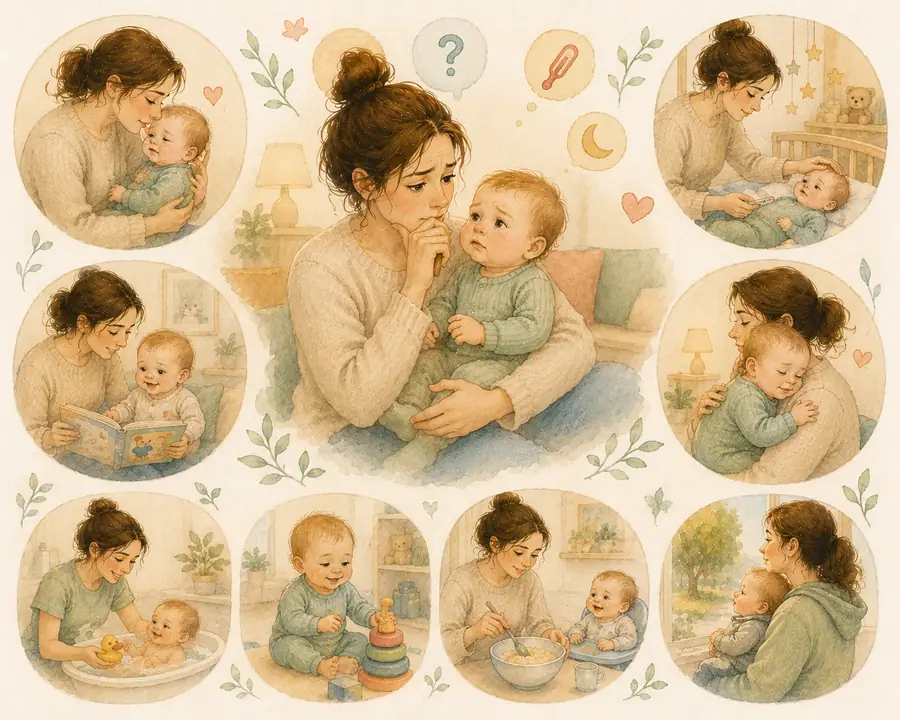
Your baby is crying, rubbing her eyes, refusing the bottle, and you genuinely can't tell whether she needs a nap or a pediatrician. An overtired baby typically shows:
⏰ Rule out timing first: enter your baby's age in the Wake windows calculator to see how long they can comfortably stay awake.
- Fussiness that builds toward the usual nap time and eases after sleep
- Eye rubbing, ear pulling and yawning, with no fever
- A sudden "second wind" of frantic energy right when you expected sleepiness
- Normal feeding and normal wet diapers (roughly 6+ in 24 hours)
A sick baby usually brings at least one physical signal on top of the mood: a fever of 38.0°C (100.4°F) or higher, noticeably worse feeding, fewer wet diapers, or a sleepiness that rest doesn't fix.
Quick reference: overtired vs. sick at a glance
| Signal | Overtired | Sick |
|---|---|---|
| Crying | Builds around usual sleep times, eases after a nap | Persistent, often a different pitch, at any hour |
| Temperature | Normal (warm cheeks from crying don't count) | 38.0°C / 100.4°F or higher |
| Feeding | Distracted, but takes close to the usual amount | Takes noticeably less, refuses repeatedly |
| Diapers | 6+ wet in 24 hours | Fewer wet diapers, darker urine |
| Sleep | Fights it, then clearly improves after one solid nap | Sleeps more than usual and still wakes miserable |
| Body | Nothing physical changes | Runny nose, cough, rash, vomiting, pulling at one ear |
The table is a starting point, not a verdict. The next sections walk through each signal, and the one-nap test below tells you when to simply wait and when to pick up the phone.
What does an overtired baby look like?
Overtiredness is a timing problem. When a baby stays awake past her wake window (about 2 to 3 hours at six months, per the AAP's sleep guidance), her body releases stress hormones to keep her going. The result looks contradictory: a child who desperately needs sleep and fights it with everything she has.
The classic tells are eye rubbing, ear pulling without fever, jerky overexcited movements, and crying that ramps up in the late afternoon. Many parents know the 5 p.m. version of their baby and barely recognize her. If this is your daily pattern, our guide to the signs a baby is overtired goes deeper, and the wake windows chart by age helps you find the timing that prevents it.
The key feature of overtiredness: it responds to sleep. One genuinely good nap, and you get a different child back. If naps keep failing despite good timing, an overtired baby who won't sleep needs a slightly different approach than a sick one.
What are the signs your baby is actually sick?
Illness shows up in the body, not just the mood. The signals that matter most, according to the AAP's guidance on when to call the pediatrician:
- Fever: 38.0°C (100.4°F) or higher, measured rectally for babies under one year
- Feeding drops: refusing several feeds in a row, or taking clearly less at each one
- Fewer wet diapers: a baby who normally soaks six and produces two is telling you something
- Physical symptoms: cough, congestion, vomiting beyond normal spit-up, diarrhea, rash, tugging at one ear repeatedly
Then there's lethargy, the word that scares parents most. Lethargy is not the same as tiredness. A tired baby fusses, arches, fights you. A lethargic baby is floppy. Hard to wake. Uninterested in you. That difference matters more than any thermometer reading. Trust it.
One more overlap trap: teething gets blamed for almost everything in the first two years. It can make a baby cranky and clingy, but it does not cause true fever. If the thermometer says 38.0°C, don't file it under teething signs.
Can being overtired cause a fever?
No. Overtiredness does not raise core body temperature. A baby who has cried hard for twenty minutes can feel hot, with flushed cheeks and a sweaty head, and that's exactly the moment parents touch a forehead and panic.
Take the temperature. Don't guess.
The NHS guidance on fever in children is blunt about this: a fever is 38°C or above, measured with a thermometer. Forehead touch is not a measurement. For babies under one year, a rectal reading (or axillary, if that's what you have) beats forehead strips and ear thermometers for accuracy. If the reading is normal and the crying eases after sleep, you were looking at exhaustion, not infection.
The one-nap test: wait or act
When there's no obvious red flag, the cheapest diagnostic you have is a nap. Here's the decision logic:
- If temperature is under 38.0°C, feeding is roughly normal, and diapers are wet → treat it as overtiredness. Offer sleep early, darken the room, and reassess after one full nap.
- If the baby wakes from that nap noticeably brighter → it was fatigue. Adjust today's wake windows and move on.
- If the baby wakes just as miserable, or worse → recheck temperature, count the day's feeds and diapers, and start treating it as possible illness.
- If at any point you see a red flag from the list below → skip the test and call.
One mom in our beta was convinced her son was getting sick every single Thursday. Three weeks of notes later, the answer was Wednesday swim class pushing bedtime 40 minutes late. The "Thursday illness" was a sleep debt with a one-day delay.
The pattern only became visible because she'd written things down. Memory alone kept telling her "he's fine on Fridays," and her brain filed Thursday under "mystery virus."
Common mistakes parents make
- Diagnosing by forehead touch. Warm from crying and feverish are different states. Only a thermometer knows.
- Giving paracetamol "just in case." Fever reducers are for actual fever with discomfort, not for fussiness. The AAP's Fever Without Fear guidance is clear that treating numbers, not symptoms, helps nobody.
- Skipping the nap to "watch for symptoms." An awake, overtired baby looks sicker with every passing hour. You're making the picture blurrier, not clearer.
- Treating every cranky evening as illness. Evening fussiness that repeats daily at the same hour is a schedule signal, not a medical one.
- Comparing siblings. Your first may have announced every cold with a fever. The second might just feed less and sleep badly. Same virus, different billboard.
When to call the pediatrician
Some situations skip the wait-and-see entirely. Call the same day, or emergency services, when you see:
- Any fever of 38.0°C+ in a baby under 3 months. Not tomorrow. The same day, per AAP guidance.
- Trouble breathing: visibly pulling in at the ribs, grunting, flaring nostrils
- Blue or gray lips or face
- A baby who is floppy, won't wake properly, or doesn't react to you
- No wet diaper for 8+ hours, sunken eyes, a sunken soft spot
- A rash that doesn't fade when you press a glass against it
- Inconsolable crying for more than two hours straight
Most respiratory infections in babies are viral and pass on their own; the CDC's prevention basics (handwashing, keeping sick visitors away) do more than any supplement. But red flags are red flags. You will never regret a call that turned out to be nothing. If fever comes with a cough and you're unsure how closely to watch it, our guide on fever and cough: monitor or call the doctor breaks down that specific scenario.
Once you do land an appointment, a few minutes organizing your notes on feeds, diapers, and sleep beforehand goes a long way; see how to prepare for a pediatric visit with your child's data for a simple system that makes the visit faster and more useful.
Frequently asked questions
Can a baby get a fever just from being overtired?
No. Exhaustion can make a baby feel warm to the touch after long crying, but it does not raise core temperature to 38.0°C or beyond. If a thermometer shows a true fever, look for illness, and in a baby under 3 months call the pediatrician the same day.
How long does it take an overtired baby to recover?
Usually one to two days of protected sleep. One early bedtime and a day of properly timed naps repairs most short-term sleep debt. If a week of good timing changes nothing, the problem probably isn't timing.
Why does my baby seem sick in the evening but fine in the morning?
Evening is when sleep pressure peaks, so overtiredness masquerades as illness at 6 p.m. and vanishes by breakfast. Mild infections also genuinely feel worse at night because inflammation and congestion worsen lying down. The morning-vs-evening contrast itself is a useful clue: illness usually persists through the morning, fatigue usually doesn't.
Should I wake a sick baby to feed?
Young babies, yes: under about 3 months, frequent feeds protect against dehydration, so don't let a sick newborn sleep through many feeds in a row. Older babies can be allowed to sleep, but track wet diapers; fewer than four in 24 hours during illness is a call-the-doctor sign.
When is sleepiness itself a red flag?
When sleep stops fixing it. A baby who takes an extra nap but wakes alert is fighting something small. A baby who is hard to wake, limp, uninterested in feeding or in you, needs medical eyes the same day, fever or not.
How KidyGrow helps you
The overtired-or-sick question is really a memory question. Was she this fussy yesterday? When did the last nap actually end? Did she feed less today, or does it just feel that way? At 7 p.m., after a full day, nobody remembers. The app remembers for you.
Log sleep and feeds for a few days (KidyGrow needs 3 to 5 days before it says anything useful) and the Daily Brief starts connecting dots you can't hold in your head: "The last three rough evenings each followed a nap that ended before 2 p.m." A sentence like that can settle the is-she-sick spiral, because a pattern that repeats with sleep timing is rarely an infection.
And when it is an infection, the same notes work for the doctor. "She fed a third less since yesterday and had two wet diapers since morning" gets you a sharper answer than "she seems off."
Sometimes the app won't find a pattern. A cold is just a cold, and no chart predicts it. But the next time the 6 p.m. meltdown hits, you'll know whether it's Tuesday's story repeating itself, and the panic finally has somewhere to go.
Sources
- American Academy of Pediatrics / HealthyChildren.org - When to Call the Pediatrician: Fever
- American Academy of Pediatrics / HealthyChildren.org - Fever Without Fear
- NHS - Fever in children
- American Academy of Pediatrics / HealthyChildren.org - Baby Sleep
- CDC - Preventing respiratory viruses