 Kidy
Kidy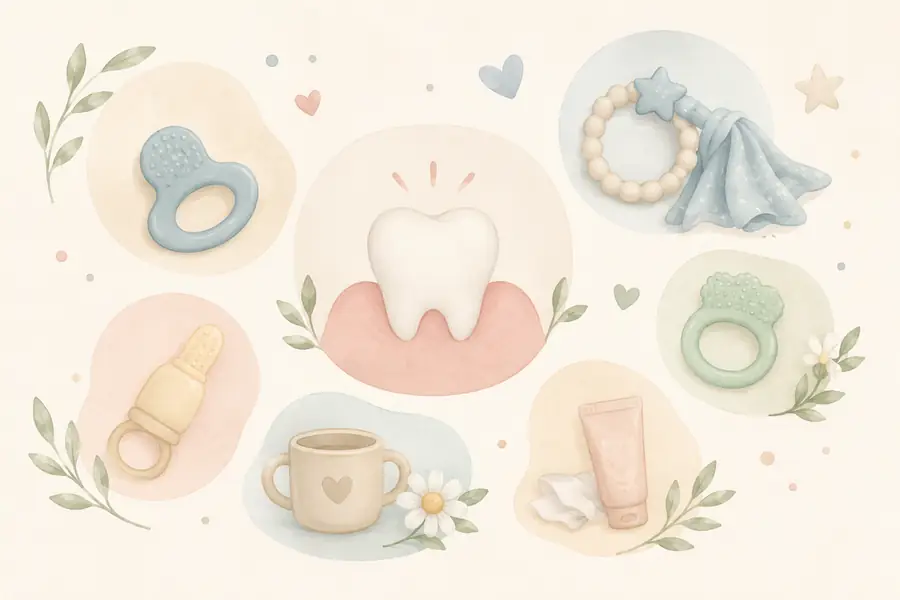
If your baby is suddenly drooling, chewing everything and clinging to you more, teething is a likely cause. The short, honest answer:
- the first tooth usually comes around 6 months, but anywhere from before 4 months to after the first birthday is normal
- real signs: sore, red gums, drooling, chewing, irritability, a slightly raised temperature below 38 °C
- the symptoms cluster in about 8 days around each tooth, not weeks
- fever of 38 °C or more, diarrhea, vomiting or a body rash are not caused by teething
- safe comfort: a teething ring cooled in the fridge, a cold wet washcloth, gum massage with a clean finger
Not every fussy week is teething. A good share of what gets blamed on it has another cause.
Quick reference: baby teeth in order
| Teeth | Usually arrive at | What parents notice |
|---|---|---|
| Lower central incisors | 6–10 months | drool, chewing, two small white dots |
| Upper central incisors | 8–12 months | often the fussiest stretch |
| Lateral incisors | 9–16 months | usually quieter than the first four |
| First molars | 13–19 months | bigger tooth, a few harder days |
| Canines | 16–23 months | short, sharp spells, then done |
| Second molars | 23–33 months | daytime grumpiness, the last wave |
The ranges come from the American Dental Association eruption chart (ADA MouthHealthy). All 20 baby teeth are usually in by about age 3.
When do babies start teething?
Most babies start teething at around 6 months. The NHS adds that some start before 4 months, some after 12, and a few are even born with a tooth (NHS, Baby teething symptoms). The AAP gives 6 to 10 months for the first teeth and notes that discomfort can start weeks or months earlier (AAP, Teething Pain). You will also see "4 to 7 months" quoted, for example by KidsHealth. The sources overlap more than they disagree: around 6, with a wide normal spread.
One thing that confuses parents: from about 3 months babies explore everything with their mouth, drool more and chew their hands. The AAP points out that this is exploring, and often has nothing to do with a tooth yet.
A late first tooth is rarely a problem on its own. Our rule of thumb: if there is no tooth at all by around 18 months, mention it at the next check-up. The ADA recommends a first dental visit by the first birthday anyway.
What are the real signs of teething?
The best evidence comes from two sources. A meta-analysis of 16 studies with 3,506 children found gum irritation in 87 %, irritability in 68 % and drooling in 56 % of teething children (Massignan et al., Pediatrics, 2016). A prospective study that followed 125 babies daily through 475 new teeth found the symptoms only in a short window: the 4 days before a tooth appeared, the day itself and the 3 days after (Macknin et al., Pediatrics, 2000).
What belongs to teething, in plain terms:
- Drooling, often through a bib in an hour
- Chewing and biting on fists, toys, your shoulder
- Rubbing the gums against whatever is near
- Red or swollen gums where the tooth is coming
- Irritability and clinginess for a few days
- A red cheek or a rash on the face from drool
- A slightly raised temperature below 38 °C (NHS)
- Less interest in solid food for a day or two
And the humbling part from the same study: no single symptom showed up in more than about a third of teething babies, and no combination could predict that a tooth was coming. You often only know it was a tooth once you see it.
If your baby is suddenly waking far more at night and you are not sure teething is the whole story, see why your baby is suddenly waking more at night. Several causes pile up at the same age.
What is NOT caused by teething
This is where a lot of families get told the wrong thing:
- Fever of 38 °C (100.4 °F) or more. The AAP is explicit: a true fever is not associated with teething and points to an illness (AAP, Baby's First Tooth).
- Diarrhea. Teething does not change how the gut works. If diarrhea lasts more than a day, call your pediatrician.
- Vomiting, cough, a runny nose or a rash on the body. In the Macknin study none of these were linked to new teeth.
The study's own conclusion is worth repeating: before a baby's signs of a possibly serious illness are put down to teething, other causes have to be ruled out. If your baby is hot and miserable, treat it as a possible illness and read fever and cough: when to monitor and when to call the doctor.
What actually helps a teething baby
Simple and cheap wins here:
- A teething ring cooled in the fridge. The NHS suggests cooling some rings before use. Not the freezer: the AAP warns against letting a baby chew directly on anything frozen solid.
- A clean, wet washcloth, twisted and chilled. Tie a knot in one end for better chewing, as the AAP suggests.
- Gentle pressure on the gum with a clean finger. Many babies settle for a moment.
- Something to chew from 6 months. If your baby has started solids, the NHS suggests raw fruit or vegetables to chew, under supervision. Skip rusks, which nearly always contain sugar.
- Extra closeness and a normal routine. Needing you more for a few days is pain plus comfort-seeking, not a bad habit. A predictable evening helps, see how to build a baby routine that works.
Wipe the drool from the chin often. That is the easiest way to keep the face rash from settling in.
Pain relief: what is safe and when
Most teething does not need medicine. For a hard evening or night, a sugar-free painkiller dosed for your baby's weight is an option.
- NHS (UK): paracetamol from 2 months, ibuprofen from 3 months (NHS, tips for helping your teething baby).
- AAP (US): an occasional dose of acetaminophen can help, and your pediatrician will tell you what is safe for your child.
Age limits differ by country and by product, so check the leaflet and ask your pharmacist. Pain relief is for a hard night, not a daily habit.
How much evidence is there behind teething remedies in general? Surprisingly little. A 2022 systematic review searched for every treatment ever trialled for teething and found five clinical studies, all at high or serious risk of bias (Canto et al., Brazilian Oral Research, 2022).
What to avoid (some are dangerous, not just useless)
- Numbing gels with benzocaine or lidocaine. The FDA says they offer little to no benefit for teething and carry serious risks, and should not be used for teething pain in children (FDA). The NHS adds that there is a lack of evidence that teething gels work.
- Homeopathic teething tablets. The FDA lists them among the products that can be dangerous.
- Amber teething necklaces and bracelets. A strangulation and choking risk, with no proven benefit (AAP, Teething jewelry warning).
- Alcohol on the gums. Old advice, never safe.
- Anything frozen solid. Too hard for sore gums.
- Sugary rusks and snacks. New teeth and sugar are a poor match from day one.
Teething and sleep
Parents almost always report worse nights with a new tooth. The research is more careful. In the Macknin study, babies were more wakeful in the 8-day window, but "sleep disturbance" as such was not clearly linked to new teeth.
The practical takeaway: a few restless nights around a tooth are plausible. Weeks of waking are not a tooth. If "teething" has been the explanation for a month, look at the day instead: naps, wake time, a new skill, a cold. Signs your baby is overtired covers the most common look-alike.
When to call the pediatrician
Call if your baby has:
- a temperature of 38 °C (100.4 °F) or more
- crying that is inconsolable or feels different from their usual upset
- refused feeds (breast, bottle or solids) for more than half a day
- diarrhea for more than a day, or vomiting
- a rash beyond the chin and cheeks
- signs that just seem off to you
Trust that feeling. A call that turns out to be "just a tooth" is a good outcome.
For what to note down before a visit, so "is this teething or something more?" becomes a useful conversation, see how to prepare for a pediatric visit.
Frequently asked questions
Can teething cause a fever?
A slight rise below 38 °C, yes. A fever of 38 °C or more, no. A meta-analysis found that temperature can go up during teething but not to the level of fever. Look for another cause and call your pediatrician.
My baby is 10 months and has no teeth. Should I worry?
Usually not. The first lower incisors come anywhere between 6 and 10 months on the ADA chart, and some babies are later still. If there is no tooth by around 18 months, mention it at the next check-up.
Does teething cause diarrhea?
No. The AAP says teething does not change how the gut works. Diarrhea usually means an infection, so call if it lasts more than a day.
How long does teething last for each tooth?
The symptoms cluster in about 8 days: the 4 days before the tooth appears, the day itself and 3 days after. The tooth can take longer to come through fully, but the fussy part is short.
Are amber necklaces safe?
No. The AAP and FDA warn against them because of strangulation and choking risk, and there is no evidence they work.
Can I give pain relief at night?
Occasionally, yes, dosed for your baby's weight. The NHS allows paracetamol from 2 months and ibuprofen from 3 months. Ask your pediatrician or pharmacist what is right for your child.
How KidyGrow helps
With teething the hard question is rarely "does it hurt". It is "is this even the tooth".
You log sleep, feeds, rough moments and symptoms such as a temperature in a few taps, and KidyGrow remembers them. The Daily Brief takes the last 24 hours into account, a fever or a bad night included, and adapts the day's suggestion.
It does not predict teeth, and it does not link the rough nights to them for you. After a week or two your entries sit side by side, and you can see whether the bad nights came as a short cluster or have run for weeks. How the app learns: behind the scenes: how KidyGrow learns your baby.
_Disclaimer: Educational only, not medical advice. For dosing, fever or any concern about your baby, call your pediatrician._
Sources
- American Dental Association (MouthHealthy). Eruption Charts (accessed September 2026).
- NHS. Baby teething symptoms (accessed September 2026).
- NHS. Tips for helping your teething baby (accessed September 2026).
- AAP HealthyChildren. Teething Pain (accessed September 2026).
- AAP HealthyChildren. Baby's First Tooth: Facts Parents Should Know (accessed September 2026).
- Macknin ML, et al. Symptoms associated with infant teething: a prospective study. Pediatrics. 2000;105(4):747-52.
- Massignan C, et al. Signs and Symptoms of Primary Tooth Eruption: A Meta-analysis. Pediatrics. 2016;137(3):e20153501.
- Canto FMT, et al. Efficacy of treatments used to relieve signs and symptoms associated with teething: a systematic review. Braz Oral Res. 2022;36:e066.
- FDA. Safely Soothing Teething Pain and Sensory Needs in Babies and Older Children (accessed September 2026).
- AAP. Teething jewelry: FDA warning (accessed September 2026).
- KidsHealth. Teething (accessed September 2026).