Kidy
Kidy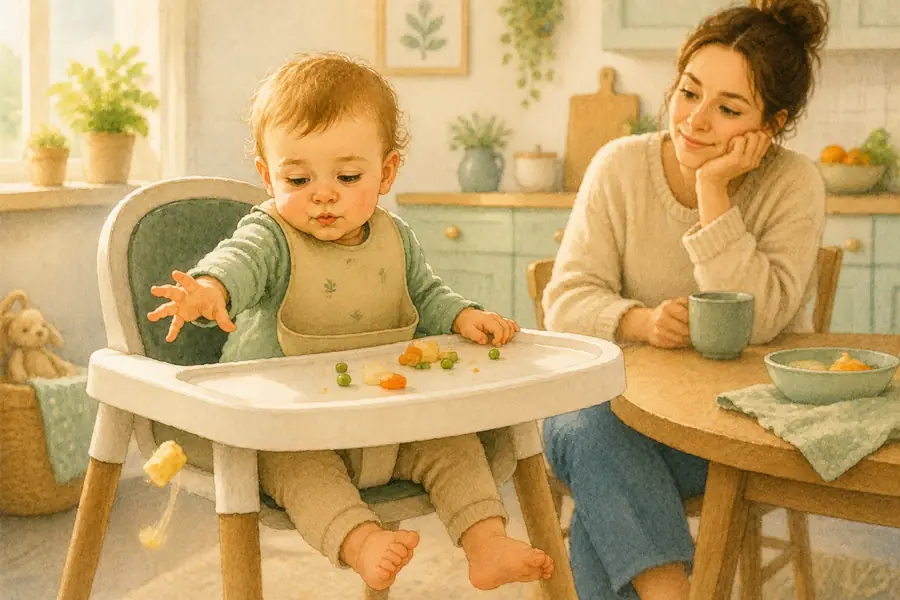
If your toddler throws food off the highchair every single meal, here is the short version:
- Food throwing is most common between 9 and 18 months, peaking around the first birthday
- It is usually exploration, communication ("I'm done"), or attention, not defiance
- The fastest fixes: smaller portions, a neutral reaction, and ending the meal calmly when throwing starts
- It is rarely a medical concern unless paired with poor weight gain, gagging, or refusal across textures
So you are wiping spaghetti off the wall again, and the dog has never eaten better. Throwing food at this age is a developmental stage, not a sign you have done something wrong. Most kids grow out of it within a few months once the response stays calm and consistent.
Quick Reference: toddler food throwing
| Question | Answer |
|---|---|
| Is it normal? | Yes, very. Peaks around 12 months |
| When does it start? | Often 8–10 months, with finger foods |
| When does it stop? | Usually fades by 18–24 months |
| Main cause | Exploration + "I'm finished" communication |
| Best first response | Neutral face, smaller amounts, end meal calmly |
| When to ask a doctor | Poor weight gain, frequent gagging, eats almost nothing |
Why does my toddler throw food every meal?
Throwing is rarely about the food itself. A baby learning that a dropped spoon makes a sound, lands somewhere, and gets a reaction is doing real cognitive work. This is cause and effect in action, the same drive that has them dropping toys off the couch forty times in a row.
The American Academy of Pediatrics describes this as normal exploratory behavior in the first two years, tied to fine motor development and a growing sense that "I can make things happen" (HealthyChildren.org, AAP).
The usual reasons, roughly in order:
- Exploration. Gravity is fascinating at 11 months. The plate is a physics lab.
- "I'm done." A toddler who cannot yet say "finished" will tell you by clearing the tray.
- Attention. If a thrown carrot earns a gasp, a laugh, or a ten-minute negotiation, it worked.
- Too much food. A loaded plate is overwhelming and invites sweeping it aside.
- Sensory input. Some kids dislike a texture and remove it the only way they can.
- Not hungry. Snacks too close to mealtime mean nothing on the plate looks worth eating.
One detail that surprises parents: the laugh is the reinforcer. One 13-month-old threw bread for a week straight because his grandfather found it hilarious every time. The throwing stopped four days after the audience did.
What actually helps when a toddler throws food
The CDC's feeding guidance and the division of responsibility model from feeding specialist Ellyn Satter point to the same boundary: the parent decides what, when, and where food is offered; the child decides whether and how much to eat (CDC, Infant and Toddler Nutrition). Throwing sits on the parent's side, because it is about table behavior, not appetite.
Here is the decision logic that works for most families:
- If the plate is overloaded → serve 2–3 small items, refill on request. Less to throw, less waste.
- If throwing starts → stay neutral, no big reaction, gasp, or lecture. Calmly say "food stays on the tray."
- If it continues → end the meal. "All done. We'll try again later." Lift them out without drama.
- If they reach for more after you end it → that was hunger. Offer the plate back once, calmly.
- If it is clearly a game → don't play. Picking it up and handing it back is the game.
Keep a splat mat or old towel under the chair. Lower your standards for the floor, not your calm. The single most effective move is the boring face. A toddler throwing food to get a reaction will stop throwing food when there is no reaction to get.
Related: Our baby and toddler feeding guide covers portion sizes and mealtime structure by age, which solves the "too much on the plate" trigger directly.
End the meal, don't extend it
Many parents accidentally turn a 10-minute meal into 40 minutes of negotiation. The longer a non-hungry toddler sits in the chair, the more throwing becomes entertainment. A meal does not need to last until the plate is empty.
A workable rhythm: offer food, give it 15–20 minutes, and when throwing signals "done," end it cleanly. No bargaining, no airplane spoon, no "three more bites." This is not the test of whether you are a good parent. End the meal.
If you suspect the throwing is really about being full, this overlaps with a toddler who refuses food. Reading hunger cues is the same skill in both cases.
Common mistakes to avoid
- Reacting big. A loud "NO!" or a laugh both teach the same thing: throwing gets you noticed.
- Picking it up repeatedly. You have just invented fetch. They throw, you retrieve, they throw.
- Punishing or shaming. A 1-year-old is not being naughty. Punishment teaches fear at the table, not table manners.
- Force-feeding the rest. This raises the stakes around food and can fuel real picky eating later.
- Huge portions. A full plate reads as "here is a pile of projectiles."
- Skipping the "all done" cue. Without a clear end, the meal drifts and throwing fills the time.
If mealtimes have become a daily battle, the patterns in picky eating without pressure and our toddler behavior guide explain why pressure backfires and calm boundaries hold.
When food throwing is not a concern, and when it might be
For the vast majority of toddlers, throwing is a phase that resolves on its own. It is not a concern when your child is growing well, eats a reasonable variety over the course of a week, and the throwing is clearly playful or "I'm finished" behavior.
Talk to your pediatrician if you also notice:
- Poor weight gain or dropping across growth percentiles
- Frequent gagging, coughing, or choking during meals
- Refusal across whole texture categories (only purees, never lumps; or only crunchy, never soft)
- Eating almost nothing at most meals, not just throwing some of it
- No interest in self-feeding by 12 months, or loss of skills they had before
These can point to an oral-motor, sensory, or feeding-difficulty issue worth a professional look, sometimes a feeding therapist or occupational therapist. Throwing alone, with healthy growth, is not on this list. If your child is eating little overall, a toddler who is not eating much walks through the difference between a fussy week and a real red flag.
Frequently asked questions
Is it normal for my toddler to throw food at every meal?
Yes. Between roughly 9 and 18 months, throwing food is a typical developmental stage tied to exploration and communication. It usually fades by age 2 once your response stays calm and the meal ends when throwing starts. Persistent throwing with healthy growth is annoying, not abnormal.
How do I get my toddler to stop throwing food?
Serve small portions, keep a neutral face, and end the meal calmly the first time throwing starts. Avoid laughing, lecturing, or picking it up over and over, since any reaction can reinforce it. Most children stop within a couple of weeks of a consistent, boring response.
Why does my toddler laugh when they throw food?
Because it is a game, and you are the other player. Watching food fall and seeing your reaction is genuinely entertaining at this age. The laughing usually stops when the audience does, so keep your face flat and end the meal rather than joining in.
Should I punish my toddler for throwing food?
No. A toddler this age is exploring and communicating, not misbehaving on purpose. Punishment adds stress to mealtimes and can worsen eating over time. A calm boundary, ending the meal, teaches the limit without fear.
When should I worry about food throwing?
Worry less about the throwing and more about the eating overall. See your pediatrician if your child has poor weight gain, frequent gagging or choking, refuses entire textures, or eats almost nothing at most meals. Throwing with healthy growth and a varied weekly intake is not a medical red flag.
Does ending the meal mean my toddler will go hungry?
Rarely. A genuinely hungry toddler will eat what is offered before the throwing turns playful. If they reach for the plate after you say "all done," offer it back once, calmly. Toddlers self-regulate intake well across a day, even if a single meal looks small.
How KidyGrow helps you
Throwing usually has a trigger you cannot see in the moment, and that is exactly the part an exhausted parent forgets by the next meal. KidyGrow holds the thread for you. You note a rough meal here and there, and over a week or two the patterns surface on their own.
By the second week, the Daily Brief might point out something like: the worst throwing meals are the ones that land within an hour of a snack, or dinners after a late, short nap. That is the kind of connection most parents never spot in real time, because no one remembers Tuesday's snack timing by Friday's dinner.
The app gets more useful after about 3–5 days of notes, not on day one. And to be honest, some weeks it will not find a clean pattern. Sometimes the answer really is teething plus a skipped nap plus a bad day. But when there is a thread, having it pointed out turns "why does every meal end like this" into "okay, that snack is too late, let me move it."
The shift is small but it is the whole job. You stop guessing meal to meal and start changing one thing at a time, based on your actual week instead of a generic chart.
_This content is educational and does not replace medical or nutritional advice. Talk to your pediatrician about your child's growth and feeding._
Related: Food-throwing is one piece of a bigger behavior pattern; the Toddler Behavior Management Guide covers the rest.
Sources
- American Academy of Pediatrics. "Ages & Stages: Toddler." HealthyChildren.org. https://www.healthychildren.org/English/ages-stages/toddler/Pages/default.aspx
- Centers for Disease Control and Prevention. "Infant and Toddler Nutrition." https://www.cdc.gov/infant-toddler-nutrition/index.html
- Satter, E. "The Satter Division of Responsibility in Feeding." Ellyn Satter Institute. https://www.ellynsatterinstitute.org/how-to-feed/
- NHS. "Help your baby enjoy new foods." https://www.nhs.uk/conditions/baby/weaning-and-feeding/