 Kidy
Kidy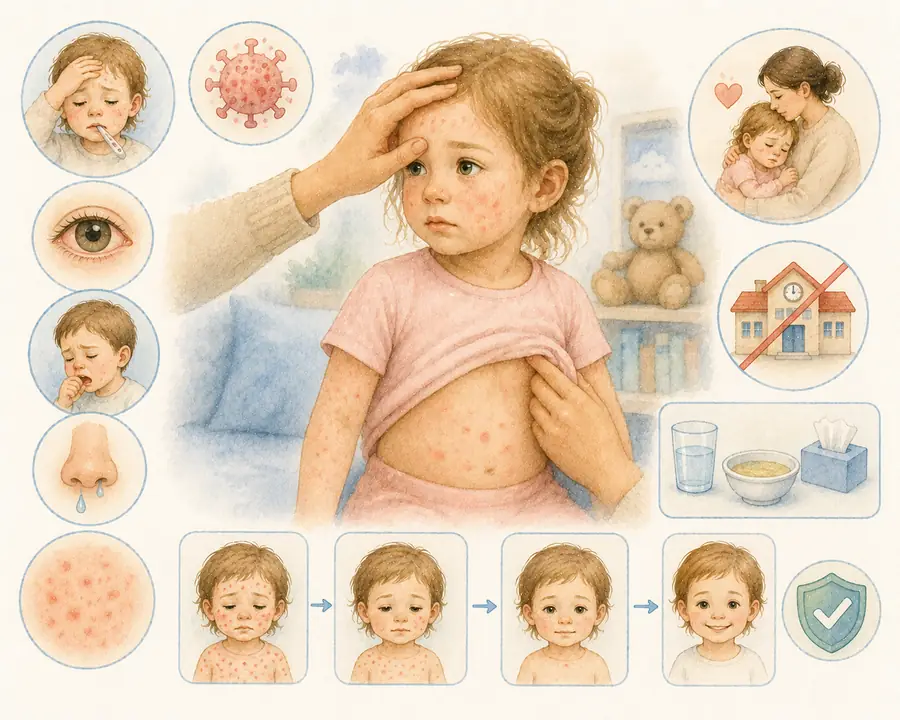
A sore throat and a fever, then an hour or two later a rash spreads across the body that you do not forget. That is scarlet fever, a bacterial infection that shows up in kids more often than most parents expect.
The short version of scarlet fever in children:
- It is caused by group A streptococcus (Streptococcus pyogenes), the same bacteria behind strep throat.
- The signature signs are a sore throat, high fever, and a fine, rough rash that feels like sandpaper, plus a "strawberry" tongue (NHS, 2023).
- Scarlet fever always needs antibiotics. Without them, the risk of complications like rheumatic fever and kidney problems stays real.
- After the first dose of antibiotics, a child can usually return to daycare in about 24 hours if they are fever-free and feel well.
- It is treatable at home, but only with a prescription. That is the part that matters most.
Quick reference: scarlet fever in children
| Cause | Group A streptococcus (bacteria) |
| Incubation | 1–4 days after contact |
| Typical age | 5–15 years; rare under 3 |
| Hallmark sign | Rough, fine rash + strawberry tongue |
| Treatment | Antibiotic (penicillin or amoxicillin), 10 days |
| Contagious without antibiotics | Up to 2–3 weeks from symptom onset |
| Return to daycare | ~24 hours after the first antibiotic dose |
| Vaccine | None exists |
What is scarlet fever and what causes it
Scarlet fever (scarlatina) is an infection caused by group A streptococcus, a bacterium that releases a specific toxin. That toxin is what produces the telltale rash. The same bacteria can cause plain strep throat, but scarlet fever adds the rash that gives it such a recognizable look.
It spreads through droplets from coughing and sneezing, through close contact, and by touching surfaces where the bacteria briefly survive. Daycare centers and schools are perfect for it to move fast, especially in winter and spring. According to NHS guidance, scarlet fever is most common in children between 5 and 15, though younger kids can get it too.
The CDC notes that group A strep infections rise and fall in waves, which is why a daycare can go months with none and then see several cases in a single week.
How scarlet fever looks: symptoms in order
The symptoms usually arrive in a recognizable sequence.
Day 1–2: sore throat and fever. It often starts suddenly with a painful throat and a high fever (101–103°F / 38–39°C, sometimes higher), with swollen lymph nodes in the neck. The child is listless, may hurt when swallowing, and feels worn out. Some kids also get nausea or a stomachache.
12–48 hours: the rash appears. The signature rash shows up first on the trunk, then spreads toward the limbs. Tiny red spots, packed close, rough to the touch. Like sandpaper. The rash spares the face, but the cheeks are typically flushed with a pale ring around the mouth (called perioral pallor), another giveaway sign.
Strawberry tongue. A few days in, the tongue changes. First a white coating, which then peels off to leave a red surface with raised taste buds, the classic strawberry tongue. It looks dramatic. On its own it needs no special care.
The course. Without antibiotics, fever and sore throat last about 5–7 days, then the rash fades and may peel slightly. With antibiotics, symptoms ease much faster, usually within 12–24 hours.
It is worth reading our piece on fever and cough: when to watch calmly and when to call the doctor, because the line between ordinary tonsillitis and scarlet fever is not always obvious at first.
Why antibiotics are non-negotiable
This is the heart of scarlet fever. Antibiotics are not only to help the child recover faster. They prevent serious complications. Left untreated, group A strep can lead to:
- Rheumatic fever - inflammation of the heart and joints that can leave lasting damage to the heart valves.
- Post-streptococcal glomerulonephritis - inflammation of the kidneys.
- Throat abscesses, ear infections, sinusitis, and rarely meningitis.
According to CDC guidance on group A strep, antibiotics lower the risk of these complications, speed recovery, and shorten the contagious window. The gold standard is penicillin for 10 days; for children allergic to penicillin, the pediatrician chooses an alternative.
Finish the whole prescribed course, even if your child looks completely well by day three. Stopping early does not fully clear the bacteria.
Scarlet fever can also strike more than once. Recovering from it does not grant lasting immunity, because strep has several strains that produce different toxins.
Contagious period and returning to daycare
Without antibiotics, a child with scarlet fever stays contagious for 2–3 weeks from when symptoms begin. With antibiotics, that drops sharply. The NHS recommends a child can go back to daycare or school 24 hours after the first dose of antibiotics, as long as they are fever-free and feel well enough.
A rash lingering after that is not a sign of contagion. It is just skin recovering.
What to do while the child is home:
- A separate cup and cutlery.
- Handwashing for the whole family, especially after wiping noses or touching the child's face.
- Toss the toothbrush once the antibiotics are done; the bacteria can survive on it.
Home care
The pediatrician handles the antibiotic. Home care is comfort support while the medicine does its job.
- Fluids. A sore throat makes swallowing hard, so offer cool drinks (not ice-cold), milk, and soups. If your child refuses to drink, call the pediatrician.
- Soft food. Yogurt, mashed potatoes, cooked oatmeal, anything that slides down without pain. Skip hot, spicy, and scratchy foods.
- Acetaminophen or ibuprofen for fever and throat pain, dosed by age and weight. No aspirin for anyone under 16.
- An antihistamine for itch if the rash is bothersome; the pediatrician can suggest one.
Prepping for the visit always helps - what you remember about when symptoms started, when the rash appeared, whether there was contact with a sick child, all of it speeds up diagnosis. Our guide on how to go into the appointment prepared with your child's own data walks through what to jot down beforehand. If your child went off food during the illness, the baby and toddler feeding guide can help ease food back in after recovery, and our piece on a child who is not eating much covers when reduced appetite is worth a closer look.
When to act vs. when to wait
| Situation | What to do |
|---|---|
| Sore throat + fever + a fine rough rash on the trunk | See the pediatrician the same day |
| Throat so painful the child cannot drink fluids | Same-day visit |
| Sore throat after close contact with a confirmed case | Get them checked |
| No improvement after 24–48 hours of antibiotics | Call back; the course may need a review |
| Fever that will not drop even with medicine | Call urgently |
What NOT to do
- Do not wait if you suspect scarlet fever. A rash that looks the part, with a sore throat and fever, earns a same-day exam.
- Do not stop the antibiotic early, even when the child looks healthy.
- Do not give aspirin to children or teens, because of the risk of Reye's syndrome.
- Do not send the child to daycare until 24 hours have passed since the first antibiotic dose and the fever is gone.
- Do not ignore returning symptoms weeks after recovery. Sometimes that signals a complication and warrants a call.
- Do not buy antibiotics on your own without an exam. Not every sore throat is strep, and unnecessary antibiotics do harm.
When to seek professional help
Call the pediatrician the same day if:
- Your child has a sore throat with fever and you notice a rash that looks like fine, red, rough grains on the trunk.
- The sore throat is bad enough that the child cannot swallow even fluids.
- Your child has a sore throat and was in close contact with someone who has confirmed scarlet fever.
Seek urgent care or call emergency services if:
- Your child does not improve after 24–48 hours of antibiotics, or gets worse.
- The fever will not come down even with fever-reducing medicine.
- Your child is extremely floppy and hard to wake.
- Signs of complications appear - joint pain, the rash returning weeks later, reduced urine, or facial swelling.
Frequently asked questions
Can a child get scarlet fever more than once?
Yes. Unlike some viral illnesses, scarlet fever does not give lasting immunity, because several strains of strep produce different toxins. A child who recovered from one strain can catch another.
Does my child still need the antibiotic if they already feel better?
Yes, the whole prescribed course, usually 10 days. Stopping early does not fully eliminate the bacteria and raises the risk of complications and resistance.
Can scarlet fever clear up without antibiotics?
The symptoms may pass on their own, but without antibiotics the risk of serious complications like rheumatic fever remains. That is why doctors always recommend treatment.
How do I tell scarlet fever apart from an ordinary viral sore throat?
Viral sore throats do not have the signature rash, and the rapid strep test and throat swab a pediatrician runs show whether the cause is bacterial. If your child has a rash along with a sore throat and fever, an exam is always warranted.
What if I, the parent, have the same symptoms?
Group A strep can infect adults too. See your own doctor, get a swab, and if it is positive, take the treatment. Otherwise you can keep reinfecting your child.
Can a child get scarlet fever from a vaccine?
No. There is no scarlet fever vaccine. Protection comes from recovering (partial, for that strain) and from antibiotic treatment that shortens the contagious period.
How KidyGrow helps you
Scarlet fever arrives fast, and it can throw you off, especially when the rash is the only new sign while the sore throat has already been around for days. KidyGrow remembers the symptoms and fever readings you have noted, so when something new shows up you have a reference point: when the sore throat started, how high the fever ran, whether it dropped with medicine.
Before the pediatrician visit, the app can pull those notes together. When you first noticed the rash, how high the fever was and how long it lasted, whether the child drank enough. That is not a diagnosis. It is just what a parent already half-remembers, laid out in order.
Knowing 24 hours have passed since the first dose and the fever is not climbing means one less thing to second-guess. And if symptoms come back weeks later, a note about when the illness happened helps the pediatrician connect the dots faster. Some weeks the app will not find a pattern worth flagging, and that is fine; here it is mostly holding the timeline so you do not have to. The morning question shifts from "wait, when did this start" to "this is what the week looked like, and now I can decide."
For the probiotics-with-antibiotics question, there is useful detail in our piece on whether babies need probiotics after antibiotics.