 Kidy
Kidy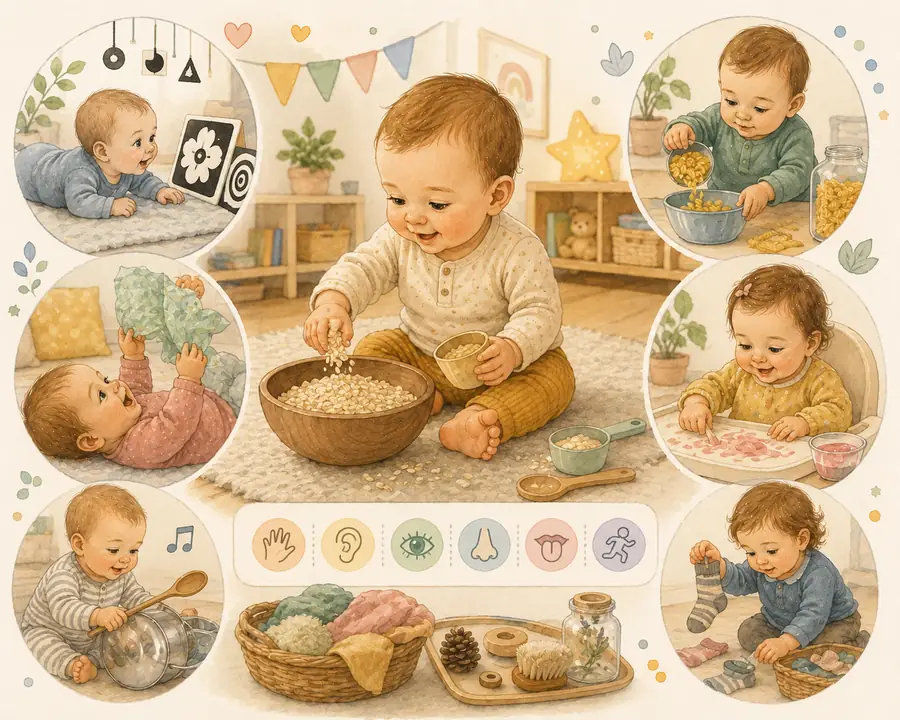
It's raining, the baby is bored, and you've already sung the same song eleven times. Indoor sensory play for babies typically needs:
🎨 Something to try today: the Developmental activity finder suggests play that fits your child's age and what they are working on.
- 5 to 10 minutes per activity (a 9-month-old's attention span, not yours)
- Materials you already own: rice, spoons, fabric scraps, a metal bowl
- One new texture, sound or smell at a time
- Full supervision, and taste-safe materials for anyone under 12 months
Sensory play is not a curriculum. It's giving your baby's brain the raw material it builds itself from, and your kitchen already contains most of it.
Quick reference: sensory ideas by age
| Age | What their senses want | Try this first |
|---|---|---|
| 0–3 months | High contrast, faces, gentle motion | Black-and-white cards during tummy time; slow ceiling-fan watching |
| 3–6 months | Reaching, grasping, mouthing | Crinkle paper under a play mat; cold metal spoon vs. wooden spoon |
| 6–12 months | Banging, dropping, textures | Muffin tin + large silicone cupcake liners; taste-safe oat "sandbox" |
| 12–18 months | Pouring, filling, emptying | Dry pasta transfer with a cup; water play with towels pre-deployed |
| 18–24 months | Pretend play, sorting, smearing | Yogurt finger painting on the high chair tray; sock matching |
Every activity on this list works on the floor of an ordinary apartment. None requires a purchase.
What counts as sensory play, and why does it matter?
Sensory play is any activity that feeds the senses: touch, sound, smell, sight, taste, movement and balance. For a baby, that definition covers almost everything, which is the point. The AAP's Power of Play resources describe play as how young children build brain architecture, and in the first two years the senses are the only entrance.
You don't need to engineer it. A baby studying the difference between a cold metal bowl and a warm towel is doing neuroscience. We wrote more about the research side in play is development: the brain science; the short version is that repetition, variety and your presence do the heavy lifting, not equipment.
The same logic applies outdoors, by the way. If the weather ever cooperates, our outdoor play ideas for babies 0–2 are the open-air version of this list.
That quiet, responsive presence, following her interest rather than steering it, is also the instinct behind gentle parenting; we unpack what that looks like in daily life in what gentle parenting actually is.
Sensory activities from 0 to 6 months
At this age, you are the main sensory activity. Your face, your voice, the way you carry her. Everything else is garnish.
- Tummy-time theater. Put one interesting object 20 cm from her face during tummy time and swap it every few minutes. The AAP's tummy-to-play guidance recommends working up to about an hour of supervised tummy time a day by 3 months, in short bursts.
- Texture parade. Brush her palm with a silk scarf, a clean sponge, a wooden spoon. Name each one. She won't remember the words. Her brain keeps the touch.
- Sound mapping. Shake a rice-filled jar to her left, then her right. Watching a newborn slowly hunt for a sound with her whole head is one of the quiet rewards of month two.
- Mirror time. A baby-safe mirror propped during floor play. She doesn't know it's her. She doesn't need to.
Sensory activities from 6 to 12 months
Now everything goes in the mouth, so the rule is simple: if it fits through a toilet-paper tube, it doesn't belong in the game. Taste-safe is the standard, per the safety basics in the NHS play and learning guidance.
- The oat sandbox. A baking tray, a layer of dry oats, two spoons and a cup. Yes, some oats end up on the floor. All of them, actually.
- Cold and warm. An ice cube sealed in a zip bag next to a warm (not hot) water bottle. Let her pat both. Narrate nothing; her face does the commentary.
- Kitchen percussion. A metal bowl, a wooden spoon, and ear plugs for you. Banging is cause-and-effect research at the loudest possible volume.
- Crinkle station. Baking paper taped to the floor. Crawling over it makes noise. That's it. That's the activity, and it routinely buys ten minutes.
Sensory activities from 12 to 24 months
Toddlers want agency: pouring, dumping, transferring, smearing. Build the activity around the mess instead of against it.
- Pasta transfer. Dry penne, two containers, one cup. Pouring back and forth is deep work at 14 months.
- Yogurt painting. A spoonful of yogurt with a drop of beet juice or cinnamon, smeared on the high chair tray. Edible, so the inevitable taste test is part of the plan.
- Water station, contained. Five centimeters of water in a basin, on towels, with cups and a colander. Set a timer for ten minutes; water play ends when the floor wins.
- Sort the socks. Two colors of socks, two boxes. Sorting is early math wearing a laundry costume.
- Smell jars. Cotton balls with a drop of vanilla or a pinch of cinnamon in punched-lid jars. One sniff each, then watch which one she returns to.
One family in our beta found that a muffin tin and dried lentils held their 14-month-old's attention for twenty minutes, while the boxed sensory kit they'd ordered managed ninety seconds. The brain wants novelty and texture, not packaging.
Common mistakes that make sensory play stressful
- Preparing more than the play lasts. If setup takes 15 minutes and the game takes 4, you'll quit by Thursday. Good sensory play is lazy by design.
- Running it at the wrong time. An overtired baby can't explore; she can only cry. Post-nap is the golden window, and the CDC's infant parenting tips put responsive, low-pressure play at the center for exactly this reason.
- Swapping activities too fast. Repetition is not boredom. A baby dropping a spoon for the ninth time is running an experiment, not failing to be entertained.
- Treating screens as sensory input. They light up vision and sound but train nothing else; if speech is on your mind, see does screen time cause speech delay.
- Comparing your floor to social media. The rainbow rice in the photo took an adult forty minutes. Your oats on a tray do the same neurological job.
When to mention it to your pediatrician
Most babies have strong preferences; some textures are an acquired taste, and that's normal. Worth raising at a check-up:
- A baby who consistently becomes distressed by ordinary touch (grass, fabric, water) well past the first months
- No interest in reaching, grasping or mouthing objects by around 6 months
- A toddler who avoids all messy textures so strongly that feeding is affected
- Loss of skills she used to have, in play or in babbling — the same rule we describe in when should a baby start talking
These are conversation starters, not diagnoses. Bring two or three concrete examples and dates; vague worry is hard to examine, specific moments are easy.
Frequently asked questions
At what age can babies start sensory play?
From birth. For a newborn, sensory play is your face at close range, gentle motion, skin contact and varied sounds. Structured activities with materials make sense from about 3 to 4 months, when reaching and grasping begin.
How long should a sensory activity last?
Five to ten minutes is a win at any age under two. Attention spans are short by design; three short rounds beat one long forced session. Stop while it's still fun and the activity stays interesting tomorrow.
Is messy play safe before age 1?
Yes, with taste-safe materials only: oats, cooked pasta, yogurt, banana. Everything will be mouthed, so plan for it instead of fighting it. Skip small hard items (raw beans, rice) until the mouthing phase passes, and supervise the whole time.
Do I need to buy sensory toys or kits?
No. The evidence behind sensory play is about varied input and responsive interaction, not products. A kitchen drawer outperforms most kits, and the AAP's play guidance emphasizes caregiver interaction over equipment. Buy nothing until something on this list bores you both.
How often should we do sensory activities?
Once a day is plenty, and even that is a guideline, not homework. Daily life (bath, cooking smells, laundry textures) already delivers sensory input; planned activities just add variety. Some days the plan is survival. That counts too.
How KidyGrow helps you
The hard part of activities isn't ideas, it's timing and memory. Which window of the day is she actually calm? Did the oat tray work last week, or was that the week it ended in tears? After a month, all rainy afternoons blur together.
KidyGrow holds the thread for you. Once you've logged sleep and moods for a few days (give it 3 to 5 days before expecting anything smart), the Daily Brief starts surfacing what an exhausted parent can't track: "Her calmest stretch this week was the 40 minutes after the morning nap." Suddenly you're not choosing between seventeen Pinterest ideas at the worst possible moment; you're putting one tray of oats into the one window where it can land.
It won't make a tired Tuesday magical. Some afternoons nothing on this list works, and the app will have no pattern to offer, because there isn't one. But over weeks it remembers which kinds of days went well and what those days had in common, which is exactly the thing you'd want to remember and never can.
The point isn't a better activity. It's reaching the end of the day with one thing that worked, and knowing why.
Sources
- American Academy of Pediatrics / HealthyChildren.org - The Power of Play
- American Academy of Pediatrics / HealthyChildren.org - Back to Sleep, Tummy to Play
- NHS - Play and learning
- CDC - Positive parenting tips: infants
- WHO - Physical activity