 Kidy
Kidy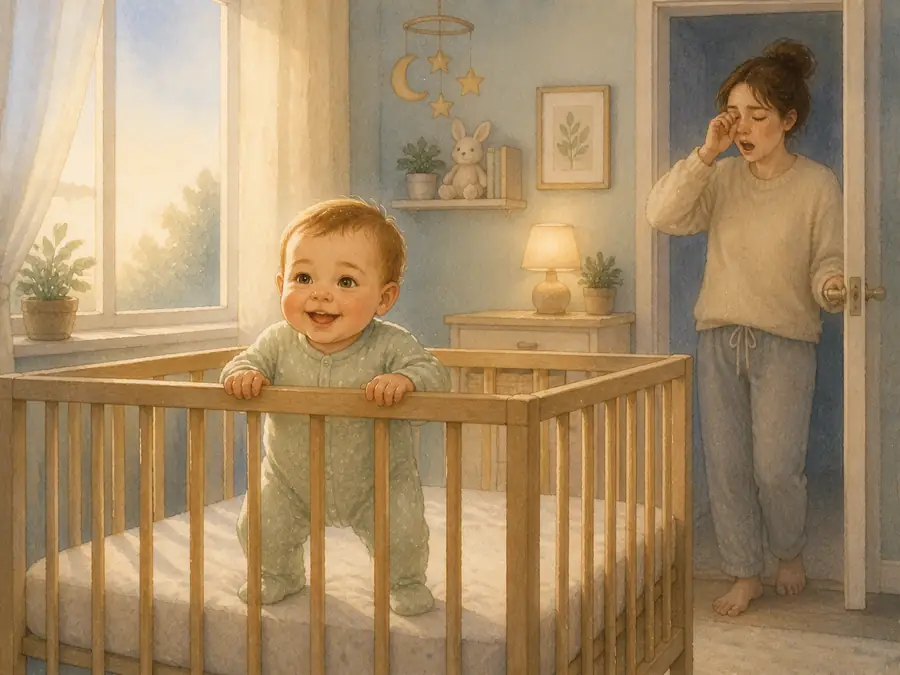
Your baby is babbling at the crib bars at 5:02 a.m. for the third week in a row. They are not crying. They are not tired. You are. The good news, and the harder news, in one paragraph:
- A happy 5 a.m. waker is usually not a sleep disorder — it is a chronotype + circadian + sleep-pressure pattern
- Light is the single biggest lever — anything brighter than 10 lux through your blinds tells the brain it is morning
- Bedtime that is too early is the most common hidden cause — counterintuitive but well-documented
- Naps in the last 3 hours of the day drag morning later, not earlier
- Call the pediatrician if 5 a.m. comes with crying, breathing pauses, or daytime crashes, not for the cheerful version alone
⏰ Check the timing first: enter your baby's age in the wake windows calculator and see how long they can comfortably stay awake between sleeps.
Quick reference: happy 5 a.m. waker
| Question | Short answer |
|---|---|
| Is a happy 5 a.m. wake normal? | Yes — common 4–24 months (AAP HealthyChildren — Sleep) |
| Most common hidden cause | Bedtime 30–60 min too early for total sleep need |
| Single biggest external fix | Blackout curtains + remove any night-light visible in the crib |
| Typical timeline for a shift | 7–14 nights of consistent light + schedule changes |
| When to call the doctor | Snoring with pauses, sudden new pattern, daytime exhaustion despite enough night sleep |
For the wider early-wake picture across the first two years see why your baby is waking too early, and for older kids see toddler waking too early every day.
What "happy at 5 a.m." actually means
Babies and young toddlers run on three intertwined systems:
Circadian rhythm — the internal 24-ish-hour clock anchored mostly by light, secondarily by routine. Babies reach a recognizable adult-like rhythm by around 12 weeks, with significant individual differences (AAP HealthyChildren, Healthy Sleep Habits).
Sleep pressure (homeostatic drive) — builds during waking, dissipates during sleep. After 10–11 hours of consolidated night sleep, pressure is mostly gone; the child wakes whether or not the room is dark.
Sleep cycles — babies cycle every 40–60 minutes. Toward morning, cycles get lighter and shorter. The 4–6 a.m. window is when most babies briefly surface between cycles. A baby with low remaining sleep pressure plus a dawn light cue surfaces, sees the room is bright enough to count as morning, and starts the day.
A happy 5 a.m. wake usually means: your baby got enough night sleep, their circadian rhythm is currently set early, and something — light, sound, or sleep-pressure depletion — is telling them the night is over. It is biology behaving correctly. It just happens to be biology behaving correctly two hours before you want.
The four most common drivers (in order)
1. Bedtime is too early. This is the most-missed cause. If your 9-month-old is asleep at 6:30 p.m. and needs 11 hours of night sleep, 5:30 a.m. is the math. Many parents push bedtime earlier when wake-ups happen, which makes the next morning earlier still. Moving bedtime 15 minutes later every 3 nights, until you find the right total night length, is the simplest fix.
2. Light is leaking into the room. A 5 a.m. baby is exquisitely sensitive to dawn. Even thin curtains, a door-frame gap, a hallway night-light, or a powered baby monitor LED can be enough. Lux meters or a free phone app help — anything above ~10 lux at the crib counts as "morning" to the developing circadian system.
3. Nap structure is wrong for age. Too short a wake window between the last nap and bedtime drags morning earlier. Too long a wake window does the opposite — overtired babies wake more often through the night and earlier in the morning. The right window is age-specific; see wake windows by age chart.
4. A daycare or routine shift is dragging mornings. A new earlier daycare drop, a parent going back to work, daylight savings, or a sibling's school start can each yank the family's anchor wake time earlier by 30–45 minutes. The baby's circadian rhythm follows within 1–2 weeks. After the shift, mornings may stay early even on weekends.
When happy 5 a.m. wake-ups are not a problem
If your baby:
- is rested, cheerful, and feeds normally
- takes age-appropriate naps without obvious crashes
- shows no breathing irregularities at night
- is gaining weight and meeting milestones
…then this is a chronotype + scheduling mismatch, not a medical issue. Some children genuinely are early larks. The question shifts from "what is wrong" to "how much of this can we live with, and what is the cheapest fix?"
When to act vs. when to wait
Wait if your child is under 4 months — circadian organization is still consolidating, and most morning patterns will reshape themselves by 5–6 months without intervention.
Try a 14-night intervention if early waking is wrecking the family. The pattern that works for most babies:
- Blackout the room to true darkness (no visible hand at arm's length)
- Move bedtime 15 minutes later every 3 nights for 1–2 weeks
- Trim the morning nap by no more than 15 minutes (gives sleep pressure room to push the wake later)
- Treat 5 a.m. as night for 14 days — quiet, dim, no toys; do not start the day until 6 a.m.
Most patterns shift in 10–14 nights. If yours does not, see is sleep training safe? what science says for whether a structured plan fits your family — and for context biggest baby sleep mistakes parents make.
How "happy 5 a.m." differs from "crying 5 a.m."
These look similar from the doorway and are mechanically different problems.
| Signal | Happy 5 a.m. | Crying 5 a.m. |
|---|---|---|
| Most likely cause | Circadian early + light | Sleep cycle disrupted (hunger, pain, overtired) |
| Best first fix | Light control + bedtime push | Check feeds, nap length, illness, teething |
| Pediatrician threshold | High (rare) | Low (more often medical) |
| Typical resolution timeline | 1–2 weeks | Days–weeks depending on cause |
For specifically distressed early waking see why does baby wake up crying at night and biggest baby sleep mistakes parents make.
What NOT to do
- Do not keep your baby awake past their natural bedtime "to tire them" — overtiredness usually makes mornings earlier, not later. See signs your baby is overtired.
- Do not start the day at 5 a.m. with lights, talking, and toys — within a week, the circadian system locks in 5 a.m. as official wake time.
- Do not stack interventions in the same week — change one variable, hold for at least 5 nights, evaluate.
- Do not skip the last nap "to get tired enough" — that usually pulls morning earlier.
When to call the pediatrician
Talk to your pediatrician if any of these accompany 5 a.m. waking:
- snoring with pauses or any breathing irregularity during sleep
- daytime exhaustion despite a full night of sleep
- sudden new pattern with fever, pain, or other illness signs
- growth or feeding concerns
- regression in milestones alongside the new sleep pattern
- parental wellbeing is severely affected — sleep deprivation has measurable effects on bonding, mood, and safety (AAP HealthyChildren — Healthy sleep habits)
A happy 5 a.m. waker alone, with no other red flags, almost never indicates anything medical. The cluster of signs is what matters.
Frequently asked questions
Is it normal for a baby to wake up happy at 5 a.m.?
Yes, especially between 4 and 24 months. It usually reflects an early-shifted circadian rhythm + adequate night sleep + a dawn light cue, not a sleep disorder. It can still be exhausting to parent — being normal does not mean you have to accept the schedule.
Will my baby grow out of 5 a.m. wake-ups?
Usually yes, especially as nap totals drop. Most children's morning settles between 6 and 7 a.m. by age 2–3 if light and bedtime are reasonable. Some children remain natural early risers — chronotype is partly genetic.
Should I feed my baby when they wake at 5 a.m.?
Depends on age and pattern. Under 6 months, a feed is often appropriate. After 6 months, if your baby is feeding well during the day, a 5 a.m. feed can become a habit-driver of the early wake. Talk to your pediatrician before changing morning feeds.
Will blackout curtains alone fix it?
Often the single highest-yield change but rarely sufficient alone. Pair with bedtime shifting and reasonable nap timing. Tape the gap above the rod — most leakage is from the top, not the sides.
Could a sleep regression be causing the 5 a.m. wake?
Yes, around 4, 8, and 12 months. A regression usually adds night wakes too, not just an earlier morning. See when do babies drop naps timeline for related schedule shifts.
Is it teething?
Possible, but teething pain wakes babies crying, not babbling. If 5 a.m. waking comes with fussiness, drooling, and feed refusal, teething is on the list. If it is cheerful, it is almost never teething.
Could the 5 a.m. wake be a chronotype that runs in the family?
Yes — heritability of morning chronotype is well established. If one parent is an early lark, the baby has a real chance of being one too. You can shift it somewhat with environment but not against the underlying biology.
How KidyGrow can help
KidyGrow learns your child as you log nap timing, night length, bedtime, and morning mood — and a happy 5 a.m. waker is exactly the case where small pattern shifts matter. The hard part is not the fix itself; it is seeing which lever moved the morning by 12 minutes and which one did nothing.
The Daily Brief surfaces those connections in a few days — because the app remembers the small details you would otherwise forget (Monday's 4:50 a.m. happy wake after a 6:15 bedtime; Wednesday's 5:55 a.m. wake after a 6:45 bedtime). The view is personalized to your baby's last week, not a generic chart. When the link between "bedtime pushed 30 minutes later" and "morning pushed 25 minutes later" shows up in your own data, you stop guessing and start adjusting. Calibration takes 3–5 days of regular logging; the longer you use it, the sharper the morning picture.
If you want a guided playbook for the same data, see using KidyGrow to fix early wake-ups step by step. For the wider context see baby sleep guide 0–2 years.
_This content is educational and does not replace professional sleep or medical advice. If early waking is significantly affecting your family or your child's health, talk to your pediatrician._
Sources
- AAP HealthyChildren — Sleep (accessed 2026).
- AAP HealthyChildren — Healthy sleep habits (accessed 2026).
- NHS — Helping your baby to sleep (accessed 2026).